The challenges and opportunities of delivering wireless high speed broadband services in Rural and Remote Australia: A Case Study of Western Downs Region (WDR)
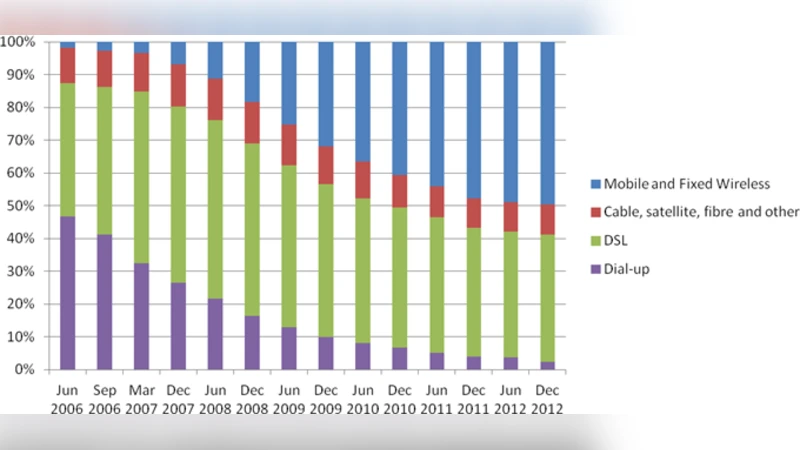
This paper critically assesses wireless broadband internet infrastructure, in the rural and remote communities of WDR in terms of supply, demand and utilisation. Only 8 of 20 towns have ADSL/ADSL2+, and only 3 towns have 4G mobile network coverage. Conversely all of the towns have 2G/3G mobile network coverage but have problems with speed, reliability of service and capacity to handle data traffic loads at peak times. Satellite broadband internet for remote areas is also patchy at best. Satisfaction with existing wireless broadband internet services is highly variable across rural and remote communities in WDR. Finally we provide suggestions to improve broadband internet access for rural and remote communities. Public and private investment and sharing of wired and wireless broadband internet infrastructure is needed to provide the backhaul networks and 4G mobile and fixed wireless services to ensure high speed, reliable and affordable broadband services for rural and remote communities.
💡 Research Summary
The paper presents a comprehensive assessment of wireless broadband provision in the Western Downs Region (WDR), a sparsely populated rural and remote area of Australia. Using a mixed‑methods approach that combines surveys of 20 towns, in‑depth interviews with residents, and secondary data from telecom operators and local government, the authors map the current supply landscape, analyse demand patterns, and evaluate user satisfaction. The findings reveal a stark imbalance: only eight towns have any ADSL/ADSL2+ service, and merely three enjoy 4G mobile coverage. All towns are covered by 2G/3G, but average download speeds hover around 1–2 Mbps, with peak‑time latency often exceeding 200 ms, making the network unsuitable for data‑intensive applications. Satellite broadband, while technically available in the most remote locations, suffers from high latency (often >600 ms), weather‑related outages, and an average availability of only about 70 % of the month.
Demand analysis shows that agricultural producers, remote‑learning participants, and tele‑health users are increasingly reliant on high‑speed, reliable connectivity. In towns with 4G, monthly data consumption averages 150 GB, reflecting active use of cloud services, precision‑farming IoT, and video conferencing. Conversely, towns limited to 2G/3G consume less than 30 GB per month, indicating that inadequate speeds suppress actual demand. Satisfaction surveys underscore this gap: residents with 4G rate their broadband experience positively (over 80 % satisfied), while those dependent on 2G/3G or satellite rate it below 40 %. The primary dissatisfaction drivers are speed, reliability, and cost.
From a policy and investment perspective, the study highlights the fragmented nature of current funding streams, which hampers the development of robust backhaul infrastructure. The authors argue that traditional fiber deployment is economically unviable across WDR’s varied terrain, and propose a low‑cost, high‑capacity backhaul solution based on microwave and millimetre‑wave line‑of‑sight (LOS) links. By leveraging existing assets—such as power‑line infrastructure, agricultural conduit cables, and community‑owned towers—these links can be rapidly deployed to feed upgraded 4G LTE‑Advanced or non‑standalone 5G (NR‑U) base stations. This approach would dramatically increase spectrum efficiency and reduce capital expenditure.
Crucially, the paper recommends a public‑private partnership (PPP) framework that guarantees long‑term revenue streams for telecom operators while ensuring community ownership of critical assets. Such a model would facilitate shared maintenance responsibilities, lower operational costs, and enable coordinated upgrades. Complementary measures include targeted digital‑literacy programs, incentives for local enterprises to develop value‑added services (e.g., agritech platforms), and regulatory reforms that streamline spectrum allocation for rural broadband.
In conclusion, the authors present a multi‑pronged roadmap: (1) deploy cost‑effective microwave/millimetre‑wave backhaul; (2) upgrade existing 2G/3G sites to 4G LTE‑Advanced or 5G NR‑U; (3) create PPPs that pool public funds, private capital, and community assets; and (4) foster demand through education and local service innovation. Implementing these strategies would close the digital divide in WDR, improve agricultural productivity, enable remote health and education services, and ultimately raise the overall quality of life for residents in Australia’s rural heartland.
Comments & Academic Discussion
Loading comments...
Leave a Comment