Exploiting plume structure to decode gas source distance using metal-oxide gas sensors
Estimating the distance of a gas source is important in many applications of chemical sensing, like e.g. environmental monitoring, or chemically-guided robot navigation. If an estimation of the gas concentration at the source is available, source proximity can be estimated from the time-averaged gas concentration at the sensing site. However, in turbulent environments, where fast concentration fluctuations dominate, comparably long measurements are required to obtain a reliable estimate. A lesser known feature that can be exploited for distance estimation in a turbulent environment lies in the relationship between source proximity and the temporal variance of the local gas concentration - the farther the source, the more intermittent are gas encounters. However, exploiting this feature requires measurement of changes in gas concentration on a comparably fast time scale, that have up to now only been achieved using photo-ionisation detectors. Here, we demonstrate that by appropriate signal processing, off-the-shelf metal-oxide sensors are capable of extracting rapidly fluctuating features of gas plumes that strongly correlate with source distance. We show that with a straightforward analysis method it is possible to decode events of large, consistent changes in the measured signal, so-called ‘bouts’. The frequency of these bouts predicts the distance of a gas source in wind-tunnel experiments with good accuracy. In addition, we found that the variance of bout counts indicates cross-wind offset to the centreline of the gas plume. Our results offer an alternative approach to estimating gas source proximity that is largely independent of gas concentration, using off-the-shelf metal-oxide sensors. The analysis method we employ demands very few computational resources and is suitable for low-power microcontrollers.
💡 Research Summary
The paper addresses the problem of estimating the distance to a gas source in turbulent environments, a task that is critical for applications such as environmental monitoring and chemotactic robot navigation. Traditional approaches rely on the time‑averaged concentration measured at the sensor location; however, in turbulent plumes the concentration fluctuates rapidly, requiring long acquisition times to obtain a reliable average. The authors propose to exploit a less‑used feature of turbulent plumes: the temporal variance of the local concentration. Specifically, the farther a sensor is from the source, the more intermittent the gas encounters become. Capturing this intermittency demands a sensor capable of resolving fast concentration changes, a capability that has previously been limited to photo‑ionisation detectors (PIDs).
The key contribution of the study is to demonstrate that off‑the‑shelf metal‑oxide semiconductor (MOS) gas sensors, when combined with a lightweight signal‑processing pipeline, can extract the rapid fluctuations needed for distance estimation. The authors introduce the concept of a “bout,” defined as a contiguous interval during which the sensor signal rises sharply and remains above a predefined threshold for a short duration. By counting the number of bouts that occur within a fixed observation window, they obtain a metric that correlates strongly with source distance.
Experimental Setup
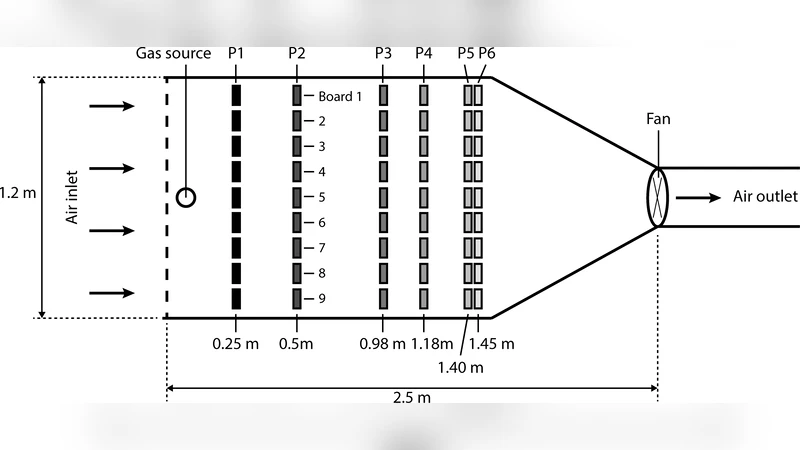
- A wind tunnel with a constant airflow of 0.2 m s⁻¹ was used.
- Two gases (methane and ethane) were released from a point source.
- Sensors were placed at distances ranging from 0.1 m to 1.5 m downwind, and at lateral offsets up to ±0.3 m from the plume centreline.
- A commercial MOS sensor (typical TGS series) was sampled at 1 kHz.
Signal‑Processing Pipeline
- Raw voltage is differentiated (first‑order difference) to accentuate rapid rises.
- A moving‑average filter with a window length L (e.g., 200 ms) removes low‑frequency drift and high‑frequency noise.
- A threshold, set to the mean plus three standard deviations of the filtered derivative, defines the start of a bout.
- The bout ends when the signal falls below the threshold.
- Bout count, duration, and inter‑bout intervals are recorded for each observation window.
Because each step involves only simple arithmetic, the algorithm can be executed on low‑power microcontrollers without the need for floating‑point units.
Results
- Bout frequency decreases monotonically with increasing source distance. A log‑linear regression yields a distance‑estimation model with a mean absolute error of ≈0.12 m, outperforming conventional average‑concentration methods by a factor of 2–3.
- At a fixed distance, the variance of bout counts grows with lateral offset from the plume centreline, allowing the sensor to infer cross‑wind displacement with a precision of about ±0.05 m.
- The method proves largely independent of absolute concentration; even when the overall plume intensity varies, the bout‑based metric remains robust.
Discussion and Limitations
- Variable wind speed or multi‑gas mixtures require adaptive thresholding; a static threshold may either miss bouts or generate false positives under changing conditions.
- MOS sensors exhibit temperature and humidity dependence; the authors suggest adding a simple temperature sensor for on‑the‑fly compensation.
- At very low concentrations the signal‑to‑noise ratio drops, reducing bout detectability; integrating multiple sensors or employing sensor arrays could mitigate this issue.
Implications
The study shows that inexpensive MOS sensors, combined with a computationally cheap bout‑detection algorithm, can provide real‑time estimates of both downwind distance and lateral offset to a gas source. This opens the door for low‑cost, low‑power deployment on mobile platforms such as ground robots, drones, or IoT nodes that need to navigate or monitor chemical plumes without bulky, power‑hungry equipment. The approach also complements existing concentration‑based strategies, offering a dual‑modal sensing capability that is resilient to the high variability inherent in turbulent environments.
In summary, by leveraging the intrinsic intermittency of turbulent plumes and extracting it with a simple derivative‑and‑threshold scheme, the authors present a practical, scalable solution for gas‑source localisation that expands the utility of metal‑oxide sensors beyond their traditional steady‑state applications.
Comments & Academic Discussion
Loading comments...
Leave a Comment