Completeness of Flat Coalgebraic Fixpoint Logics
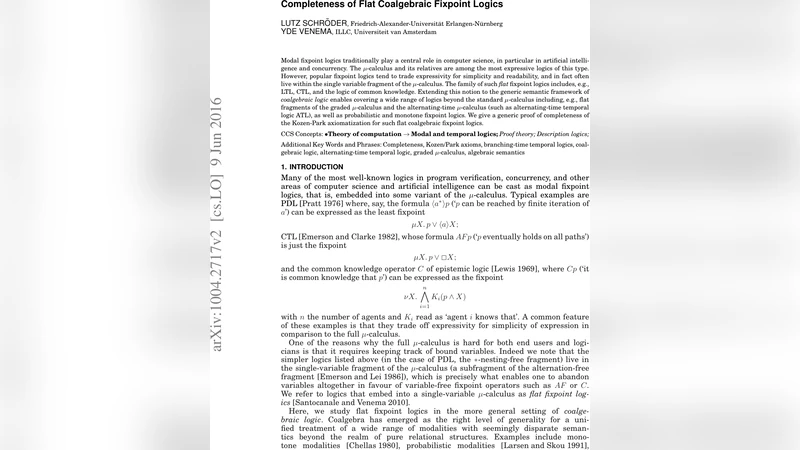
Modal fixpoint logics traditionally play a central role in computer science, in particular in artificial intelligence and concurrency. The mu-calculus and its relatives are among the most expressive logics of this type. However, popular fixpoint logics tend to trade expressivity for simplicity and readability, and in fact often live within the single variable fragment of the mu-calculus. The family of such flat fixpoint logics includes, e.g., LTL, CTL, and the logic of common knowledge. Extending this notion to the generic semantic framework of coalgebraic logic enables covering a wide range of logics beyond the standard mu-calculus including, e.g., flat fragments of the graded mu-calculus and the alternating-time mu-calculus (such as alternating-time temporal logic ATL), as well as probabilistic and monotone fixpoint logics. We give a generic proof of completeness of the Kozen-Park axiomatization for such flat coalgebraic fixpoint logics.
💡 Research Summary
The paper investigates the completeness of flat coalgebraic fixpoint logics, a broad class of modal fixpoint languages that restrict fixpoint operators to a single bound variable. By situating these logics within the generic coalgebraic semantics framework, the authors are able to treat a wide variety of systems—ranging from classic temporal logics such as LTL and CTL, through epistemic logics of common knowledge, to more exotic variants like the graded μ‑calculus, alternating‑time μ‑calculus (including ATL), probabilistic fixpoint logics, and monotone fixpoint logics—under a single, uniform theory.
The technical development begins with a concise recap of coalgebraic semantics. A state space X is equipped with a transition functor T: Set → Set, and modal operators are interpreted as predicate liftings of T. Within this setting, a “flat” fixpoint formula has the shape μ x. φ(x) or ν x. φ(x) where φ contains the variable x exactly once and no other fixpoint nesting. This restriction guarantees that the unfolding of a fixpoint is a simple, linear substitution process, avoiding the combinatorial explosion typical of full μ‑calculus.
The core contribution is a generic completeness proof for the Kozen‑Park axiomatization (KP) applied to any flat coalgebraic fixpoint logic. The classic KP system consists of the standard propositional axioms, modal K‑axioms, and two fixpoint rules: the unfolding (μ‑rule) μ x. φ → φ
Comments & Academic Discussion
Loading comments...
Leave a Comment