X-ray Observation of Mars with Suzaku at Solar Minimun
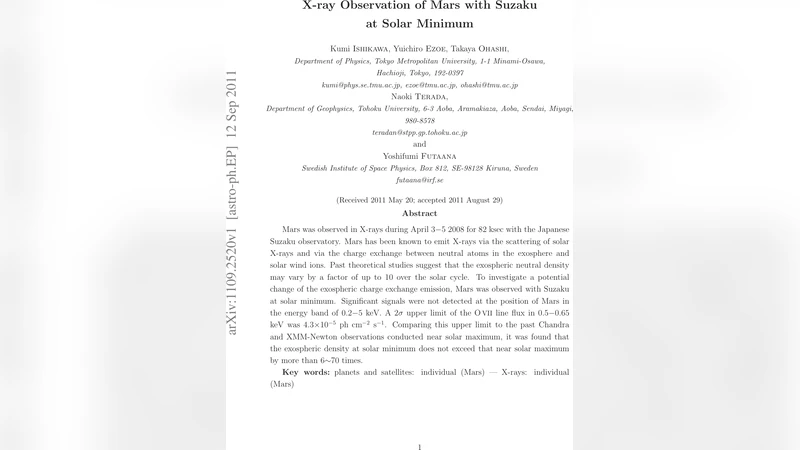
Mars was observed in X-rays during April 3-5 2008 for 82 ksec with the Japanese Suzaku observatory. Mars has been known to emit X-rays via the scattering of solar X-rays and via the charge exchange between neutral atoms in the exosphere and solar wind ions. Past theoretical studies suggest that the exospheric neutral density may vary by a factor of up to 10 over the solar cycle. To investigate a potential change of the exospheric charge exchange emission, Mars was observed with Suzaku at solar minimum. Significant signals were not detected at the position of Mars in the energy band of 0.2-5 keV. A 2 sigma upper limit of the O VII line flux in 0.5-0.65 keV was 4.3$\times10^{-5}$ ph cm$^{-2}$ s$^{-1}$. Comparing this upper limit to the past Chandra and XMM-Newton observations conducted near solar maximum, it was found that the exospheric density at solar minimum does not exceed that near solar maximum by more than 6-70 times.
💡 Research Summary
The authors present the first X‑ray observation of Mars obtained during a solar minimum, using the Japanese Suzaku satellite’s X‑ray Imaging Spectrometer (XIS). The observation was carried out from 2008 April 3 to 5, accumulating a net exposure of 82 ks while Mars was at heliocentric and geocentric distances of 1.7 AU and 1.4 AU, respectively, and at a phase angle of 37°. The XIS, comprising three front‑illuminated (FI) and one back‑illuminated (BI) CCD, offers low instrumental background due to Suzaku’s low‑Earth orbit, making it well suited for detecting faint, spatially extended emission such as the Martian halo.
Data reduction followed standard Suzaku processing (HEAsoft 6.4, pipeline version 2.2.7.18). To keep Mars within the XIS field of view, the spacecraft was repointed 27 times over the three‑day interval, limiting vignetting effects. After screening, the authors generated images in two bands: 0.2–1 keV (BI‑optimized) and 1–5 keV (FI‑optimized). They first consulted the NASA Bright Source Catalog and then applied CIAO’s wavdetect to identify point‑like sources. Twelve candidate sources were found; all were excluded using circular masks (2′ radius for most, 3′ for the three brightest) before further analysis.
Correcting the images for Mars’s orbital motion revealed no excess emission at the planet’s position in either band. For spectroscopy, events were extracted from a 3′ radius circle centred on Mars (encompassing the full orbital drift during each pointing) and a surrounding annulus (3′–6′) was used as background. The resulting spectrum showed no statistically significant feature from 0.2 to 10 keV; the only noticeable line at ~7–8 keV is attributed to instrumental Ni Kα fluorescence.
The authors derived a 2σ upper limit for the O VII triplet (0.5–0.65 keV) of 1.7 × 10⁻³ counts s⁻¹, corresponding to a photon flux of 4.3 × 10⁻⁵ ph cm⁻² s⁻¹. To interpret this limit, they compared it with earlier detections by Chandra (2001) and XMM‑Newton (2003). Those observations recorded O VII fluxes of 5.5 × 10⁻⁵ and 3.7 × 10⁻⁵ cts cm⁻² s⁻¹, respectively, during periods of higher solar activity. By scaling for the solar X‑ray flux (measured by GOES‑12), heliocentric/geocentric distances, and phase angles, the expected fluorescent O VII flux for the Suzaku epoch is ~10⁻⁷ cts cm⁻² s⁻¹—well below the Suzaku upper limit. Thus, solar‑scattered fluorescence contributes negligibly to the Suzaku measurement.
For the charge‑exchange (CX) component, the authors employed a simple volumetric emissivity model Pₓ = α n_sw u_sw n_n, where n_sw and u_sw are the solar‑wind proton density and speed (derived from ACE SWEPAM and Mars Express ASPERA‑3), n_n is the neutral density in the collisionally thin exosphere, and α encapsulates heavy‑ion fraction, average CX cross‑section, and average photon energy. Assuming the CX X‑ray flux scales linearly with the product of solar‑wind flux and line‑of‑sight neutral column, they used the Suzaku upper limit to constrain the exospheric neutral density. The solar‑wind proton flux during the Suzaku observation was roughly half that during the Chandra/XMM epochs. Consequently, the Suzaku non‑detection implies that the exospheric neutral density at solar minimum cannot exceed the solar‑maximum value by more than a factor of 6–70 (the range reflects uncertainties in solar‑wind heavy‑ion composition and CX cross‑sections).
These results directly test theoretical models predicting large variations (up to an order of magnitude) in Martian exospheric density over the solar cycle. The Suzaku upper limit disfavors models that predict a substantially denser exosphere during solar minimum, supporting instead those that suggest only modest or no variation. The authors acknowledge limitations: incomplete ACE/ASPERA‑3 coverage (especially loss of data on April 3), the use of proton flux as a proxy for heavy‑ion flux, and the simplifications inherent in a single‑step CX model.
In summary, the Suzaku observation provides a stringent constraint on both fluorescent and CX X‑ray emission from Mars at solar minimum. The lack of detectable emission indicates that the Martian exosphere’s neutral column density does not increase dramatically during low solar activity, placing an empirical upper bound of roughly 6–70 times the solar‑maximum value. This work demonstrates the utility of low‑background X‑ray observatories for probing planetary exospheres and highlights the need for coordinated, multi‑epoch observations to fully characterize solar‑wind–planet interactions across the solar cycle.
Comments & Academic Discussion
Loading comments...
Leave a Comment