How E-Mental Health Services Benefit University Students with ADHD: A literature Review
E-mental health is an area within e-health in which the key role of IS/IT has not been well established. Both clinicians and scholars are uncertain as to the role of IS/IT and its potential benefits. This research review is introduced to assist in understanding the enabling role in e-mental health and it focused on one area of mental health, Attention Deficit Hyperactivity Disorder (ADHD) in university students. ADHD is estimated to affect approximately 6% of university students by negatively impacting students’ academic performance and social life; hence, fewer of these students complete their degrees as compared to their peers. This review outlines the potentials of using IS/IT in the treatment of ADHD in university students. It also serves to greatly contribute to e-mental health development and thereby to help to uncover further possibilities of IT/IT to support broad areas within mental health disorders and services.
💡 Research Summary
**
The paper presents a systematic literature review that investigates how e‑mental health (eMH) technologies can support university students diagnosed with Attention‑Deficit/Hyperactivity Disorder (ADHD). Recognizing that eMH—a sub‑field of e‑health—has largely been applied to mood and anxiety disorders, the authors aim to fill a gap by focusing on a neurodevelopmental condition that affects roughly 6 % of the higher‑education population and is associated with poorer academic outcomes, lower graduation rates, and social difficulties.
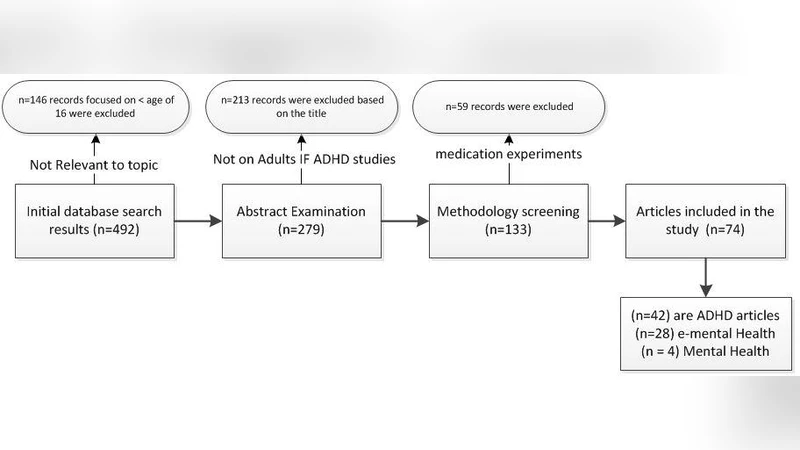
The methodology follows Petticrew and Roberts’ guidelines for systematic reviews. The authors searched major academic databases (ACM Digital Library, ScienceDirect, IEEE Xplore, SpringerLink, ProQuest, Australian Standards) and supplemented the search with Google Scholar. Keywords combined terms related to e‑mental health, information systems/technology (IS/IT), internet, mobile, mental health, ADHD, college, and university. No date limits were imposed on the broader eMH literature, but ADHD‑specific articles were restricted to publications after 2004. After screening titles, abstracts, and full texts, the authors excluded medication‑only studies, biological research, and work focusing on children under 16. From an initial pool of over 260 records, 74 peer‑reviewed journal articles remained for analysis, which the authors categorized into three streams: eMH (28 articles), ADHD (47 articles), and general mental health (4 articles).
The results identify five core eMH service categories in Australia: (1) health promotion and psycho‑education, (2) prevention and early intervention, (3) crisis and suicide prevention, (4) treatment, and (5) recovery. The review highlights a range of “sensible technologies” already deployed for mental health, including SMS reminders, email coaching, instant‑messaging, video/audio conferencing, smartphone apps, and web‑based platforms. Specific to ADHD, the literature reports the use of (a) coaching and education delivered via mobile or email, (b) neurofeedback therapy, and (c) internet‑based cognitive‑behavioral therapy (CBT). These tools aim to improve executive functions (time management, organization), emotional self‑regulation, and stress coping, all of which are critical for academic success.
In the discussion, the authors synthesize four major benefits of eMH for university‑aged adults with ADHD:
- Improved Accessibility – Digital platforms allow 24/7, location‑independent access, reducing barriers such as stigma, transportation, and scheduling conflicts.
- Cost‑Effectiveness and Quality Enhancement – Online delivery lowers per‑patient costs, automates data collection, and can reach remote or underserved campuses while maintaining therapeutic fidelity.
- Enhanced Mental‑Health Literacy and Promotion – Online psycho‑educational content improves users’ understanding of ADHD, encourages help‑seeking, and can be integrated into university curricula.
- Early Intervention and Prevention – Web‑based screening and self‑help tools can identify at‑risk students before academic decline becomes entrenched, and can also address comorbid risk behaviors such as substance misuse.
Nevertheless, the review acknowledges significant gaps. There is a paucity of ADHD‑specific eMH programs; most existing solutions target depression or anxiety. Empirical evidence on long‑term outcomes, user engagement, and comparative effectiveness versus traditional face‑to‑face therapy remains limited. Moreover, implementation challenges—such as clinicians’ limited digital competence, variability in students’ digital literacy, privacy and data‑security concerns, and the need for interdisciplinary collaboration between mental‑health providers and IT specialists—are highlighted as barriers to widespread adoption.
The conclusion calls for targeted research to (a) develop and rigorously evaluate ADHD‑focused eMH interventions, (b) explore clinician and student perspectives through qualitative interviews, (c) conduct cost‑benefit analyses, and (d) establish best‑practice guidelines for integrating IS/IT into university mental‑health services. By addressing these gaps, the field can move from theoretical potential to practical, evidence‑based solutions that improve academic retention and overall well‑being for students living with ADHD.
Comments & Academic Discussion
Loading comments...
Leave a Comment