Polarized X-rays from Magnetized Neutron Stars
We review the polarization properties of X-ray emission from highly magnetized neutron stars, focusing on emission from the stellar surfaces. We discuss how x-ray polarization can be used to constrain neutron star magnetic field and emission geometry, and to probe strong-field quantum electrodynamics and possibly constrain the properties of axions.
💡 Research Summary
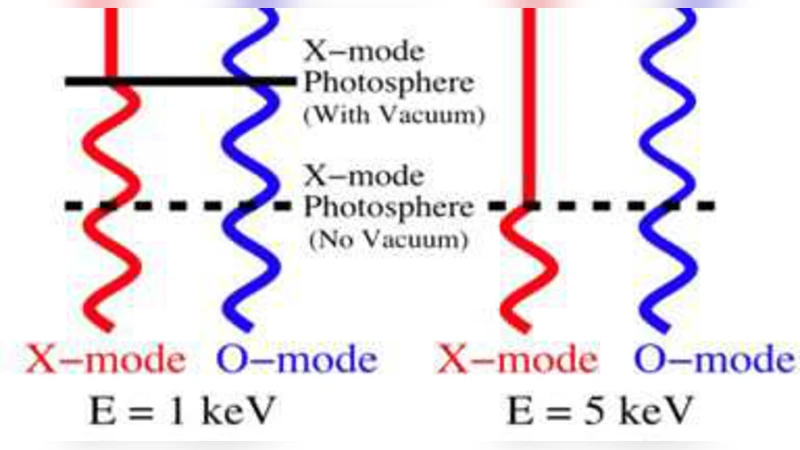
The paper provides a comprehensive review of the polarization properties of X‑ray emission originating from the surfaces of highly magnetized neutron stars. It begins by outlining the basic radiative mechanisms at work on neutron‑star surfaces—thermal emission, bremsstrahlung, and cyclotron processes—all occurring in a plasma permeated by magnetic fields of order 10¹²–10¹⁵ G. In such an environment the electromagnetic radiation naturally separates into two normal modes: the ordinary (O‑mode), whose electric field oscillates parallel to the magnetic field, and the extraordinary (X‑mode), whose electric field oscillates perpendicular to the field. The relative emissivity of these modes depends strongly on magnetic field strength and photon energy; for B ≳ 10¹⁴ G the X‑mode dominates the emergent spectrum.
A central theme of the review is the role of strong‑field quantum electrodynamics (QED). In ultra‑strong magnetic fields the vacuum becomes birefringent, a phenomenon known as vacuum birefringence. As photons propagate outward they encounter a “vacuum resonance” where the plasma‑induced and vacuum‑induced indices of refraction coincide. At this resonance, mode conversion can occur with a probability that depends on the photon energy, local plasma density, and magnetic field strength. The conversion typically flips the polarization angle by 90°, imprinting a characteristic signature on the observed polarization. Consequently, measurements of the linear polarization degree (LPD) and polarization angle as functions of photon energy and pulse phase can be used to infer the magnetic‑field geometry (dipolar, multipolar, or more complex configurations) and the temperature distribution across the stellar surface.
The authors present detailed Monte‑Carlo and ray‑tracing simulations for a variety of geometric models, including uniform temperature surfaces, localized hot spots, and combinations of dipole and higher‑order multipole fields. The simulations predict phase‑dependent LPD values ranging from a few percent up to ~70 % for favorable viewing angles, and they show how the polarization angle swings across the pulse profile. These predictions are directly testable with current X‑ray polarimetry missions such as IXPE, which has already reported polarization measurements for several magnetars that are consistent with QED‑induced birefringence. Future missions—eXTP, POLARIX, and STROBE‑X—will provide broader energy coverage (2–10 keV), higher timing resolution, and improved sensitivity, enabling precise mapping of the polarization light curves.
Beyond testing QED, the review highlights the potential of X‑ray polarimetry to probe new physics, specifically the existence of axion‑like particles (ALPs). In the presence of a strong magnetic field, photons can oscillate into ALPs, an effect that preferentially affects the X‑mode. This conversion would introduce subtle spectral features and a modulation of the polarization degree that depend on the ALP‑photon coupling constant gₐγγ and the ALP mass mₐ. By comparing observed polarization spectra with detailed magnetospheric models, one can place competitive upper limits on gₐγγ or even detect a signal if the coupling lies within the sensitivity reach of upcoming instruments.
The paper concludes with an outlook: (1) systematic polarimetric surveys of magnetars and high‑field pulsars will refine measurements of magnetic‑field strength, topology, and surface temperature maps; (2) detection of vacuum birefringence will constitute a direct laboratory‑scale verification of strong‑field QED; (3) combined X‑ray and optical/infrared polarimetry will enhance the search for ALPs, potentially constraining or discovering physics beyond the Standard Model. In sum, surface‑origin X‑ray polarization offers a uniquely powerful probe of both neutron‑star interior physics and fundamental quantum electrodynamics, and the imminent generation of high‑precision polarimeters promises to open a new observational window on these extreme astrophysical laboratories.
Comments & Academic Discussion
Loading comments...
Leave a Comment