Permutations of context-free, ET0L and indexed languages
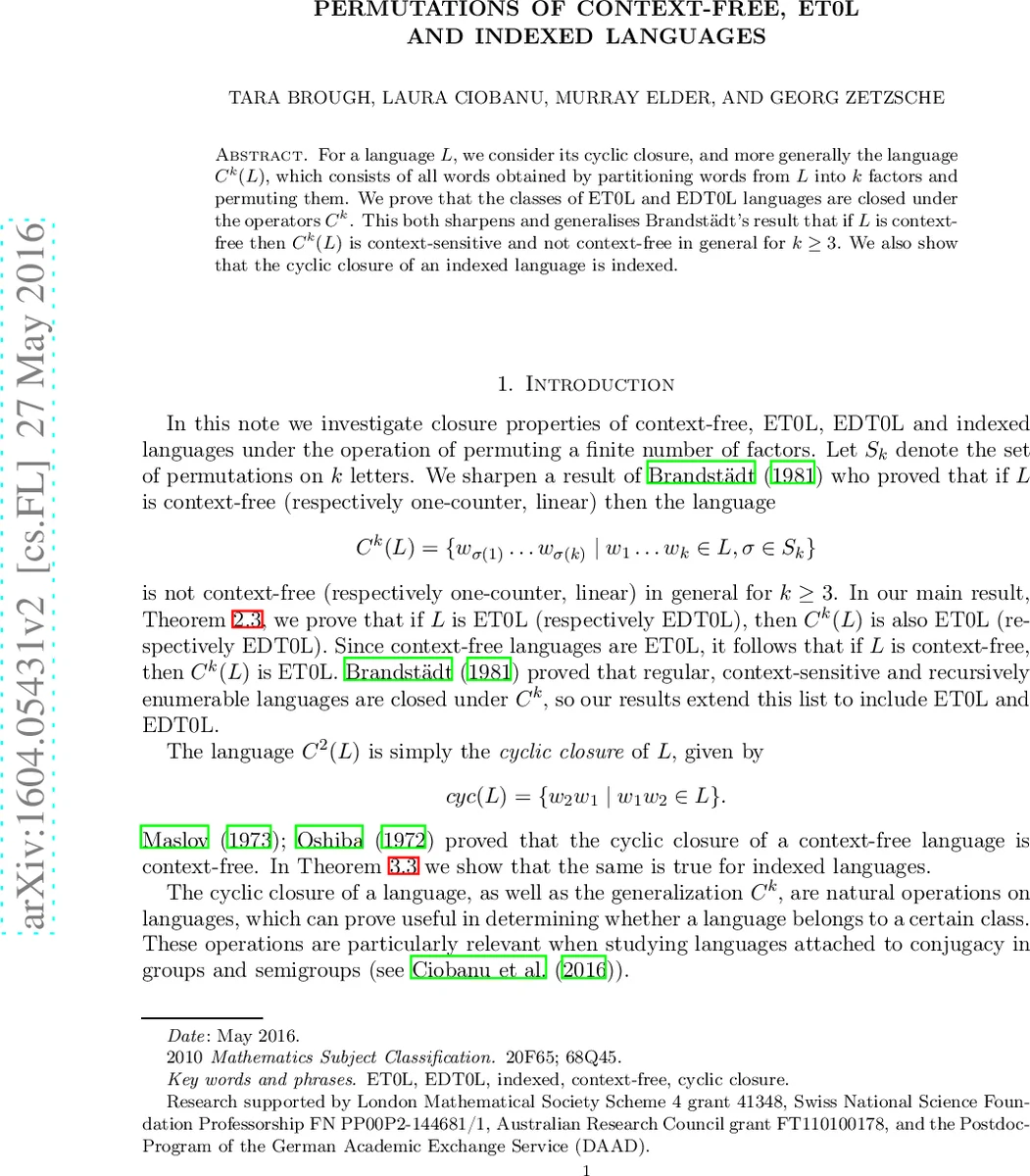
For a language $L$, we consider its cyclic closure, and more generally the language $C^k(L)$, which consists of all words obtained by partitioning words from $L$ into $k$ factors and permuting them. We prove that the classes of ET0L and EDT0L languages are closed under the operators $C^k$. This both sharpens and generalises Brandst"adt’s result that if $L$ is context-free then $C^k(L)$ is context-sensitive and not context-free in general for $k\geq 3$. We also show that the cyclic closure of an indexed language is indexed.
💡 Research Summary
The paper investigates the closure properties of several well‑studied language families—ET0L, EDT0L, and indexed languages—under a natural operation that permutes a fixed number of factors of a word. For a language L and a positive integer k, the operator C^k(L) consists of all strings obtained by splitting any word w∈L into k consecutive blocks w₁…w_k and then concatenating those blocks in an arbitrary order prescribed by a permutation σ∈S_k. When k=2 this operation reduces to the cyclic closure cyc(L)={w₂w₁ | w₁w₂∈L}. The authors sharpen and generalise earlier work of Brandstädt (1981), who showed that for context‑free (and even one‑counter or linear) languages the set C^k(L) is in general not in the same class for k≥3, while regular, context‑sensitive and recursively enumerable languages are closed under C^k.
Main contributions
-
ET0L and EDT0L are closed under C^k.
The authors first embed the original language L into a marked version L′={#₀ w₁ #₁ … #_{k‑1} w_k #_k | w₁…w_k∈L} using fresh delimiter symbols #₀,…,#_k. For ET0L this follows directly from closure under rational transductions; for EDT0L they construct L′ by repeatedly applying Lemma 2.4, which shows that inserting a single delimiter while preserving the language’s deterministic table structure is possible, and then intersect with a regular language to enforce the correct order of delimiters. -
Permutation via (a,b)-languages and a π‑transformation.
For each permutation σ, the delimiters #{σ(i)‑1} and #{σ(i)} are treated as a distinguished pair (a,b). The paper introduces the notion of an (a,b)-language—words that contain exactly one a and one b, possibly surrounded by other symbols—and defines a morphism π that moves the substring between a and b to a new location marked by auxiliary symbols p and q. Proposition 2.9 proves that π(L) stays within the same family (ET0L or EDT0L) when L is an (a,b)-language. The proof hinges on constructing a new ET0L/EDT0L system that carries, in the second component of each non‑terminal, a “flag” indicating whether the non‑terminal contributes to the a‑segment, the b‑segment, both, or none. Tables are carefully designed so that the deterministic property is preserved in the EDT0L case. -
Assembling C^k(L).
For each σ∈S_k the transformed language L_σ = {#₀…#k w{σ(1)}…w_{σ(k)} | #₀ w₁ #₁ … #_{k‑1} w_k #_k∈L′} is obtained by applying the π‑construction to the appropriate pair of delimiters. Finally, a homomorphism erasing all delimiters and a finite union over all σ yield C^k(L). Since ET0L and EDT0L are closed under homomorphism and finite union, C^k(L) belongs to the same class as L. This establishes Theorem 2.3: “If L is ET0L (resp. EDT0L) then C^k(L) is also ET0L (resp. EDT0L).” -
Cyclic closure of indexed languages.
Indexed languages, introduced by Aho (1968), are generated by grammars that augment context‑free productions with a stack of “indices”. The authors first bring any indexed grammar into a normal form consisting of four rule types (A→B f, A f→B, A→BC, A→a). They then analyse parse trees and define a “path‑skeleton” (the 1‑neighbourhood of a root‑to‑leaf path). To obtain the cyclic closure cyc(L), they show how to rearrange the skeleton so that the two sub‑paths corresponding to w₁ and w₂ are swapped while preserving the index stack. This is achieved by adding new productions that move a non‑terminal across the stack without altering the stack content. The construction guarantees that every word of the form w₂w₁ is derivable in the modified grammar, and conversely any derivation of such a word can be projected back to a derivation of w₁w₂ in the original grammar. Consequently, Theorem 3.3 states that the cyclic closure of an indexed language is again indexed.
Significance and impact
- The results place ET0L and EDT0L in a privileged position: they are strictly more expressive than context‑free languages yet retain robustness under factor permutation, a property that fails for many intermediate families (one‑counter, linear). This deepens our understanding of the structural hierarchy between context‑free, ET0L/EDT0L, indexed, and higher classes.
- Showing that indexed languages are closed under cyclic closure extends the known closure properties of indexed languages (which already include union, concatenation, homomorphism, etc.) and provides a useful tool for group‑theoretic applications where conjugacy classes correspond to cyclic permutations of words.
- The proof techniques—particularly the use of (a,b)-languages, flag‑augmented non‑terminals, and careful table design—are modular and may be adapted to study other operations such as reversal, insertion of a bounded number of symbols, or more general permutations on substrings.
- By unifying the treatment of ET0L/EDT0L and indexed languages, the paper bridges two strands of formal language theory that are often studied separately, suggesting further avenues for cross‑class investigations (e.g., whether certain subclasses of indexed languages inherit the ET0L‑style closure properties).
Overall, the paper makes a substantial contribution to the theory of formal languages by clarifying how permutation‑based operations interact with powerful language families, thereby enriching the toolbox available to researchers in automata theory, combinatorial group theory, and computational linguistics.
Comments & Academic Discussion
Loading comments...
Leave a Comment