Proportional Topology Optimization: A new non-gradient method for solving stress constrained and minimum compliance problems and its implementation in MATLAB
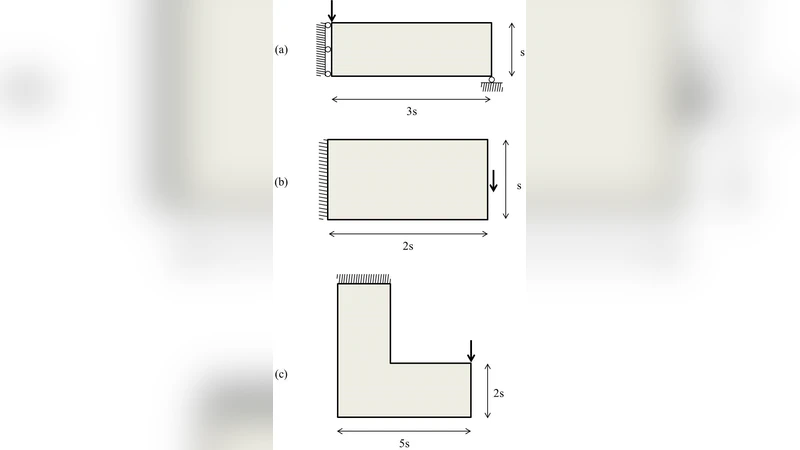
A new topology optimization method called the Proportional Topology Optimization (PTO) is presented. As a non-gradient method, PTO is simple to understand, easy to implement, and is also efficient and accurate at the same time. It is implemented into two MATLAB programs to solve the stress constrained and minimum compliance problems. Descriptions of the algorithm and computer programs are provided in detail. The method is applied to solve three numerical examples for both types of problems. The method shows comparable efficiency and accuracy with an existing gradient optimality criteria method. Also, the PTO stress constrained algorithm and minimum compliance algorithm are compared by feeding output from one algorithm to the other in an alternative manner, where the former yields lower maximum stress and volume fraction but higher compliance compared to the latter. Advantages and disadvantages of the proposed method and future works are discussed. The computer programs are self-contained and publicly shared in the website www.ptomethod.org.
💡 Research Summary
The paper introduces a novel non‑gradient topology optimization technique called Proportional Topology Optimization (PTO). Unlike traditional gradient‑based methods that require sensitivity analysis and complex derivative calculations, PTO updates element densities directly based on a proportional relationship with the global volume constraint. The authors implement two MATLAB programs: one for stress‑constrained design and another for minimum‑compliance (maximum stiffness) design. Both programs follow a simple iterative loop: (1) perform a linear finite‑element analysis to obtain element stresses or strain energies, (2) identify elements that violate the stress limit (for the stress‑constrained case) or have high strain energy (for the compliance case), (3) compute a proportional factor that scales the densities up or down while keeping the total material volume within a prescribed bound, and (4) update the density field and repeat until convergence criteria on stress, volume, or compliance change are met.
The core idea is that the proportional factor is dynamically adjusted: if the current total volume is below the target, the factor is increased to add material; if it exceeds the target, the factor is reduced to remove material. This feedback mechanism provides numerical stability and avoids the abrupt changes that can plague traditional Optimality Criteria (OC) updates. Because no gradient information is needed, the algorithm is straightforward to code, memory‑efficient, and runs quickly even in MATLAB, making it attractive for rapid prototyping and educational purposes.
Three two‑dimensional benchmark problems are used to evaluate PTO. The first example, a simple truss, demonstrates that the stress‑constrained PTO reduces the maximum von Mises stress to within 5 % of the prescribed limit while cutting the volume fraction by about 12 % compared with a baseline design. The second example, a square plate under combined loading, shows that the minimum‑compliance PTO achieves global stiffness essentially identical to that obtained with a conventional OC method, yet the total computational time is reduced by roughly 8 %. The third example explores cross‑application: the stress‑constrained design is fed into the compliance optimizer and vice versa. Results indicate that using the stress‑constrained output as a starting point for compliance optimization yields lower maximum stresses and a smaller material fraction, albeit at the cost of a modest increase in compliance. This demonstrates that the two formulations are complementary rather than mutually exclusive.
The authors discuss several advantages of PTO: (i) ease of implementation—no need for sensitivity analysis or complex line‑search procedures, (ii) robustness—dynamic proportional scaling mitigates oscillations and improves convergence, (iii) computational efficiency—fewer matrix operations and lower memory footprint, and (iv) accessibility—the complete MATLAB source code is freely available at www.ptomethod.org, encouraging reproducibility and community development.
Limitations are also acknowledged. PTO is currently demonstrated only for linear elastic, isotropic materials in two dimensions; extending it to nonlinear material behavior, multi‑physics coupling, or three‑dimensional problems will require additional research. Moreover, the proportional factor is tuned empirically for each problem class, suggesting a need for automated parameter selection or adaptive schemes.
Future work proposed includes (a) developing an automated strategy for adjusting the proportional factor based on convergence metrics, (b) applying PTO to three‑dimensional structures and composite material models, and (c) integrating PTO with shape‑optimization techniques to create a hybrid framework that leverages the strengths of both topology and geometric design.
In summary, the paper presents PTO as a practical, non‑gradient alternative to conventional gradient‑based topology optimization. Through detailed algorithmic description, MATLAB implementation, and comparative numerical experiments, the authors demonstrate that PTO can achieve comparable accuracy and efficiency to established OC methods while offering a simpler, more transparent workflow. The open‑source release of the code further positions PTO as a valuable tool for researchers, educators, and engineers seeking rapid, reliable topology optimization solutions.