The linear response function of an idealized atmosphere. Part 2: Implications for the practical use of the Fluctuation-Dissipation Theorem and the role of operators non-normality
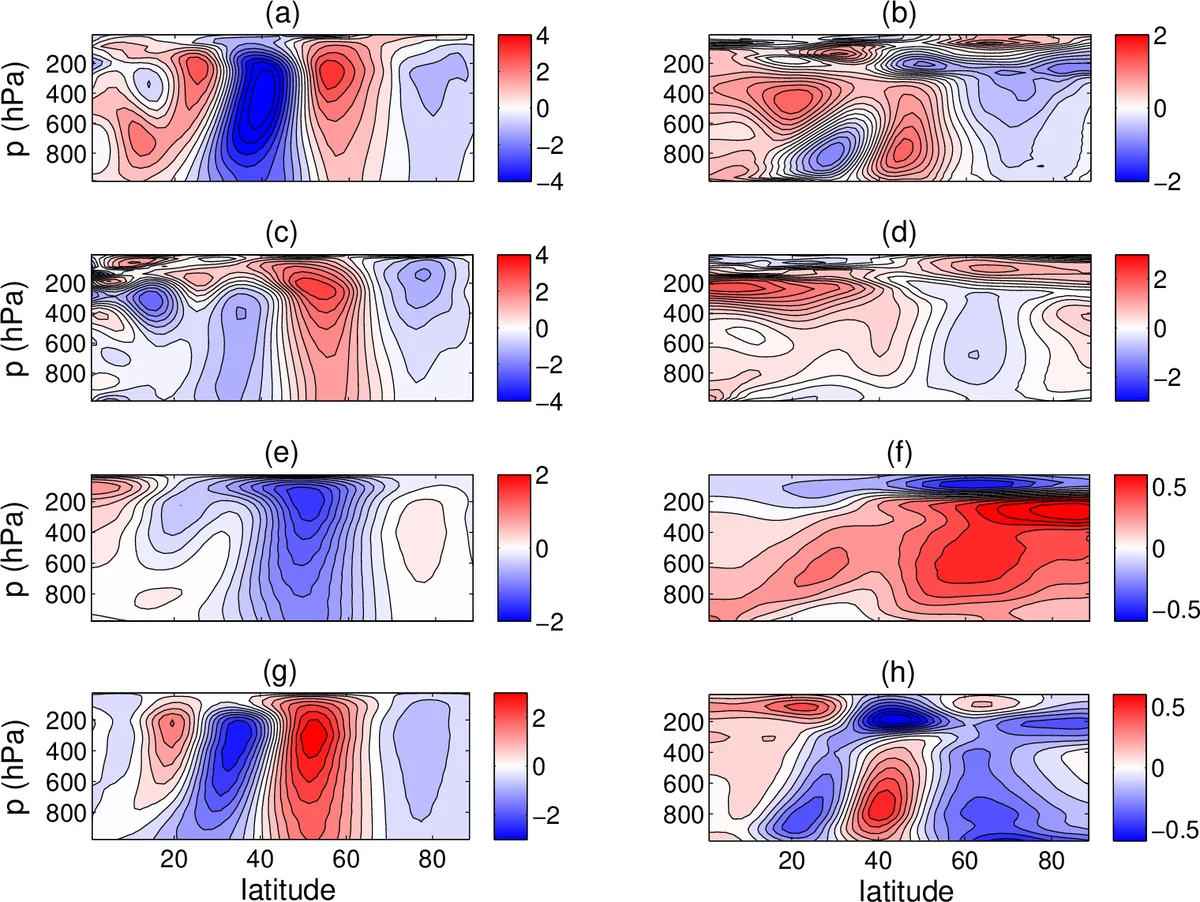
A linear response function (LRF) relates the mean-response of a nonlinear system to weak external forcings and vice versa. Even for simple models of the general circulation, such as the dry dynamical core, the LRF cannot be calculated from first principles due to the lack of a complete theory for eddy-mean flow feedbacks. According to the Fluctuation-Dissipation Theorem (FDT), the LRF can be calculated using only the covariance and lag-covariance matrices of the unforced system. However, efforts in calculating the LRFs for GCMs using FDT have produced mixed results, and the reason(s) behind the poor performance of the FDT remains unclear. In Part 1 of this study, the LRF of an idealized GCM, the dry dynamical core with Held-Suarez physics, is accurately calculated using Green’s functions. In this paper (Part 2), the LRF of the same model is computed using FDT, which is found to perform poorly for some of the test cases. The accurate LRF of Part 1 is used with a linear stochastic equation to show that dimension-reduction by projecting the data onto leading EOFs, which is commonly used for FDT, can alone be a significant source of error. Simplified equations and examples of 2 x 2 matrices are then used to demonstrate that this error arises because of the non-normality of the operator. These results suggest that errors caused by dimension-reduction are a major, if not the main, contributor to the poor performance of the LRF calculated using FDT, and that further investigations of dimension-reduction strategies with a focus on non-normality are needed.
💡 Research Summary
This paper investigates why the linear response function (LRF) of an idealized atmospheric general‑circulation model, obtained via the Fluctuation‑Dissipation Theorem (FDT), often fails to reproduce the true forced response, even though an accurate LRF can be constructed using Green’s functions (Part 1). The authors work with the dry dynamical core equipped with Held‑Suarez physics, a widely used benchmark that solves the primitive equations on a T63 spectral grid. In Part 1 they generated a “ground‑truth” LRF (denoted ˜ M_GRF) by applying hundreds of weak, localized momentum and thermal forcings, measuring the mean response for each, and inverting the resulting linear system. This Green’s‑function LRF reproduces forced experiments with negligible error, confirming the linearity of the system for the perturbation amplitudes considered.
In Part 2 they compute an alternative LRF (˜ M_FDT) solely from the statistics of an unforced control run, following the quasi‑Gaussian formulation of the FDT:
˜ M_FDT = −
Comments & Academic Discussion
Loading comments...
Leave a Comment