Event shape sorting
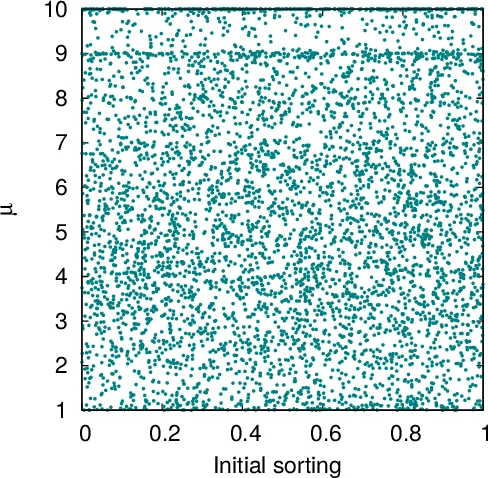
We propose a novel method for sorting events of multiparticle production according to the azimuthal anisotropy of their momentum distribution. Although the method is quite general, we advocate its use in analysis of ultra-relativistic heavy-ion collisions where large number of hadrons is produced. The advantage of our method is that it can automatically sort out samples of events with histograms that indicate similar distributions of hadrons. It takes into account the whole measured histograms with all orders of anisotropy instead of a specific observable (e.g. $v_2$, $v_3$, $q_2$). It can be used for more exclusive experimental studies of flow anisotropies which are then more easily compared to theoretical calculations. It may also be useful in the construction of mixed-events background for correlation studies as it allows to select events with similar momentum distribution.
💡 Research Summary
**
The paper introduces a novel “Event Shape Sorting” (ESS) technique designed to group heavy‑ion collision events according to the full azimuthal distribution of produced hadrons, rather than relying on a single flow observable such as (v_2), (v_3) or a (q_n) vector. The authors argue that conventional event selection based on multiplicity or a single anisotropy coefficient does not guarantee that the selected events have experienced similar initial conditions or hydrodynamic evolution, especially because fluctuations in the geometry and energy deposition generate anisotropies of all orders on an event‑by‑event basis.
Methodology
The core of ESS is a Bayesian classification scheme applied to the histogram of particle counts in azimuthal angle bins for each event. For an event described by a vector of bin occupancies ({n_i}) (with total multiplicity (M)), the probability that it belongs to a given event class (\mu) is written as a multinomial likelihood:
\
Comments & Academic Discussion
Loading comments...
Leave a Comment