Optimal uncertainty quantification for legacy data observations of Lipschitz functions
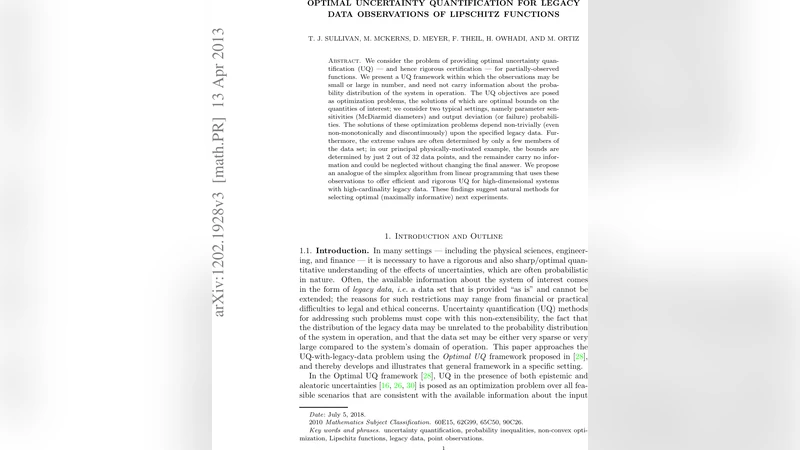
We consider the problem of providing optimal uncertainty quantification (UQ) — and hence rigorous certification — for partially-observed functions. We present a UQ framework within which the observations may be small or large in number, and need not carry information about the probability distribution of the system in operation. The UQ objectives are posed as optimization problems, the solutions of which are optimal bounds on the quantities of interest; we consider two typical settings, namely parameter sensitivities (McDiarmid diameters) and output deviation (or failure) probabilities. The solutions of these optimization problems depend non-trivially (even non-monotonically and discontinuously) upon the specified legacy data. Furthermore, the extreme values are often determined by only a few members of the data set; in our principal physically-motivated example, the bounds are determined by just 2 out of 32 data points, and the remainder carry no information and could be neglected without changing the final answer. We propose an analogue of the simplex algorithm from linear programming that uses these observations to offer efficient and rigorous UQ for high-dimensional systems with high-cardinality legacy data. These findings suggest natural methods for selecting optimal (maximally informative) next experiments.
💡 Research Summary
The paper tackles the challenging problem of providing rigorous, optimal uncertainty quantification (UQ) for functions that are only partially observed through “legacy” data—measurements collected in the past, possibly in small numbers, and without any knowledge of the underlying probability distribution of the system in operation. The authors assume that the unknown function is globally Lipschitz continuous with a known Lipschitz constant. This structural assumption replaces the need for a full probabilistic model and enables the derivation of deterministic bounds that are valid for any admissible input distribution consistent with the observations.
Two canonical UQ objectives are considered. The first is the McDiarmid diameter (or parameter sensitivity), which quantifies the worst‑case change in the output when a single input component is varied while all others are held fixed. The second is the probability that the output exceeds (or falls below) a prescribed threshold—a failure probability that is central to reliability analysis. Both objectives are cast as optimization problems over the set of all Lipschitz functions that interpolate the legacy data. The optimal values of these problems constitute the tightest possible upper (or lower) bounds on the quantities of interest, given only the data and the Lipschitz constant.
A striking theoretical finding is that the optimal bounds depend on the data in a highly non‑monotonic and often discontinuous way. Adding a new observation does not guarantee a tighter bound; in some cases the bound may stay unchanged, while in others a single new point can cause a sudden jump. Moreover, the extreme values are typically dictated by a very small subset of the data, termed the “active” points. In the authors’ physically motivated example involving 32 measurements of a material property, only two points determine the optimal McDiarmid diameters and failure‑probability bounds; the remaining 30 points are effectively irrelevant for the UQ task. This observation leads to a natural notion of data informativeness and suggests that many legacy measurements may be discarded without loss of rigor.
From a computational standpoint, the authors develop an algorithm inspired by the simplex method of linear programming. Starting from an initial active set, the algorithm iteratively performs “pivot” operations: it evaluates whether any inactive observation can improve the current bound, and if so, swaps it into the active set. Each iteration solves a low‑dimensional linear program that reflects the Lipschitz constraints restricted to the current active points. The procedure converges when no further improvement is possible, at which point the active set defines the optimal bound. Because the active set remains small even in high‑dimensional settings, the algorithm scales polynomially with the number of variables and observations, making it feasible for problems with hundreds of input dimensions and thousands of legacy data points. Numerical experiments confirm that the method attains the exact optimal bounds orders of magnitude faster than generic global optimization techniques.
The paper also discusses how the identified active points can guide the design of future experiments. Since the bounds are determined by a few critical observations, a rational next‑experiment strategy is to target regions of the input space that are farthest from the current active set or that have the potential to become active. By acquiring data precisely where it can most affect the bound, one can achieve maximal reduction in uncertainty with minimal experimental effort—a principle that aligns with optimal experimental design but is derived here without any probabilistic prior.
In summary, the authors present a rigorous UQ framework that (i) replaces probabilistic assumptions with a Lipschitz regularity condition, (ii) formulates optimal sensitivity and failure‑probability bounds as tractable optimization problems, (iii) reveals that only a handful of legacy measurements drive these bounds, and (iv) provides a simplex‑like algorithm that efficiently solves the problems even in high‑dimensional, high‑cardinality settings. The work offers both theoretical insight into the structure of data‑driven uncertainty bounds and practical tools for engineers and scientists who must certify the reliability of complex systems based on limited, historical data. Future extensions could incorporate stochastic priors, handle measurement noise more explicitly, or apply the methodology to dynamical systems where Lipschitz continuity holds in function space.
Comments & Academic Discussion
Loading comments...
Leave a Comment