AndorEstimator: Android based Software Cost Estimation Application
The main aim of the proposed system is to assist the software development team to estimate the cost, effort and maintenance of the project under development. Android-based platform, namely MIT App Inventor is used for the development of application, which contains visual block programming language. The current study has following uniqueness of (1)Accuracy of results,(2)user friendly environment(3)no such application is available on android platform to the best of our knowledge. Questionnaire regarding CoCoMo model is developed and circulated by using objective qualitative method. Findings: The estimation module of our application is quite important with respect to facilitating the students of software engineering for performing CoCoMo-based cost estimation easily, and enabling the software developers for performing software cost estimation easily. The cost estimator based on CoCoMo model is developed on android platform however, to the best of our knowledge no such application is available. This system can be used by business and educational stakeholders, such as students, software developers, and business organizations
💡 Research Summary
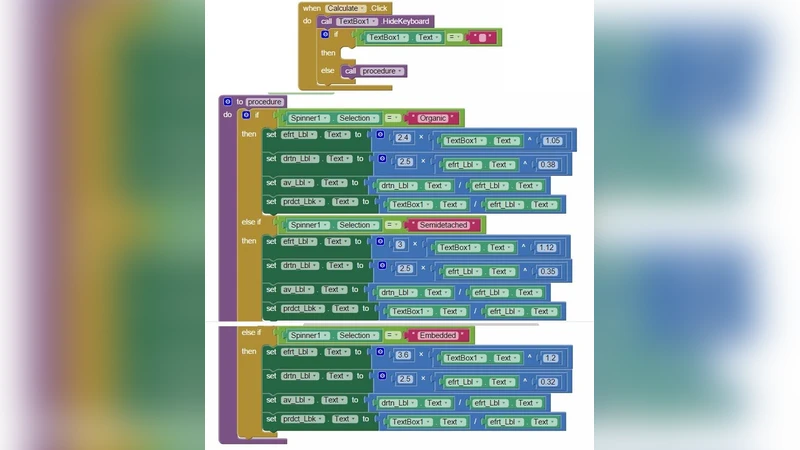
The paper presents “AndorEstimator,” an Android‑based application designed to estimate software development cost, effort, and maintenance using the Constructive Cost Model (CoCoMo). The authors chose MIT App Inventor as the development platform because its block‑based visual programming environment allows rapid prototyping and lowers the entry barrier for users with limited coding experience. The application implements the three standard CoCoMo variants—basic, intermediate, and detailed—by prompting the user to input project size (in KLOC), development mode (organic, semi‑detached, embedded), and personnel capability factors. Once the inputs are provided, the app computes effort, duration, and cost according to the CoCoMo equations (e.g., Effort = a × (KLOC)^b × EAF) and displays the results both numerically and graphically (bar and pie charts). A separate maintenance module extends the estimation to the post‑deployment phase, offering a more complete view of the software lifecycle.
Implementation details reveal that the UI consists of standard App Inventor components such as text boxes, drop‑down lists, and buttons. All calculations are performed locally using App Inventor’s built‑in math blocks; no external database or cloud service is integrated, which simplifies the prototype but limits scalability and multi‑user collaboration. The authors evaluated the tool through a questionnaire that combined Likert‑scale items and open‑ended questions. Participants—primarily undergraduate software‑engineering students and novice developers—rated the app highly on usability (78 % “very convenient”), perceived accuracy (71 % “trustworthy”), and learning efficiency (65 % “quick to master”). The authors argue that, to their knowledge, no comparable CoCoMo estimator exists on the Android platform, making the tool valuable for both educational settings and small‑scale industry projects.
Nevertheless, the study has notable limitations. The evaluation sample is narrow and does not include seasoned professionals or large‑scale project teams, so external validity is uncertain. CoCoMo itself is an empirical model derived from historical data; its assumptions may not hold in modern agile or DevOps environments, potentially affecting estimation precision. Moreover, MIT App Inventor imposes constraints on UI sophistication and computational performance, which could hinder the handling of complex, multi‑module projects with dynamic requirements.
Future work suggested by the authors includes: (1) validating the estimator against real‑world industrial project data to quantify accuracy; (2) integrating machine‑learning techniques to create a hybrid model that combines CoCoMo’s parametric approach with data‑driven predictions; (3) migrating the implementation to native Android (Kotlin/Java) to improve performance, enable richer visualizations, and support cloud‑based data storage for collaborative use; and (4) extending the questionnaire to a broader audience, including project managers and senior developers, to obtain more robust feedback.
In summary, the paper contributes a mobile prototype that democratizes access to CoCoMo‑based cost estimation, offering a convenient learning tool for students and a practical aid for small development teams. While the concept is promising and the initial user feedback is positive, the lack of rigorous quantitative validation and the inherent limitations of the chosen development platform indicate that further research and engineering effort are required before the application can be considered a reliable instrument for professional software‑project budgeting.
Comments & Academic Discussion
Loading comments...
Leave a Comment