Equivariant Kasparov theory of finite groups via Mackey functors
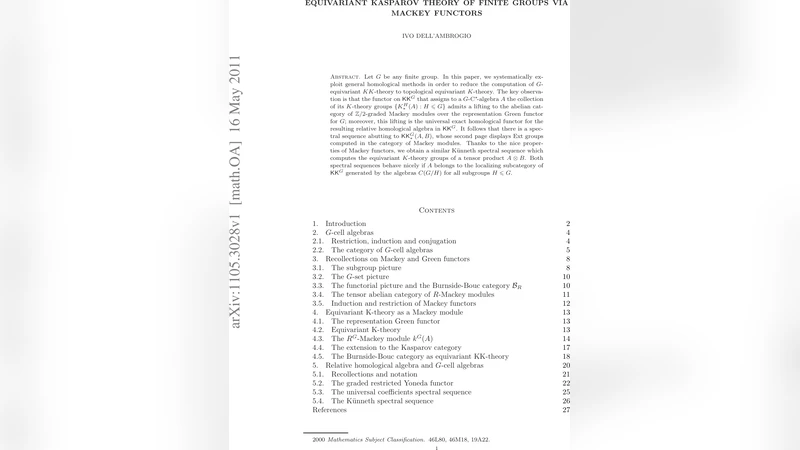
Let G be a finite group. We systematically exploit general homological methods in order to reduce the computation of G-equivariant KK-theory to topological equivariant K-theory. The key observation is that the functor assigning to a separable G-C*-algebra the collection of all its equivariant K-theory groups lifts naturally to a homological functor taking values in the abelian tensor category of Mackey modules over the classical representation Green functor for G. This fact yields a new universal coefficient and a new Kuenneth spectral sequence for the G-equivariant Kasparov category, whose convergence behavior is nice for all G-C*-algebras in a certain bootstrap class.
💡 Research Summary
The paper develops a systematic method to reduce the computation of equivariant Kasparov theory (KK‑theory) for a finite group G to the more tractable equivariant topological K‑theory. The central idea is to view, for any separable G‑C*-algebra A, the whole family of equivariant K‑theory groups {K*_H(Res⁽ᴳ⁾H A)}{H≤G} as a single Z/2‑graded Mackey functor k_G*(A). This Mackey functor naturally carries the structure of a module over the representation Green functor R_G (the Grothendieck ring of complex G‑representations). Consequently, k_G* defines a homological functor
k_G*: KK⁽ᴳ⁾ → R_G‑Mac,
where R_G‑Mac denotes the abelian tensor category of graded R_G‑modules (Mackey modules). The authors prove that k_G* is the universal stable homological functor for KK⁽ᴳ⁾ relative to the family of restriction functors {K*_H ∘ Res⁽ᴳ⁾_H}. In other words, any homological invariant of KK⁽ᴳ⁾ factoring through the K‑theory of all subgroups must factor uniquely through k_G*.
Using the machinery of relative homological algebra in triangulated categories, the paper derives two spectral sequences:
-
Universal Coefficient Spectral Sequence (UCSS). For any A, B ∈ KK⁽ᴳ⁾, E₂^{p,q} = Ext^{p}{R_G}(k_G*(A), k_G*(B)){‑q} ⇒ KK⁽ᴳ⁾_{p+q}(A, B).
Here Ext is computed in the Grothendieck abelian category R_G‑Mac; the grading by Z/2 is encoded in the subscript. The sequence lives in the right half‑plane (p ≥ 0) and converges conditionally when A belongs to the “G‑cell” subcategory Cell G (the localizing triangulated subcategory generated by the algebras C(G/H)). If A admits a finite‑length projective resolution as an R_G‑module, the spectral sequence collapses after a finite number of pages (specifically, it is confined to 0 ≤ p ≤ m+1 where m is the resolution length).
-
Künneth Spectral Sequence. For any A, B ∈ KK⁽ᴳ⁾, E₂^{p,q} = Tor^{R_G}{p}(k_G*(A), k_G*(B)){q} ⇒ K⁽ᴳ⁾_{p+q}(A ⊗ B).
This sequence computes the equivariant K‑theory of the tensor product A⊗B. It also converges strongly when A∈Cell G, and collapses under the same finite‑projective‑resolution hypothesis.
The paper introduces the notion of G‑cell algebras (Cell G) as the smallest triangulated subcategory of KK⁽ᴳ⁾ containing all C₀(G/H) and closed under countable coproducts. It shows that Cell G is a tensor‑triangulated subcategory, stable under restriction, induction, and conjugation functors. Moreover, many natural G‑C*-algebras (including all separable commutative ones) lie in Cell G, and the subcategory enjoys closure under extensions, inductive limits, exterior equivalence of actions, and crossed products with commuting Z‑ or R‑actions.
A key technical bridge is the identification of the category of R_G‑Mackey modules with the category of additive contravariant functors from the permutation algebra perm G (the full subcategory of KK⁽ᴳ⁾ spanned by algebras C(X) for finite G‑sets X) to Ab. This equivalence, proved via the Burnside–Bouc category, shows that k_G* restricted to perm G is essentially the Yoneda embedding, reinforcing its universality.
The authors illustrate the power of the machinery with a concrete vanishing result: if for a G‑C*-algebra A we have K*_E(Res⁽ᴳ⁾_E A)=0 for every elementary subgroup E≤G, then for any B, K⁽ᴳ⁾*(A⊗B)=0. The proof uses the Künneth spectral sequence: the hypothesis forces k_G*(A)=0, making the E₂‑page of the Künneth sequence zero, and strong convergence (since A∈Cell G) yields the desired vanishing.
The paper also situates its contributions relative to existing literature. It notes that similar Mackey‑module spectral sequences have appeared in equivariant stable homotopy (e.g.,
Comments & Academic Discussion
Loading comments...
Leave a Comment