Filtered Hirsch Algebras
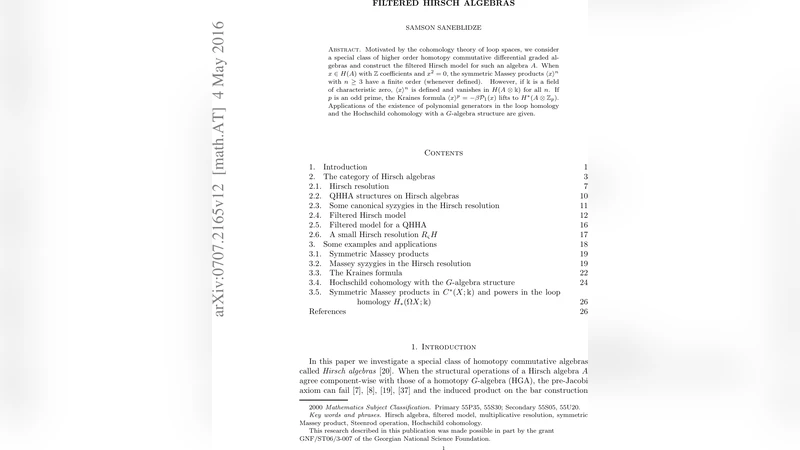
Motivated by the cohomology theory of loop spaces, we consider a special class of higher order homotopy commutative differential graded algebras and construct the filtered Hirsch model for such an algebra $A$. When $x\in H(A)$ with $\mathbb{Z}$ coefficients and $x^{2}=0,$ the symmetric Massey products $% \langle x\rangle ^{n}$ with $n\geq 3$ have a finite order (whenever defined). However, if $\Bbbk $ is a field of characteristic zero, $\langle x\rangle ^{n}$ is defined and vanishes in $H(A\otimes \Bbbk )$ for all $n$. If $p$ is an odd prime, the Kraines formula $\langle x\rangle ^{p}=-\beta \mathcal{P}{1}(x)$ lifts to $H^{\ast }(A\otimes {\mathbb{Z}}{p}).$ Applications of the existence of polynomial generators in the loop homology and the Hochschild cohomology with a $G$-algebra structure are given.
💡 Research Summary
The paper introduces a new class of differential graded algebras (DGAs) equipped with higher‑order homotopy‑commutative operations, called filtered Hirsch algebras, motivated by the cohomology of loop spaces. A filtered Hirsch algebra consists of a DGA ((A,d)) together with a family of multilinear operations (E_{p,q}) (for (p,q\ge0)) satisfying compatibility with the differential, a filtered version of the Hirsch identities, and a graded symmetry that generalizes the usual Hirsch algebra structure. The authors show that such algebras naturally arise from the cellular chain complexes of loop spaces (\Omega X), where the higher operations encode the Samelson products and Steenrod‑type operations present in the loop space cohomology.
The central construction is the filtered Hirsch model. Given any DGA (A), one builds a free Hirsch algebra (F(H)) on the cohomology (H=H^\ast(A)) and a morphism (\varphi:F(H)\to A) that is a quasi‑isomorphism and respects all higher operations. The model is filtered: the filtration on (F(H)) mirrors the filtration induced by the higher operations on (A). This provides a systematic way to replace a possibly complicated DGA by a much simpler free object while preserving the full homotopy‑commutative structure. The construction proceeds inductively on the filtration degree, using obstruction theory to lift the differential and the (E_{p,q}) operations step by step.
With the model in hand, the authors study symmetric Massey products (\langle x\rangle^{n}) for a class (x\in H(A)) with integer coefficients and (x^{2}=0). They prove that whenever the product is defined (i.e. the necessary indeterminacy vanishes), it has finite order for every (n\ge3). The proof relies on the fact that in a filtered Hirsch algebra the higher operations generate torsion elements whose order is bounded by the filtration level. In contrast, when the coefficient ring is a field of characteristic zero (e.g. (\mathbb Q)), all such symmetric Massey products vanish identically for every (n). This reflects the fact that the higher operations become null‑homotopic after rationalization.
A striking result concerns odd prime characteristics. For an odd prime (p), the classical Kraines formula in the cohomology of spaces, \
Comments & Academic Discussion
Loading comments...
Leave a Comment