Physics in 100 Years
Here I indulge in wide-ranging speculations on the shape of physics, and technology closely related to physics, over the next one hundred years. Themes include the many faces of unification, the re-imagining of quantum theory, and new forms of engineering on small, intermediate, and large scales.
💡 Research Summary
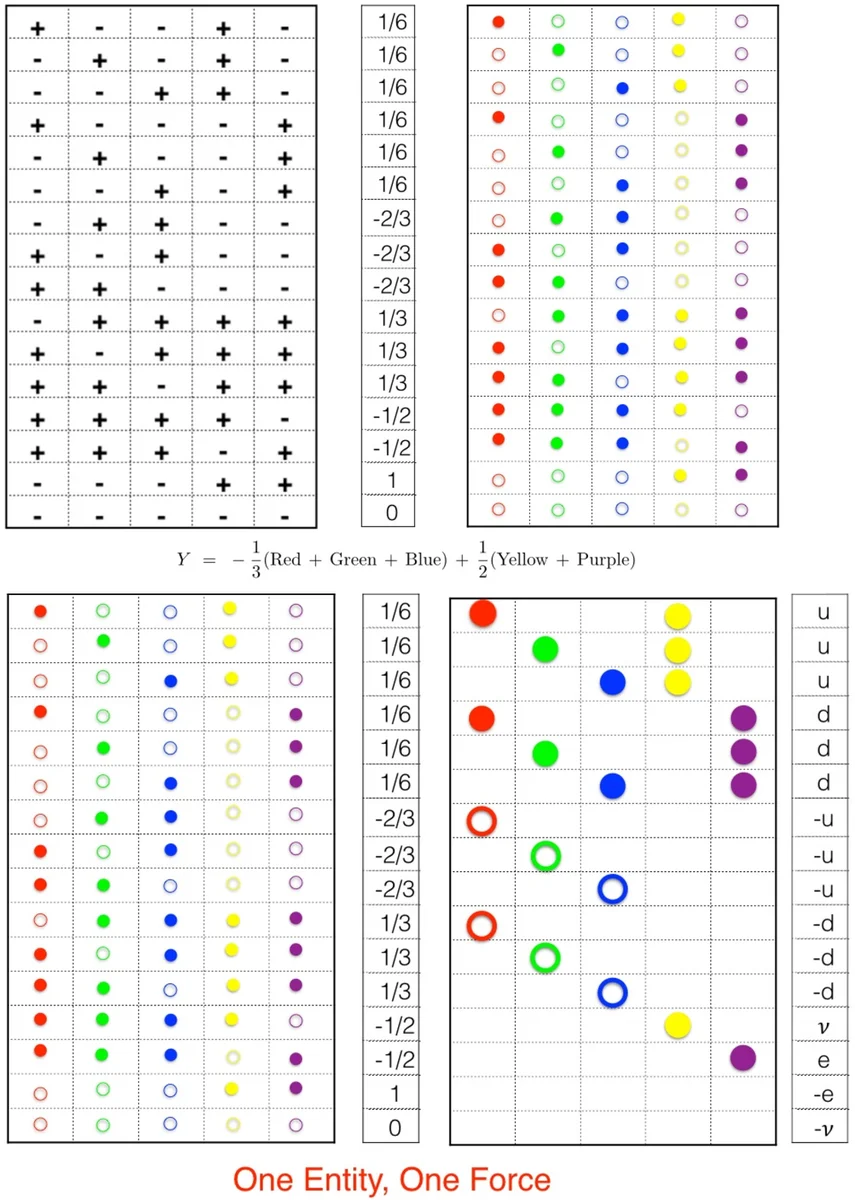
Frank Wilczek’s “Physics in 100 Years” is a speculative yet disciplined essay that surveys the current strengths and weaknesses of fundamental physics and projects how they might evolve over the next century. He begins by defining the present “Core Theory” – the quantum field theories of the strong, weak, electromagnetic, and gravitational interactions – as a set of locally symmetric gauge theories described by the group SU(3) × SU(2) × U(1) × SO(3,1). Using illustrative diagrams, he shows how the color charges of SU(3) and the weak isospin of SU(2) can be decomposed into a Cartan subgroup (SO(2)^5), making the pattern of quarks and leptons appear as a natural consequence of a larger symmetry such as SO(10) or SU(5).
Wilczek then turns to quantitative evidence for unification. If one runs the renormalization‑group equations (RGEs) for the three gauge couplings of the Standard Model up to very high energies, the couplings approach each other but miss exact convergence (Fig. 3). Introducing supersymmetry (SUSY) changes the particle spectrum above a breaking scale of order 1 TeV, adding superpartners that modify the vacuum polarization. With this minimal supersymmetric extension (the MSSM), the three gauge couplings meet at a single point around 2 × 10^16 GeV (Fig. 4). Wilczek interprets SUSY as an expansion of space‑time into “quantum dimensions” whose coordinates are Grassmann numbers rather than real numbers. In this view, SUSY extends the familiar Galilean/Lorentz invariance, turning fermions into bosons and vice‑versa while preserving gauge charges. Because SUSY cannot be exact (superpartners are not degenerate with known particles), it must be spontaneously broken, much like the electroweak symmetry. The unification scale is high enough that proton decay mediated by heavy gauge bosons is not ruled out, yet low enough that gravitational corrections to the RG flow remain negligible. Moreover, the same scale naturally accommodates the see‑saw mechanism for tiny neutrino masses.
Wilczek acknowledges that several aspects of the current picture remain unsatisfactory. The Higgs sector does not fit neatly into simple unified multiplets; the origin of three families and their detailed mass‑mixing patterns is still mysterious; and the classic prediction of proton decay has not yet been observed despite increasingly stringent limits. He stresses that these “weak points” are precisely where future experimental and theoretical work must focus.
In the third part he broadens the discussion to include gravity and possible extra dimensions. While string theory offers a mathematically rich framework that could, in principle, embed all four forces, its lack of concrete experimental signatures makes it an open question whether it will become the final unifying theory. Wilczek mentions other avenues—larger broken orthogonal groups (SO(1,N) → SO(1,3)), cosmic strings with exotic properties, and the Peccei‑Quinn mechanism that predicts a light pseudo‑scalar particle, the axion. He argues that the axion, if it constitutes a cosmic background, would provide a direct observational bridge between cosmology and particle physics.
The essay culminates in two concrete, testable predictions for the next hundred years: (1) Proton decay will finally be observed, opening a new empirical field centered on baryon‑number‑violating processes; and (2) Axions will be detected as a cosmic background, spawning a rich sub‑discipline of axion cosmology and fundamental physics. He also predicts that supersymmetric partners will be discovered, ushering in a “golden age” of particle physics.
Throughout, Wilczek frames his speculation as “disciplined imagination,” insisting that speculation must be anchored in three criteria: identifying current weak points, recognizing growth areas in technique and capability, and locating the “sweet spots” where the two intersect. By systematically applying this framework, he argues that the most plausible pathways to progress are already visible: higher‑energy colliders, ultra‑sensitive detectors for rare processes, advances in quantum information that may enable new experimental designs, and theoretical work that refines unification schemes while remaining open to surprises. In sum, the paper offers a thoughtful roadmap: the next century will likely see the experimental confirmation of supersymmetry, the discovery of proton decay, and the detection of axion dark matter, all of which will dramatically reshape our understanding of the fundamental constituents of nature and their unifying principles.
Comments & Academic Discussion
Loading comments...
Leave a Comment