MWStat: A Modulated Web-Based Statistical System

In this paper we present the development of a modulated web based statistical system, hereafter MWStat, which shifts the statistical paradigm of analyzing data into a real time structure. The MWStat system is useful for both online storage data and q…

Authors: Francisco Louzada, Anderson Ara
MWStat: A Modulated Web-Based Statistical System
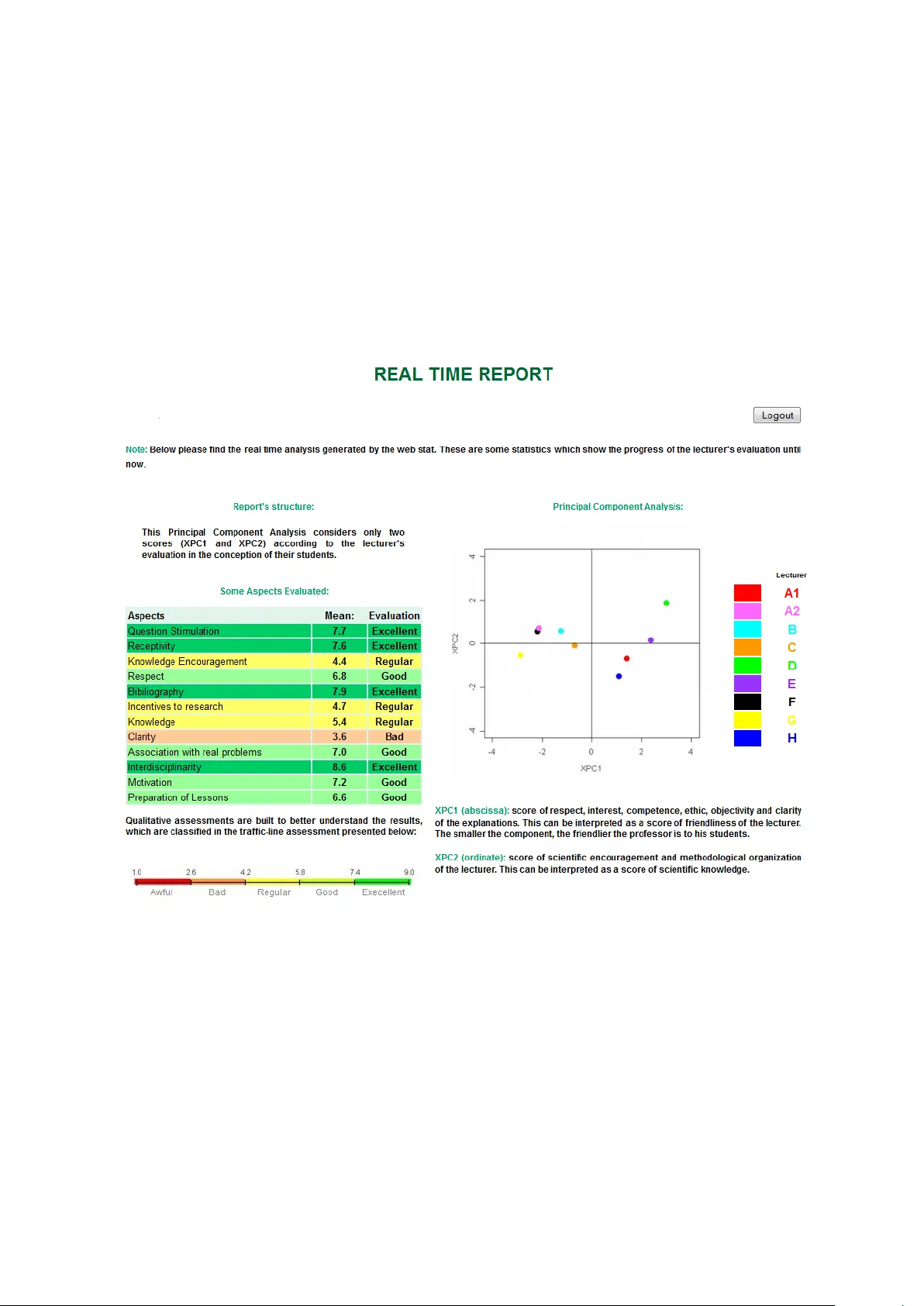
MWStat: A Mo dulated W eb-Based Statistical System F rancisco Louzada a and Anderson Ara a a Univ ersidade de São P aulo, Instituto de Matemática e Ciências da Computação, São Carlos, SP , Brazil Abstract In this pap er w e presen t the dev elopmen t of a modulated web based statistical system, hereafter MWStat, whic h shifts the statistical paradigm of analyzing data in to a real time structure. The MWStat system is useful for b oth online storage data and questionnaires analysis, as well as to provide real time disp osal of results from analysis related to several statistical metho dologies in a customizable fashion. Overall, it can b e seem as a useful tec hnical solution that can be applied to a large range of statistical applications, which needs of a scheme of devolution of real time results, accessible to an y one with internet access. W e displa y here the step-b y-step instructions for implementing the system. The structure is accessible, built with an easily in terpretable language and it can b e strategically applied to online statistical applications. W e rely on the relationship of sev eral free languages, namely , PHP , R, MySQL database and an Apache HTTP serv er, and on the use of softw are to ols such as phpMyA dmin. W e exp ose three didactical examples of the MWStat system on institutional ev aluation, statistical quality control and multiv ariate analysis. The metho dology is also illustrated in a real example on institutional ev aluation. Keywor ds: Online Surv ey , Statistical System, Real Time Results, Statistical Methods. 1. In tro duction F or decades the pattern of rationality based on statistical analysis has exp erienced slowness, which b egins with the data collection, passes b y the statistical analysis itself, and ends up in the final presenta- tion of the results obtained in form of a rep ort. F or instance, in traditional data collect research there is a gap in time b et ween the application of a questionnaire, the obtainmen t of the answ ers of resp ondents, the application of statistical techniques and the visualization of informativ e rep orts on the final results, i.e., p ossibly a slow pro cess that often ma y inv olv e a high cost. On the other hand, on accoun t of internet demo cratization, online surveys are b ecoming widely used. In an informal survey ov er the netw ork, Kay e and Johnson (1999) identified ov er 2000 surv eys in 59 differen t areas that benefit from the tec hnology fo cused on online questionnaires. Solomon (2001), F rick er et al. (2005) and Cox and Cox (2008), amongst others, show internet based surveys offer significan t adv an tages o v er traditional survey techniques. Ho w- ev er, despite the wide use of online research, the gap in time b et ween the b egin of a survey and the final presen tation of the statistical analysis results remains. Thus, there is a real need for a environmen t which facilitates the application of a survey while directly connecting the resp onses in a customizable real time informativ e rep ort in order to quickly provide all the information generated by the survey . Pr eprint submitte d to June 16, 2018 Ov er the w orld wide w eb we can find some environmen ts that organize national statistics datasets, suc h as the Virtual Statistical en vironment housed on http://www.virtualstatisticalenvironment.org/ , as well as, there are environmen ts which collect online data fo cusing on creating and publishing online surv eys, suc h as the SurveyMonk ey ( http://www.surveymonkey.com/ ) and QuestionPro ( http://www. questionpro.com/ ). It is also easily found statistical systems for sp ecific statistical analysis, such as Y oung T ung and Sc huenemey er (1991), Krtolica et al. (1991), Hatanak a and Y amada (2003), Analytica ( http://www.lumina.com/ ), and Plug&Score ( http://plug- n- score.com ), just to name a few. Moreo ver, some online statistical environmen ts are capable to pro duce some simple plots, frequency tables, cross-tabulation and summary measures. SOCR (Dinov, 2006) ( http://www.socr.ucla.edu/ ) prop oses a suite of Jav a applets for statistical online computation, visualization, analysis and virtual exp erimen tation, EasyCalculation en vironment ( http://easycalculation.com/ ) is a free online math w ebsite which helps users to learn mathematics and statistics. The ab o ve environmen ts cannot carry out customized statistical analysis wh ic h may inv olve more sophisticated pro cedures, such as a regression analysis, a m ultiv ariate analysis, quality control charts, among others. Other en vironments suc h as the R-PHP (Mineo and Pon tillo, 2006) ( http://dssm.unipa.it/R- php/ ), RStudio (RStudio, 2012) and rApache (Horner, 2012) allow the utilization of R softw are directly online, that may b e installed on any server. These environmen ts hav e a sophisticated communication b etw een the R softw are and servers, but do not interact dynamically with users who do not hav e knowledge of the R language. The environmen t JStatCom (Krätzig, 2007) defines some classes to connect existing math libraries (Ox, Matlab or R programming languages) with Ja v a client. The Rweb environmen t (Banfield, 1999) has three different v ersions, the first allows to type the co de, click the submit button and a page with the results is returned, the second is based on Jav ascript procedures and the third is designed as a p oin t click interface that can b e used in introductory statistic courses. Also, Online Analytical Statistical Information System (O ASIS, 2015) is a online system that provides some sophisticated and public analysis of health and so cial science data. And, R-fiddle (R-FIDDLE, 2015) provides a free environmen t to write, run and share R-co de right inside the browser. Another approach for interactivit y is performed b y Shiny (Chang et al., 2015), a R pac k age with a straigh t connection from R to a webserv er. It is divided in tw o comp onents: a user-interface script and a serv er script. In this case Shiny has its own structure to p erform web applications, but with restricted HTML or PHP customisation. In the present paper w e built the MWStat virtual environmen t, with easy HTML or PHP customi- sation, ov ercoming the problems discussed ab ov e. The MWStat is based on a scheme of devolution of real time results, accessible to any one with internet access. In other words, these pro cedures are fo cused on ho w to build a user-friendly interface and ho w to relate any website with the R soft ware to generate dynamic results for any online purp oses. The pro cedures exp osed in this pap er may b e easily applied by statisticians with a basic knowledge of web programming. The structure is accessible and built with an easy in terpretation language (PHP) and strategically applied in online applications. This pro cedure can b e considered an system, since it replaces the manual collecting data and is able to exp ose more targeted results to real problems. The MWStat relies on the relationship of several free op en-source languages, namely , PHP ( http//: www.php.net ), R ( http//:cran.r- project.org ), MySQL database ( http//:www.mysql.com ) and an 2 Apac he HTTP server ( http//:www.apache.org ), the latter for hosting and interpreting other languages. Moreo ver, we used the phpMyAdmin interface ( http//:www.phpmyadmin.net ) as an auxiliary to ol, re- lated to the administration of MySQL database using PHP language. These technologies w ere gathered in a LAMP server (Linux, Apache, MySQL and PHP), whic h is a p opular solution of free op en source soft ware to build a viable web serv er of general purp ose with a low costing structure and high p erformance (Neiderauer, 2004). Com bining all the technologies ab ov e, the MWStat can p erform online collection and data analysis, and the obtained results are provided in real time, dep ending only on the pro cessing time of the statistical analysis to b e considered. Moreov er, the MWStat is also very flexible, since it is completely customizable and it can b e built into indep enden t mo dules, according to the user needs. The main ob jective of the present pap er is to present the MWStat and the softw ares inv olved in its construction, displaying some tec hnical pro cedures on how to building it. F ollowing this pap er, an yone with some computational knowledge may build a web based statistical system environmen t that p erforms online statistical analysis for any purp oses. The v ersions of the softw are used in this work are provided, but the same procedures can b e extended to different versions or even other operating en vironment platform and database soft ware. W e provide the basic co des for the implementation of the R environmen t on any LAMP server, but more detailed co des are av ailable in our homepage ( http://www.mwstat.com ). In Section 2 the softw ares used for building the MWStat and their considered versions are display ed. In Section 3 we show the pro cedures for server installation and setup, which are necessary for the inter- pretation of the languages. In Section 4 we present examples of the MWStat implementation for ev ent ev aluation, as well as for tw o more areas, statistical qualit y con trol and m ultiv ariate analysis, those can b e accessed in the MWStat homepage through login and password provided. Moreo ver, a fourth example is also provided on institutional ev aluation, whic h has b een used in several applied researchers in Brazil. W e finish the paper with some final comments in Section 5, where we also presen t the web based statistical system homepage and the v arious applied research developmen ts based on its environmen t. 2. Soft wares applied for building the MWStat environmen t In this section, we present the softw are used in the construction of the MWStat. Essentially , they are free soft wares which can b e easily found on the web. • Lin ux Ubuntu Server 9.10 (or higher): Ubuntu is a complete Linux operating en vironment, com- pletely free, with great practicality , configuration and use (T arng and Liou, 2006). The installation file of this op erating environmen t is av ailable on website http://www.ubuntu.com , where the image of its installation CD can b e downloaded. • R softw are: computing environmen t for the p erformance of statistical analysis and graph building. It compiles and runs on a wide v ariety of UNIX platforms, Windows and MacOS. In our case, w e used the R implemen ted in UNIX through a Linux server. • MYSQL 5.0 (or higher): database management environmen t (DBMS) that uses the SQL (Structured Query Language) as interface. It is curren tly one of the most p opular databases, with ov er 100 million installations w orldwide. 3 • PHP 5.0 (or higher): (James and W are, 2003) acronym for Hyp ertext Prepro cessor, is a language for creating script directly in to the server designed sp ecifically for the web. Within an HTML page, PHP co des can b e executed ev ery time the page is visited. This code is interpreted on the web serv er and generates HTML viewing or other displa y t yp e. Belo w are listed some adv antages of PHP: high p erformance; interfaces for many different database environmen ts; in tegrated libraries for many common tasks from the w eb; Low cost, Easy to learn and use, p ortabilit y , av ailability to source co de. V ersion 5.0 was developed to impro ve to Ob ject Oriented Programming and is a v ailable now in version 5.2.13 ( http://www.php.net ). • phpMyA dmin 2.7.0-pl2: (or higher): computer program developed in PHP to administer MySQL o ver the Internet. F rom this environmen t you can create and remov e databases; create, delete and mo dify tables; insert, delete and edit fields, execute SQL co de and manipulate key fields. F or this pap er, we used implemented features and bug fixes up to version 2.6.2 ( http://www.phpmyadmin. net ). Figure 1: General structure of the systemenvironmen t. 3. Implemen tation pro cedures F or describing the implemen tation pro cedures, we fo cus on listing the pro cedures for creating the MWStat environmen t, as well as the softw are installation, settings and programming, at the exp ense of displa ying the b est hardware configuration for a computer (server) to implement the system, which is out of the scop e of the pap er. W e show the implemen tation of the environmen t in an Ubun tu Linux serv er, with web supp ort (Apac he), PHP and MySQL, also known as LAMP serv er. The Linux op erating en vironmen t was installed on a sp ecific computer, following these steps: 1. Through the installation file from the Ubuntu 9.10 Linux, we create a CD to start the computer from it, in other words, do the b oot from the CD. If the CD do es not run automatically , we must configure the Setup (BIOS) for b oot priority . 4 2. Cho ose the preferred language (shortcut to select language: F2). 3. Start the installation, clic k Install Ubun tu Server. 4. After the detection of the netw ork cards on the computer, w e must p erform the configuration of the static IP , in other w ords, the num b er for the netw ork interface card eth0. 5. Name the serv er: OnlineSytem. 6. Cho ose a lo cation: for example, Sao Paulo, Brazil. 7. After that, w e started the disk partitioner through the "assisted partitioning - use entire disk" where in this case, all necessary partitions will b e created automatically . 8. Inform the administrator user name and passw ord. 9. Inform the Pro xy server address, if any . 10. W e m ust select the pack ages to b e installed along with the environmen t: the LAMP Server. 11. Once the en vironment and the chosen services are installed, the server will restart. After p erforming the pro cedures ab o ve, the serv er created can be accessed from an y browser (eg In ternet Explorer, Mozilla, Op era etc) through its IP address, sho w ed in Step 4. Figure 1 sho ws the o verall MWStat environmen t server structure. W e may configure the server directly on the mac hine installed, b y Linux’ Shell. Therefore, we are in terested in creating a sp ecific place for environmen t files, making it a v ailable through the Internet, installing the R soft ware and creating an en vironment where it can generate graphs and comm unicate with the MySQL database soft ware. W e start the configuration pro cess by creating a user and their resp ective folder, where the environmen t files will b e. By taking the user name usertest , use the following command: sudo useradd usertest In this case, a folder is created in home /usertest/ where the files created by this user will remain, w e shall use this folder to sa ve the environmen t files. Likewise, we can redirect this folder to a fixed address on the In ternet. Thus, we edit the alias file with the command: sudo nano /etc/apache2/conf.d/alias Notice that in this case we use the nano text editor, whic h is a traditional editor of the Linux Ubuntu. After op ening this file, insert the following lines: Alias /dados/home/usertest/ Options Indexes FollowSymLinks AllowOverride All Order allow,deny Allow from all After running the commands ab o ve, files that are in the home directory /usertest/ can b e accessed directly through a bro wser using the address IP/data/ . 5 Inside the directory /usertest/ w e can create a new directory and sav e the phpmy admin files there, where w e can manage the tables in MySQL . In this context, we must install the R softw are on our serv er. W e must enter the address http://cran. r- project.org/bin/linux/ubuntu/ and after that, p erform the installation. The entire pro cedure can b e done through the following commands: sudo nano /etc/apt/sources.list sudo apt-get update sudo apt-get install r-base After the construction to this entire structure, w e still hav e to provide the R softw are with the ability to generate graphics in the Linux environmen t. W e applied ghostscript technology and used the following command line: sudo apt-get install gs W e must also pro vide the R softw are with the ability to connect with the MySQL database. F or such, w e used the pack age RMySQL (James and DebRoy, 2006), installed with the command: sudo apt-get install r-cran-rmysql Directly from the server, we can run the softw are just by typing R in any directory . The commands in R language to access the MySQL database are displa y ed b elo w (they m ust necessarily b e in .r format and sa ved on the server): require(RMysQL) con<-dbConnect(dbDriver("MySQL",) user="username", dbname = "databasename", password="passwd") dados=dbGetQuery(con,paste("select * from tablename")) After all the pro cedures ab o ve, we ha ve the structure required for the relationship among the languages in fo cus. Thus, we can edit .php files using the resources installed on the server. By programming in PHP , we can run directly from web pages files written in R language. The co des b elo w access files .r through the PHP language, statistical.r . This file refers to calculations that ha ve v alue vectors or images as output. F or example, a vector of means, which will b e assigned to the v ariable php $res or graphs generation co des. $ command = ” echo 0 argv < − \ ” statistical . r \ ”; source ( argv ) 0 ” | ” . ” / usr / bin / R \\ − − vanilla − − slave ”; $res = exec($command); 4. Some Applications In this section, w e displa y three general applications of our system. The first, second and third examples of applications of the system for ev ent ev aluation, quality control and m ultiv ariate analysis, resp ectiv ely . They can b e accessed online by the readers. Moreov er, the first and third o applications can b e totally reproduced in a standalone fashion by do wnloading the co des from http://www.mwstat.com . The fourth application is an institutional ev aluation which was carried out on an undergraduate curse in Statistics from the Univ ersidade F ederal de São Carlos, Brazil. 6 Figure 2: The files and their relationship in the even t ev aluation Example. 4.1. Some intr o ductory examples In this section, we display more three general didactical applications of the MWStat. The first one is based on a dynamic even t ev aluation which allows to measure the quality of scientific even ts, such as, conferences, symp osia, meetings, workshops, among other. This example consists in 11 questions ab out academic purp oses in a generic ev ent. Participan ts answer an online questionnaire and an instant online rep ort is provided in real time. The files and their relationship for this example are shown in Figure 2. The files may b e downloaded from http://www.mwstat.com in a standalone fashion, in the sense that an in terested reader can easily reproduce the ov erall example. The Figure 3 shows the online questionnaire and Figures 4 and 5 show a part of the instant rep ort. The second application is fo cused in statistical pro cess control, the default dataset was taken from Mon tgomery’s b ook (Montgomery, 1991). It consists of 40 samples of size 4 to control of the diameter of the piston rings. The Figure 6 shows the online rep orts with a default dataset in SPC analysis. The third example is based on a principal comp onen t analysis, the default dataset (Drapp er and Smith, 1966) is comp osed by a sample of 4 v ariables ab out 21 days of op eration of a plant oxidizing. The Figure 7 shows the online report with a default dataset for PCA analysis. The files may b e downloaded 7 Figure 3: Online questionnaire for the even t evaluation example. from http://www.mwstat.com in a standalone fashion, in the sense that an in terested reader can easily repro duce the ov erall example. All examples present ab ov e can b e accessed online from the address http://www.mwstat.com in the article examples link. T o access the examples enter the w ebsite and pro vide the password HJT534 ; the upp ercase letters must b e maintained. In the even t ev aluation example, the readers may answer the online questionnaire and access the entire instan t rep ort. The passw ord to access this questionnaire is mwstat . A ccording to the presen t exemplification, only one user w as established, but an indefinite num b er of users could b e set up. In the other examples the readers may en ter their own dataset or use a given default dataset a v ailable in the environmen t. 4.2. Institutional Evaluation Example The fourth example is related to an institutional ev aluation. The main purpose of institutional ev aluation is to supp ort the univ ersity’s commitmen ts to academic and op erational excellence through the collection, analyses and rep orting of diversified data. The MWStat environmen t was used with the 8 Figure 4: A part of the Instant p ersonal traits rep ort for the even t ev aluation example. purp ose of ev aluating lectures and general asp ects of a particular departmen t within a Brazilian universit y . The environmen t was tested on a stratified sample of 165 students of an undergraduate statistics course. Th us, eac h randomly c hosen student receiv ed an email containing an explanatory text follow ed by the w ebsite address and a random password, with which it was p ossible to access the restricted area designated to the studen ts. The password was randomly generated and encrypted in the database. After each student answered the questionnaires designated to them, the environmen t sent a new e-mail thanking and confirming the successful storage of the resp onses. The answers are properly inserted into a MySQL database that safely only the database administrator (researcher) has access. After each student p erformed his resp onses succe ssfully , the homepage of the website is up dated and a link to the ev aluation results is provided. An instantaneous rep ort can b e viewed throughout all the ev aluation. In the authentication area, programmed in PHP , the login and passw ord of the individual are verified and, furthermore, the level of hierarch y of information compatible with his status is identified. In other w ords, how muc h information is pro vided to him. F or instance, students may ha ve a different level of information in comparison with the lectures they ev aluated. In terms of illustration, let us consider that the login was made by the director for undergraduate studies in statistics. The director has access to the ov erall online rep ort of his departmental lectures ev aluation. An illustration of such rep ort is shown in Figure 8. The rep ort displa ys a principal comp onen t analysis, and the general ev aluation of each particular asp ect. How ev er, other statistical metho dologies can b e straightforw ardly considered. F or sak e of comparison we tried, without success, to consider the most known online statistical envi- ronmen ts with the purpose of ev aluating lectures and general asp ects of the particular problem treated 9 Figure 5: Another part of the Instant p ersonal traits rep ort for the even t ev aluation example. in this section. Survey Monkey and QuestionPro hav e some free licenses able to p erform one survey that con tains at most ten questions and one hundred resp onses, more adv anced surv eys can b e carried out through paymen t; remembering 165 studen ts were sampled. Besides, their statistical analysis are based only on descriptive statistics and basic graphs; a principal comp onen t analysis could not b e considered. SOCR has many possible statistical analyses but the en vironment is restricted by the developer’s Jav a applets and it is not customizable. R-PHP do es not hav e any online pro cedure enabling data collection and analysis in real time. Th us, each in its turn is ov ercome by the MWStat. Through the steps exposed in this pap er, the MWStat arises as a environmen t which is able to carry out an y num b er of online surv eys, with unlimited n umber of questions and resp onses. Besides the MWStat performs an y customized statistical analysis that may inv olve more general sophisticated pro cedures. With our op en source technology it is p ossible to p erform any kind of data collection and analysis in virtual en vironments, allo wing the monitoring of the real-time results. 5. Final Comments This pap er discuss a current technological trend based on statistical calculations directly online, and displa ys the necessary to ols to build a mo dule of the MWStat, a dynamic environmen t applied to online researc h. The MWStat results from the relationship of three programming languages (PHP , MySQL and R), and it may b e considered for p erforming many statistical tasks within a web page structure. Our fo cus here is to display the necessary pro cedures so that the MWStat may b e implemented and disseminated 10 Figure 6: A online rep ort of the statistical control pro cess example. in other servers. The developmen t of other asp ects such as web forms is linked to the exp erience of the programmer who will use the serv er display ed here. There is plent y of ro om for future developmen ts of the MWStat. W e b elieve almost all statistical tech- niques can b e implemented by using the strategy prop osed in the pap er shi fting the statistical paradigm from offline to online analysis, accessible to any one with only internet access. F or instance, we envisage new MWStat mo dules on metho dologies such as time series for financial online analysis, online statistical qualit y control, parametric and non-parametric bio equiv alence tests, and so on. In general terms, by means of an y metho d implemented on the R softw are, the MWStat can p erform online collection, data analyses, results and ev en rep orts, pro viding real time up-to-date statistical metho ds av ailable online to practitioners and researc hers. A p ossible c hallenge is to consider the MWStat for educational purp oses, since it may provide a straigh tforward path for learning statistics, without the need of installing an y soft ware but only an in ternet access. Figure 9 presents the MWStat homepage ( http://www.mwstat.com ), where the presented examples ma y b e tried as w ell as the entire co des of the first and second examples may b e downloaded, providing an straightforw ard wa y of interested readers to repro duce the statistical analysis presented here in their o wn servers, as well as develop their own R web based statistical applications. The MWStat has b een used in several applied researchers in Brazil and abroad. W e cite the develop- 11 Figure 7: A online rep ort of the principal comp onen t analysis example. men t of the mo dule SAO-Docentes (in Portuguese, SAO is the acronym for "Sistema de A v aliação Online" and Do centes denotes lectures), which was sp ecifically built for providing a real time p oll for teacher ev al- uation at the F ederal Universit y of São Carlos (Brazil). During the years of 2010–2015, the SAO-Docente w as answered for more than 10,000 students for teacher ev aluation of more than 2,000 universit y courses. The module SAO-Egressos (in Portuguese, Egressos denotes graduates or egress studen ts), whic h was built to provide information on an ov erall ev aluation of the F ederal Universit y of São Carlos (Brazil) by its egress studen ts. Ov er 2011–2014, more than 4,000 ex-students were exp osed to the SA O-Egressos. Some reports (in Portuguese) may b e found in the site www.cpa.ufscar.br . F urther, the MWStat has b een used for business satisfaction surveys. F or instance, w e cite a hotel p oll conducted for a Brazilian hotel group in 2009 and 2010, a business p oll conducted for a Brazilian accounting company in 2009 and 2011, a question system for a Business and Commercial Chamber of tw o counties in 2014. The MWStat has also b een used as part of the metho dological structure of statistical analysis in masters and do ctorate thesis, such as the "The national p olicy on tec hnical assistance and rural extension: P erceptions and T rends" b y P ettan (2010) and "Perception of the architectural work space for the universit y communit y: the UFSCar case study" by Salv ador (2011). Moreov er, the MWStat has b een successfully applied for more than 40 congresses ev aluations in Brazil, P ortugal and Peru. W e p oin t out some of them such as the 54th Annual Meeting of the Brazilian Region of the International Biometrical So ciet y and the 13th Symp osium on Applied Statistics to Agronomic Experimentation, b oth held in São Carlos, Brazil, in 2009, the 3td School of Sampling and Researc h Metho dology and the 2nd International W orkshop on Surv eys for P olicy Ev aluation, b oth held in Juiz de F ora, Brazil, in 2011, the 20th and 21st National Symp osium of Probability and Statistics, held resp ectiv ely in João Pessoa and Natal, Brazil, in 2012 and 12 2014, and the 60th ISI W orld Statistics Congress (WSC), held in Rio de Janeiro, Brazil, July 2015. A ckno wledgments : The researchers of F rancisco Louzada and Anderson Ara are supp orted by the Brazilian organizations CNPq and F APESP . References Banfield, J., 1999. Rw eb:web-based statistical analysis. Journal of Statistical Softw are 4, 1–15. Chang, W., Cheng, J., Allaire, J., Xie, Y., McPherson, J., 2015. Shiny: web application framew ork for r. R pac k age version 0.11 1. Co x, J. B., Cox, K. B., 2008. Y our Opinion, Please: Ho w to Build the Best Questionnaires in the Field of Education. Corwin Press, New Y ork. Dino v, I. D., 2006. So cr: Statistics online computational resource. Journal of Statistical Softw are 16, 1–20. Drapp er, N. R., Smith, H., 1966. Applied Regression Analysis. John Wiley & Sons, New Y ork. F ric ker, S., Galesic, M., T ourangeau, R., Y an, T., 2005. An exp erimen tal comparison of web and telephone surv eys. Public Opinion Quarterly 69 (2), 370–392. Hatanak a, M., Y amada, H., 2003. Co-trending: A Statistical System Analysis of Economic T rends. Springer-V erlag, T oky o. Horner, J., 2012. rApac he: W eb application developmen t with R and Apache. URL http://www.rapache.net/ James, D. A., DebRoy , S., 2006. RMySQL: R interface to the MySQL database. R pack age version 0.5-11. Edition. James, L., W are, B., 2003. Op en Source W eb Developmen t with LAMP: Using Linux, Apache, MySQL, P erl, and PHP . Addison W esley . Ka ye, B., Johnson, T., 1999. Research metho dology: T aming the cyber fron tier. so cial science computer review. So cial Science Computer Review, 17 (1), 323–337. Krätzig, M., 2007. A softw are framework for data analysis. Computational Statistics & Data Analysis 52 (2), 618–634. Krtolica, R., Obradovic, I., Bozinovic, R., 1991. Sfiltex: tow ard an exp ert system for time-series filter design. Journal of Applied Statistics 18, 121–137. Mineo, A. M., P ontillo, A., 2006. Using r via php for teac hing purp oses: R-php. Journal of Statistical Soft ware 17, 1–12. 13 Mon tgomery , D., 1991. Introduction to Statistical Quality Control, 2nd Edition. John Wiley & Sons, Ne w Y ork. Neiderauer, J., 2004. Php para quem conhece php: recursos av ancados para a criacao de websites dinam- icos. Sao P aulo: Nov atec Editora Ltda. O ASIS, 2015. Oasis. URL http://www.oasisdataarchive.org/ P ettan, K. B., 2010. A p olítica nacional de assistência técnica e extensão rural (pnater): Percepçõ es e tendências. Ph.D. thesis, Univ ersidade Estadual de Campin as - UNICAMP , Brazil. R-FIDDLE, 2015. R-fiddle. URL http://www.r- fiddle.org RStudio, 2012. In tegrated developmen t environmen t for R (V ersion 0.96.122) [Computer soft ware]. Boston, MA. URL http://www.rstudio.org/ Salv ador, E. V., 2011. Percepção arquitetônica do espaço de trabalho p ela comunidade universitária. estudo de caso da ufscar - campus são carlos. Master’s thesis, Univ ersidade F ederal de São Carlos, Brazil. Solomon, D. J., 2001. Conducting web-based surveys. Practical Assessmen t, Research & Ev aluation 7(19). T arng, W., Liou, H., 2006. The developmen t of an in ternet virtual zo o. Adv anced T echnology for Learning 3(2) (E2), 69–81. Y oung T ung, S. T., Sch uenemeyer, J. H., 1991. An exp ert system for statistical consulting. Journal of Applied Statistics 18, 35–47. 14 Figure 8: Online rep ort on view at course co ordinator. 15 Figure 9: W ebsite of the MWStat where p ossible developers may provide their statistical analysis modules for general users. 16

Original Paper

Loading high-quality paper...

Comments & Academic Discussion

Loading comments...

Leave a Comment