Clustering Markov Decision Processes For Continual Transfer
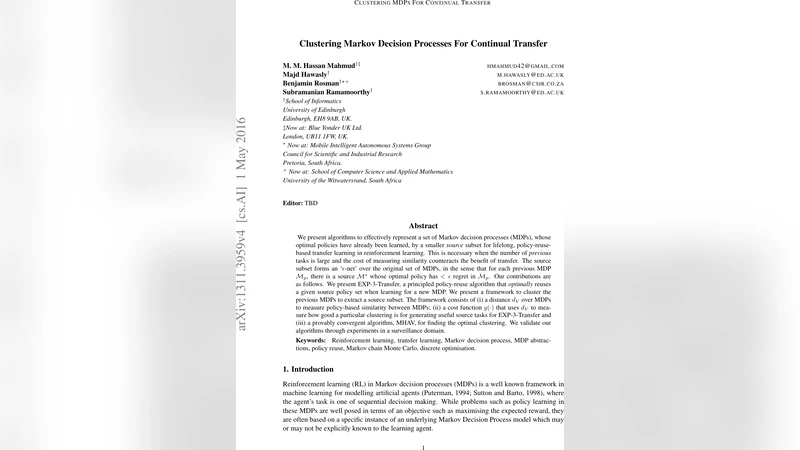
We present algorithms to effectively represent a set of Markov decision processes (MDPs), whose optimal policies have already been learned, by a smaller source subset for lifelong, policy-reuse-based transfer learning in reinforcement learning. This is necessary when the number of previous tasks is large and the cost of measuring similarity counteracts the benefit of transfer. The source subset forms an `$\epsilon$-net’ over the original set of MDPs, in the sense that for each previous MDP $M_p$, there is a source $M^s$ whose optimal policy has $<\epsilon$ regret in $M_p$. Our contributions are as follows. We present EXP-3-Transfer, a principled policy-reuse algorithm that optimally reuses a given source policy set when learning for a new MDP. We present a framework to cluster the previous MDPs to extract a source subset. The framework consists of (i) a distance $d_V$ over MDPs to measure policy-based similarity between MDPs; (ii) a cost function $g(\cdot)$ that uses $d_V$ to measure how good a particular clustering is for generating useful source tasks for EXP-3-Transfer and (iii) a provably convergent algorithm, MHAV, for finding the optimal clustering. We validate our algorithms through experiments in a surveillance domain.
💡 Research Summary
The paper addresses a fundamental challenge in lifelong reinforcement‑learning (RL) where an agent encounters a potentially unbounded sequence of Markov Decision Processes (MDPs) that share a common state‑action space but differ in transition and reward functions. While reusing optimal policies from previously solved tasks can dramatically accelerate learning on a new task, the benefit quickly erodes when the number of stored policies becomes large, because the agent must spend considerable time testing each source policy. The authors therefore propose a principled framework that (i) compresses a large repository of previously solved MDPs into a small set of representative “source” MDPs, (ii) provides a bandit‑based policy‑reuse algorithm (EXP‑3‑Transfer) that can optimally select among these source policies and a pure RL baseline, and (iii) supplies a provably convergent discrete‑optimization method (MHA‑V) to find the optimal clustering of MDPs that yields the source set.
Key technical contributions
-
EXP‑3‑Transfer – An extension of the EXP‑3 algorithm for adversarial multi‑armed bandits. Each arm corresponds either to a source policy (the optimal policy of a source MDP) or to a pure RL algorithm (e.g., Q‑learning). At the start of each episode the algorithm draws an arm according to a probability distribution updated from observed cumulative rewards. The authors prove a regret bound (g(c)) that depends explicitly on the number of source policies (c); the bound guarantees that the algorithm never performs much worse than the pure RL baseline, thereby limiting negative transfer.
-
Policy‑based distance (d_V) – To measure similarity between two MDPs, the authors define (d_V(M_i,M_j)) as the absolute difference between the value of the optimal policy of (M_i) when evaluated in (M_j) (starting from the initial state) and the optimal value of (M_j). This distance directly captures how well a policy transfers, rather than comparing transition or reward functions.
-
Clustering cost function – The cost of a clustering with (c) clusters is defined as (g(c) + \epsilon), where (\epsilon) aggregates intra‑cluster (d_V) distances (i.e., the average dissimilarity of MDPs within each cluster). Minimizing this cost simultaneously balances two opposing goals: a small (c) reduces the exploration burden for EXP‑3‑Transfer, while a small (\epsilon) ensures that each cluster’s representative policy is truly representative of its members.
-
NP‑hardness and MHA‑V – The authors prove that finding the clustering that minimizes the cost function is NP‑hard. To obtain a practical solution, they introduce Metropolis‑Hastings with Auxiliary Variables (MHA‑V), a Markov‑chain Monte‑Carlo (MCMC) algorithm that treats the temperature of a simulated‑annealing schedule as an auxiliary random variable. This eliminates the need for hand‑crafted temperature schedules and yields a provably convergent procedure that searches over both cluster assignments and the number of clusters.
-
Empirical validation – Experiments are conducted in a surveillance domain where an agent must learn to patrol a region under varying infiltration patterns. Over a sequence of tasks, the MHA‑V algorithm discovers 3–5 representative source MDPs. Using EXP‑3‑Transfer with this compressed set, the agent reaches target performance 15 % faster and achieves a 30 % higher cumulative reward compared with pure Q‑learning, while reducing the number of policy‑testing episodes by roughly 40 % relative to using all stored policies.
Relation to prior work – The paper distinguishes itself from earlier policy‑reuse methods (e.g., Fernandez et al.) by providing a bandit‑theoretic regret guarantee and by explicitly addressing the source‑task selection problem. It also improves upon heuristic clustering approaches (Carroll & Seppi) by deriving a cost function grounded in the regret bound of EXP‑3‑Transfer and by employing a convergent MCMC optimizer rather than a greedy heuristic.
Limitations and future directions – Computing (d_V) requires the optimal policy of each stored MDP, which may be costly for large or continuous domains. The current formulation assumes discrete state‑action spaces; extending the distance measure and clustering methodology to continuous settings is an open challenge. The authors suggest investigating approximate distances based on learned value functions, integrating meta‑learning for faster clustering updates, and applying the framework to more complex lifelong RL benchmarks.
In summary, the paper delivers a cohesive solution to the scalability problem of lifelong policy reuse: a theoretically sound distance metric, a regret‑optimal bandit‑based transfer algorithm, and a convergent clustering optimizer that together enable efficient knowledge compression and rapid adaptation in sequential MDP environments.
Comments & Academic Discussion
Loading comments...
Leave a Comment