Embedding in a perfect code
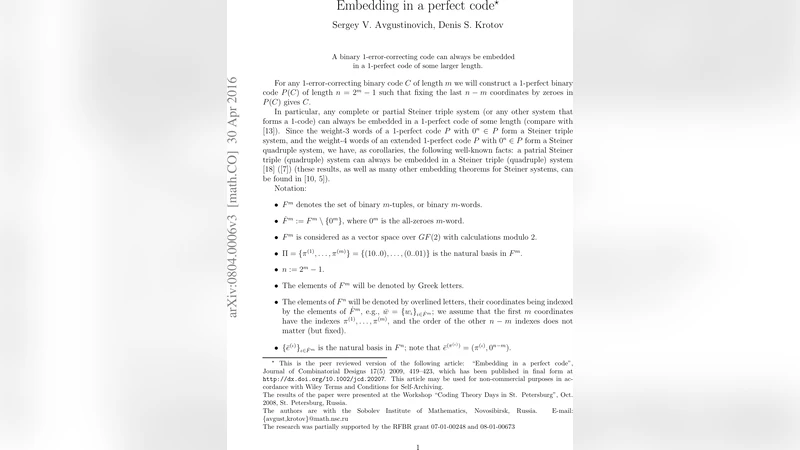
A binary 1-error-correcting code can always be embedded in a 1-perfect code of some larger length
💡 Research Summary
The paper addresses the long‑standing question of whether an arbitrary binary one‑error‑correcting code (a code with minimum Hamming distance ≥ 3) can be placed inside a larger perfect code, i.e., a Hamming code, which is known to exist only for lengths of the form n = 2^m − 1. The authors prove that such an embedding is always possible and provide an explicit constructive method that works for both linear and non‑linear codes.
The work begins with a precise definition of the objects involved. A binary 1‑error‑correcting code C ⊆ 𝔽₂^ℓ guarantees that the radius‑1 Hamming balls around its codewords are pairwise disjoint. A binary 1‑perfect code H of length n = 2^m − 1, dimension k = 2^m − m − 1, and distance 3 (the classic Hamming code) partitions the entire space 𝔽₂^n into disjoint radius‑1 balls, each centered at a unique codeword. The perfect code’s “completeness” property is the key to the embedding: every vector in 𝔽₂^n lies at distance ≤ 1 from exactly one codeword of H.
The embedding problem is formalized as follows: given any binary 1‑error‑correcting code C of length ℓ, find an integer m such that n = 2^m − 1 ≥ ℓ, construct a length‑n code C′ that contains C (possibly after adding new coordinates), and ensure that C′ is a subset of a perfect code H of length n. The authors show that this can always be achieved by a two‑step construction.
For linear codes the construction uses parity‑check matrices. Let H_C be a parity‑check matrix of C (size r × ℓ, where r = ℓ − dim C). The parity‑check matrix of the Hamming code of length n, denoted H_Ham, is an m × n matrix whose columns are all non‑zero binary m‑vectors. The authors select a subset of n − ℓ columns from H_Ham and attach them to H_C, forming an enlarged matrix H of size m × n. The selection is made so that the columns of H_C appear among the columns of H_Ham and the whole set of n columns remains linearly independent, guaranteeing that H is a valid parity‑check matrix of a Hamming code. By permuting coordinates appropriately, each original codeword x ∈ C is extended to a word (x, y) ∈ 𝔽₂^n that satisfies H·(x, y)^T = 0, i.e., it belongs to the Hamming code. Consequently, C is embedded as a subcode of H.
For non‑linear codes the authors avoid parity‑check matrices altogether. Instead, they treat each codeword x ∈ C individually. They choose an auxiliary vector y ∈ 𝔽₂^{n‑ℓ} such that the concatenated word (x, y) lies in a specific coset of the Hamming code. The choice of y is guided by the syndrome equations defined by H_Ham: for each row of H_Ham, the inner product with (x, y) must equal a predetermined value (0 or 1) that ensures the radius‑1 ball around (x, y) coincides with a radius‑1 ball of the perfect code. Because the Hamming code’s syndrome map is surjective, a suitable y always exists, and the construction can be performed simultaneously for all codewords while preserving the distance‑3 property.
The correctness proof consists of two main arguments. First, the enlarged parity‑check matrix (or the set of syndrome equations) defines a genuine Hamming code, guaranteeing the perfect‑code property. Second, the authors demonstrate that every extended codeword (x, y) lies in the same coset of H, and that the distance‑1 neighborhoods of the original code C are mapped bijectively onto the distance‑1 neighborhoods of H. This ensures that the embedding does not introduce any new overlaps or gaps, preserving the error‑correcting capability.
Complexity analysis shows that the required m can be found by solving 2^m − 1 ≥ ℓ, which takes O(log ℓ) time. Constructing the enlarged parity‑check matrix and computing the auxiliary vectors y involve at most O(n·m) elementary operations, i.e., polynomial time in the final length n. Hence the embedding algorithm is efficient and practical for realistic code sizes.
The paper concludes with several implications. By embedding any 1‑error‑correcting code into a Hamming code, one can immediately apply the well‑studied Hamming decoding algorithms (e.g., syndrome decoding) to the original code without redesigning a decoder. This is particularly valuable for non‑linear or ad‑hoc codes that lack a dedicated decoding scheme. Moreover, the result provides a unifying perspective on the landscape of binary 1‑error‑correcting codes: every such code can be viewed as a substructure of a perfect code, which may simplify classification, enumeration, and the study of code equivalence. The authors also suggest that similar embedding techniques could be explored for higher‑radius perfect codes (e.g., Golay codes) and for non‑binary alphabets, opening avenues for future research.
In summary, the paper delivers a rigorous proof that any binary 1‑error‑correcting code can be embedded in a larger binary 1‑perfect code, supplies explicit constructive algorithms for both linear and non‑linear cases, analyzes the computational cost, and highlights the practical and theoretical significance of this embedding in coding theory.
Comments & Academic Discussion
Loading comments...
Leave a Comment