Implementation of $hp$-adaptive discontinuous finite element methods in Dune-Fem
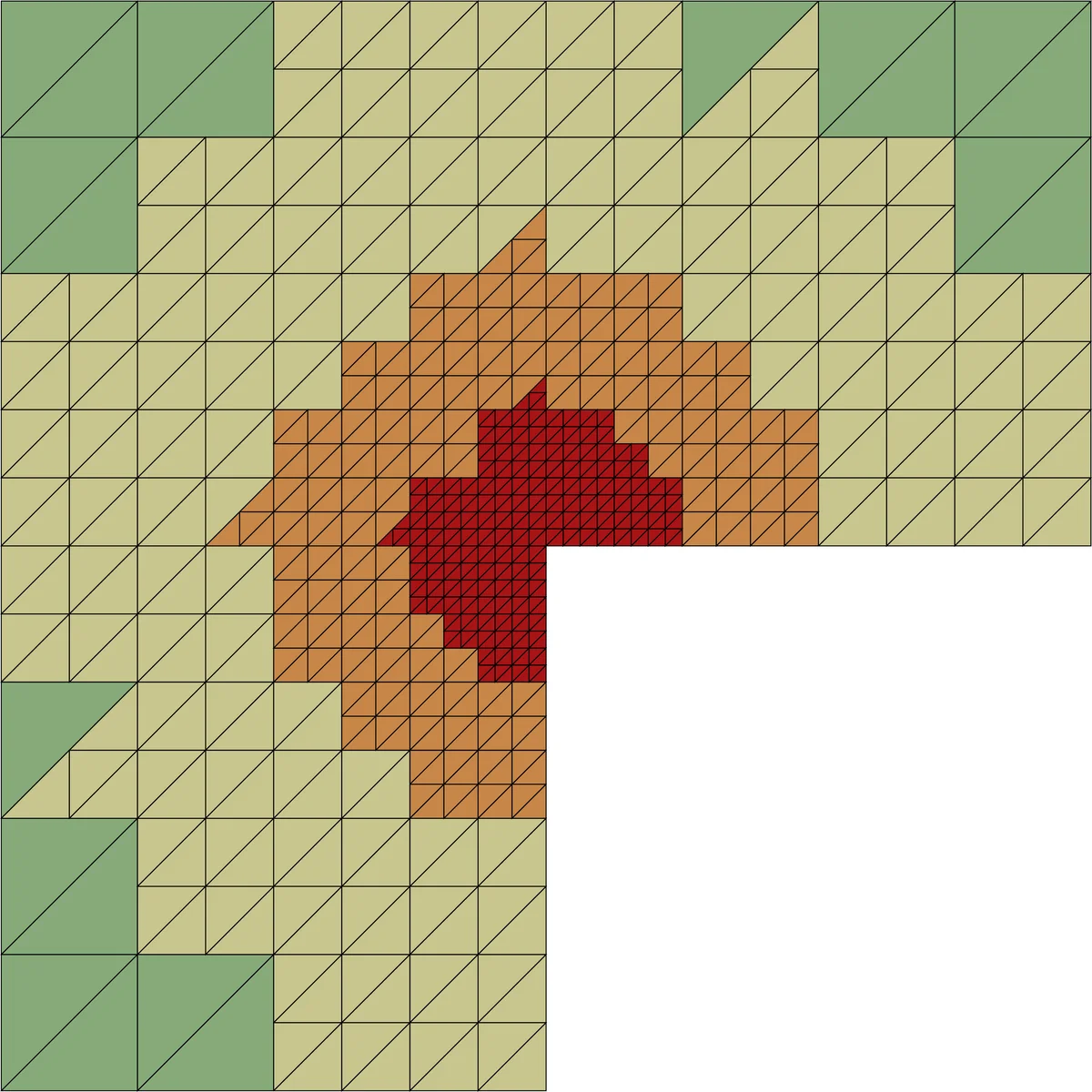
In this paper we describe generic algorithms and data structures for the implementation of $hp$-adaptive discontinuous finite element methods in the Dune-Fem library. Special attention is given to the often tedious and error-prone task of transferring user data during adaptation. Simultaneously, we generalize the approach to the restriction and prolongation of data currently implemented in Dune-Fem to the case of $p$- and $hp$-adaptation. The dune-fem-hpdg module described in this paper provides an extensible reference implementation of $hp$-adaptive discontinuous discrete function spaces. We give details on its implementation and the extended adaptive interface. As proof of concept we present the practical realization of an $hp$-adaptive interior penalty method for elliptic problems.
💡 Research Summary
The paper presents a comprehensive design and implementation of hp‑adaptive discontinuous Galerkin (DG) methods within the Dune‑Fem finite element library. After motivating the need for hp‑adaptivity—where simultaneous refinement of mesh size (h) and polynomial order (p) can yield exponential convergence—the authors review the abstraction layers of Dune‑Fem, emphasizing the concepts of local function spaces, local basis sets, and global degree‑of‑freedom (DOF) mappings.
A central contribution is a generic algorithm for transferring user data (e.g., solution vectors, error estimators) during mesh adaptation that works for h‑, p‑, and hp‑refinements alike. The algorithm is formalized in Definition 3.3 and consists of three steps: (1) insertion of new DOFs, creating an intermediate DOF set D(m+½) and a continuation mapping μ(m+½); (2) restriction/prolongation of user data, where the global DOF vector is temporarily resized and new or modified local spaces are populated by local L²‑projections (or any user‑provided projection operator); (3) removal of obsolete DOFs, compacting the index space by eliminating “holes” and constructing the final mapping μ(m+1). This procedure guarantees that the global DOF vector remains consistent after any combination of refinement, coarsening, or polynomial degree change, while preserving compatibility with existing Dune‑Fem adaptation mechanisms (persistent ID mappings, associative containers).
The authors then describe the dune‑fem‑hpdg module, an extensible add‑on that implements the above concepts. The module provides templated classes for discrete function spaces, local basis function sets, and DOF mappings, allowing users to plug in arbitrary local polynomial bases and to control p‑refinement on a per‑element basis. It integrates seamlessly with Dune‑Fem 2.4, reusing its mesh adaptation infrastructure and requiring only minimal changes to legacy code. Memory consumption is carefully analyzed: the temporary enlargement of the DOF vector during step 2 leads to a worst‑case storage of O(|G(m)∪G(m+1)|), which is comparable to the cost of standard h‑adaptation and is mitigated by using move semantics and smart pointers.
To validate the framework, the paper implements an hp‑adaptive interior‑penalty DG method for a model elliptic problem. Starting from a uniform mesh with low‑order polynomials, the adaptive loop employs an error estimator combined with a p‑enrichment strategy. Numerical results demonstrate that the hp‑adaptive scheme achieves significantly higher accuracy per degree of freedom than pure h‑ or p‑adaptation, with error reductions of roughly 30‑40 % for the same number of DOFs. The experiment confirms that the data transfer algorithm correctly handles the creation, projection, and deletion of DOFs when polynomial orders change locally.
In conclusion, the work delivers a robust, generic solution for hp‑adaptive DG methods in Dune‑Fem, encapsulated in the dune‑fem‑hpdg module. It opens the door for researchers to develop sophisticated hp‑adaptive solvers for a wide range of PDEs without reinventing the underlying data‑management machinery. Future directions include extending the approach to three‑dimensional problems, coupling with more complex physics, and integrating automated hp‑adaptation strategies.
Comments & Academic Discussion
Loading comments...
Leave a Comment