Testing the Quantal Response Hypothesis
This paper develops a non-parametric test for consistency of players' behavior in a series of games with the Quantal Response Equilibrium (QRE). The test exploits a characterization of the equilibrium choice probabilities in any structural QRE as the…
Authors: Kirill Pogorelskiy, Emerson Melo, Matthew Shum
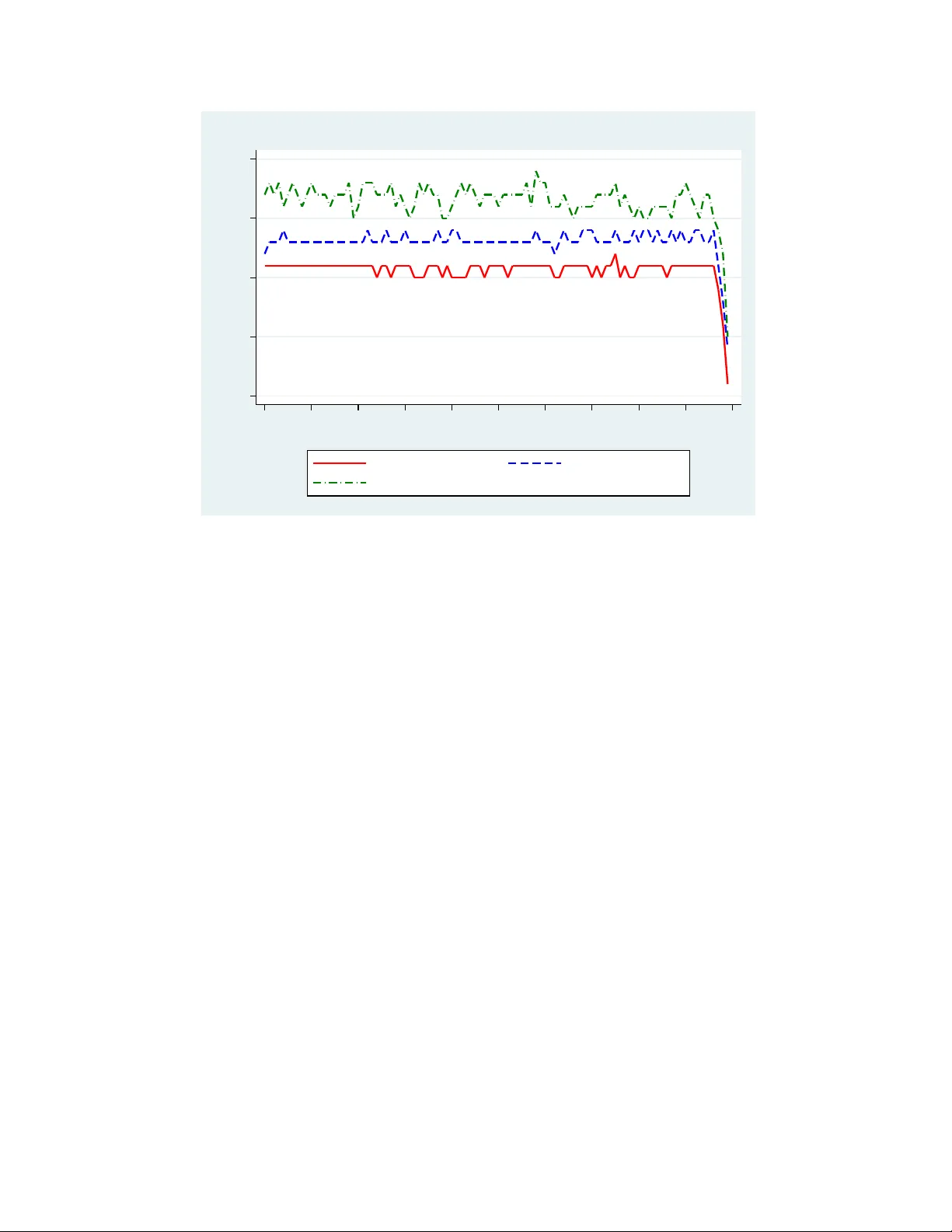
T esting the Quan tal Resp onse Hyp othesis ∗ Emerson Melo † Kirill P ogorelskiy ‡ Matthew Sh um § Octob er 28, 2021 Abstract This pap er develops a non-parametric test for consistency of pla yers’ b eha vior in a series of games with the Quantal Resp onse Equilibrium (QRE). The test exploits a c haracterization of the equilibrium c hoice probabilities in any structural QRE as the gradien t of a con vex function, whic h th us satisfies the cyclic monotonicity inequalities. Our testing pro cedure utilizes recen t econometric results for momen t inequalit y mo dels. W e assess our test using lab experimental data from a series of generalized matching p ennies games. W e reject the QRE hypothesis in the p ooled data, but it cannot be rejected in the individual data for ov er half of the sub jects. JEL codes: C12, C14, C57, C72, C92 Keyw ords: quan tal resp onse equilibrium, b eha vioral game theory , cyclic mono- tonicit y , momen t inequalities, experimental economics 1 In tro duction A v ast literature in exp erimental economics has demonstrated that, across a wide v ariet y of games, b eha vior deviates systematically from Nash equilibrium-predicted behavior. In order to relax Nash equilibrium in a natural fashion, while preserving the idea of equilibrium, McKelv ey & P alfrey ( 1995 ) introduced the notion of Quantal R esp onse Equilibrium (QRE) . QRE has b ecine a p opular to ol in exp erimen tal economics b ecause typically it provides an impro ved fit to the exp erimen tal data; moreo ver, it is also a key model in b eha vioral game theory and serves as a benchmark for tractable alternativ e theories of b ounded rationality . 1 While most existing work estimating structural QRE (e.g., Merlo & P alfrey ( 2013 ), Camerer, Nunnari, & P alfrey ( 2015 ) to name a few) utilize the p ar ametric , logit version of QRE and its v arian ts, the nonp ar ametric tests of QRE ha ve not b een av ailable. ∗ Ac knowledgmen ts: W e thank Marina Agranov, Larry Blume, F ederico Ec henique, Ben Gillen, Russell Golman, Phil Haile, J¨ org Sto ye, Leeat Y ariv and especially T om Palfrey for supp ort and insightful comments. W e also thank the participan ts of the Y ale conference on Heterogenous Agents and Micro econometrics. W e are grateful to Michael McBride and Alyssa Acre at UC Irvine ESSL lab oratory for help with running exp erimen ts. † Departmen t of Economics, Indiana Universit y Blo omington. Email: emelo@iu.edu ‡ Departmen t of Economics, Univ ersity of W arwick. Email: k.pogorelskiy@warwick.ac.uk § Division of the Humanities and So cial Sciences, California Institute of T ec hnology . Email: mshum@caltech.edu 1 See Camerer ( 2003 ) and Cra wford, Costa-Gomes, & Irib erri ( 2013 ). The latest b o ok-length treatment of the theory b ehind QRE and its numerous applications in economics and p olitical science is forthcoming in Go eree, Holt, & Palfrey ( 2016 ). 1 2 This pap er is the first to develop and implement a formal nonparametric pro cedure to test, using exp erimen tal data, whether sub jects are indeed b eha ving according to QRE. Our approac h is related to the econometrics literature on semiparametric discrete choice mo dels and moment inequalities. Our test is based on the notion of cyclic monotonicity , a concept from con vex analysis whic h is useful as a characterizing feature of conv ex p oten tials. Cyclic monotonicit y imp oses joint inequalit y restrictions b et w een the underlying choice frequencies and pa y offs from the underlying games; hence, w e are able to apply to ols and metho dologies from the recent econometric literature on moment inequality models to derive the formal statistical prop erties of our test. Imp ortan tly , our test for QRE is nonp ar ametric in that one need not sp ecify a particular probability distribution for the random sho c ks; thus, the results are robust to a wide v ariet y of distributions. Subsequen tly , we apply our test to data from a lab exp eriment on generalized matching pennies games. W e find that QRE is rejected soundly when data is p o oled across all sub jects and all pla ys of eac h game. But when we consider sub jects individually , w e find that the QRE hypothesis cannot b e rejected for up w ards of half the sub jects. This suggests that there is substantial heterogeneit y in b eha vior across sub jects. Moreov er, the congruence of sub jects’ play with QRE v aries substantially dep ending on whether sub jects are pla ying in the role of the Row vs. Column pla y er. Our w ork here builds up on and extends Haile, Hortacsu, & Kosenok ( 2008 ) (hereafter HHK) who show ed that, that without imp osing strong assumptions on the sho c k distributions, QRE can rationalize an y outcome in a given game. HHK describe sev eral approac hes for testing for QRE, but did not provide guidance for formal econometric implemen tation of such tests. W e build up on one of these approac hes, based on the relation b et w een changes in QRE probabilities across the series of games that only differ in the pay offs and the changes in the respective exp ected pa y offs, and dev elop an econometric test for consistency of the data with a QRE in this more general case. Our use of the notion of cyclic monotonicity to test the QRE h yp othesis app ears new to the literature. Elsewhere, cyclic monotonicity has b een studied in the context of multidimensional mec hanism design. In particular, the papers by Ro c het ( 1987 ), Saks & Y u ( 2005 ), La vi & Swam y ( 2009 ), Ashlagi et al. ( 2010 ), and Arc her & Klein b erg ( 2014 ) (summarized in V ohra ( 2011 , Chap- ter 4)), relate the incentiv e compatibilit y (truthful implementation) of a mec hanism to its cyclic monotonicit y prop erties. Similarly , the pap ers b y F osgerau & de P alma ( 2015 ) and McF adden & F osgerau ( 2012 ) in tro duce cyclic monotonicit y to study revealed preference in discrete choice mo dels. Finally , in this pap er w e apply the cyclic monotonicity to test for QRE using exp erimen tal data in which play ers’ pay offs are known (b ecause they are set by the experimenter). The cyclic monotonicit y prop ert y may also b e useful in settings where the researcher do es not completely observ e agents’ utilities. In other w ork inv olving one of the authors ( Shi, Sh um, & Song , 2015 ) w e ha ve also used cyclic monotonicity for iden tification and estimation of semiparametric multinomial c hoice mo dels, in whic h the pa yoff sho c ks are left unsp ecified (as here), but the utilit y functions are parametric and assumed to be kno wn up to a finite-dimensional parameter. The rest of the paper is organized as follows. Section 2 presents the QRE approac h. Section 3 3 introduces the test for the QRE hypothesis, and Section 4 discusses the moment inequalities for testing. Section 5 discusses the statistical prop erties of the test. Section 6 describes our exp erimen t, with subsections 6.1 and 6.2 presenting the exp erimen tal design and results resp ectiv ely . Section 7 concludes. App endix A provides additional details ab out the in terpretation of the cyclic monotonicit y inequalities. App endices B and C con tain omitted pro ofs and additional theoretic results. App endix D con tains omitted computational details of the test. App endix E contains exp erimen tal instructions. 2 QRE background In this section w e briefly review the main ideas behind the QRE approach. W e use the notation from McKelvey & Palfrey ( 1995 ). Consider a finite n -p erson game G ( N , { S i } i ∈ N , { u i } i ∈ N ). The set of pure strategies (actions) a v ailable to play er i is indexed by j = 1 , . . . , J i , so that S i = { s 1 , . . . , s J i } , with a generic element denoted s ij . Let s denote an n -v ector strategy profile; let s i and s − i denote pla yer i ’s (scalar) action and the vector of actions for all pla y ers other than i . In terms of notation, all v ectors are denoted b y bold letters. Let p ij b e the probabilit y that pla yer i c ho oses action j , and p i denote the vector of pla y er i ’s c hoice probabilities. Let p = ( p 1 , . . . , p n ) denote the v ector of probabilities across all the play ers. Play er i ’s utilit y function is giv en b y u i ( s i , s − i ). At the time she chooses her action, she do es not know what actions the other pla yers will play . Define the exp ected utility that pla yer i gets from pla ying a pure strategy s ij when every one else’s join t strategy is p − i as u ij ( p ) ≡ u ij ( p − i ) = X s − i p ( s − i ) u i ( s ij , s − i ) , where s − i = ( s kj k ) k ∈ N − i , and p ( s − i ) = Q k ∈ N − i p kj k . In the QRE framework uncertaint y is generated by play ers’ making “ mistakes ”. This is mo delled b y assuming that, given her b eliefs about the opp onen ts’ actions p − i , when c ho osing her action, pla yer i do es not choose the action j that maximizes her expected utility u ij ( p ), but rather chooses the action that maximizes u ij ( p ) + ε ij , where ε ij represen ts a preference sho c k at action j . F or eac h pla yer i ∈ N let ε i = ( ε i 1 , . . . , ε iJ i ) b e drawn according to an absolutely contin uous distribution F i with mean zero. 2 Then an exp ected utilit y maximizer, play er i , giv en beliefs p , chooses action j iff u ij ( p ) + ε ij ≥ u ij 0 ( p ) + ε ij 0 , ∀ j 0 6 = j. Since preference sho c ks are random, the probabilit y of choosing action j given b eliefs p , denoted 2 Notice that as a result each action can b e c hosen with a p ositiv e probability , ruling out consistency with a pure- strategy Nash equilibrium (which can be restored in the limit as the sho c ks go to zero.) This is never a concern for our test since the choice probabilities are estimated from the data and necessarily contain some noise ruling out pure strategies. F urthermore all games in our application hav e a unique totally-mixed Nash equilibrium. 4 π ij ( p ), can be formally expressed as π ij ( p ) ≡ P j = arg max j 0 ∈{ 1 ,...,J i } u ij 0 ( p ) + ε ij 0 = Z { ε i ∈ R J i | u ij ( p )+ ε ij ≥ u ij 0 ( p )+ ε ij 0 ∀ j 0 ∈{ 1 ,...,J i } } dF i ( ε i ) (1) Then a Quantal R esp onse Equilibrium is defined as a set of choice probabilities n π ∗ ij o suc h that for all ( i, j ) ∈ N × { 1 , . . . , J i } , π ∗ ij = π ij ( π ∗ ) Throughout, we assume that all pla yers’ preference shock distributions are invariant ; that is, the distribution do es not depend on the pay offs: Assumption 1. (Invariant sho ck distribution) F or al l r e alizations ε i := ( ε i 1 , . . . , ε iJ i ) and al l p ayoff functions u i ( · ) , we have F i ( ε i | u i ( · )) = F i ( ε i ) . Suc h an in v ariance assumption was also considered in HHK’s study of the quantal resp onse mo del, and also assumed in most empirical implementations of QRE. 3 In the sp ecific environmen t of our test here, the in v ariance assumption allows us to compare c hoice probabilities across differen t tests using the prop ert y of cyclic monotonicity , whic h w e explain in the next section. 3 A test based on con v ex analysis In this section we prop ose a test for the QRE hypothesis. W e start b y defining the following function: ϕ i ( u i ( π )) ≡ E max j ∈ S i { u ij ( π ) + ε ij } (2) In the discrete choice mo del literature, the expression ϕ ( u ) is known as the so cial surplus function. 4 Imp ortan tly , this function is smo oth and con vex. Now the QRE probabilities π ij ( π ∗ ) can b e expressed as π ∗ i = ∇ ϕ i ( u i ( π ∗ )) (3) This follows from the w ell-known Williams-Daly-Zac hary theorem from discrete-c hoice theory (which can be considered a version of Ro y’s Iden tity for discrete c hoice m odels; see Rust ( 1994 , p.3104)). Th us if Eq. ( 3 ) holds for all play ers i , then n π ∗ ij o is a quan tal resp onse equilibrium. Eq. ( 3 ) c haracterizes the QRE choice probabilities as the gradient of the con vex function ϕ . It is well- kno wn ( Rock afellar , 1970 , Theorem 24.8) that the gradien t of a con v ex function satisfies a cyclic monotonicity prop ert y . This prop ert y is the generalization, for functions of several v ariables, of the fact that the deriv ativ e of a univ ariate con vex function is monotone nondecreasing. 3 Most applications of QRE assume that the utility shocks follo w a logistic distribution, regardless of the magnitude of pa yoffs. One exception is McKelvey , Palfrey , & W eb er ( 2000 ), who allow the logit-QRE parameter to v ary across differen t games. This direction is further developed in Rogers, Palfrey , & Camerer ( 2009 ). 4 F or details see McF adden ( 1981 ). 5 T o define cyclic monotonicit y in our setting, consider a cycle 5 of games C ≡ { G 0 , G 1 , G 2 , . . . , G 0 } where G m denotes the game at index m in a cycle. These games are c haracterized b y the same set of c hoices for eac h pla y er, and the same distribution of pay off shocks (i.e., satisfying Assumption 1 ), but distinguished by pa yoff differences. Let [ π ∗ i ] m denote the QRE c hoice probabilities for pla y er i in game G m , and u m i ≡ u m i ([ π ∗ ] m ) the corresponding equilibrium exp ected pay offs. Then the cyclic monotonicity prop ert y says that G L− 1 X m = G 0 [ u i ] m +1 − [ u i ] m , [ π ∗ i ] m ≤ 0 (4) for all finite cycles of games of length L ≥ 2, and all play ers i . 6 Expanding the inner pro duct notation, the Cyclic Monotonicit y (CM) conditions may b e written as follo ws: G L− 1 X m = G 0 J i X j =1 u m +1 ij − u m ij [ π ∗ ij ] m ≤ 0 (5) This prop ert y only holds under the inv ariance assumption. Without it, the pa yoff sho c k distri- butions, and hence the social surplus functions, will b e differen t across eac h game, implying that their corresp onding c hoice probabilities are gradients of differen t so cial surplus functions. Because of this, the cyclic monotonicity prop ert y need not hold. The num ber of all finite game cycles times the num b er of pla yers can be, admittedly , very large. T o reduce it, we note that the cyclic monotonicity conditions ( 5 ) are in v arian t under the change of the starting game index in the cycles; for instance, the inequalities emerging from the cycles { G i , . . . , G j , G k , G i } and { G j , . . . , G k , G i , G j } are the same. In tuitively CM conditions can b e deriv ed from, and also imply , pla yers’ utility maximization in appropriately p erturb ed games. In particular, in App endix A w e prov e the follo wing result Prop osition 1. Consider a cycle of length L ≥ 2 . The cyclic monotonicity c onditions hold if and only if e ach player’s choic e pr ob abilities in e ach game along the cycle maximize the differ enc e in her exp e cte d utility b etwe en every two adjac ent games in the cycle. Prop osition 1 establishes the equiv alence b et ween the cyclic monotonicity condition and utilit y maximization among a family of p erturbed games that only v ary in the pa y offs. The equiv alence in prop osition critically depends on the fact that equilibrium probabilities are giv en by expression ( 3 ). F ormally , expression ( 3 ) allo ws us to use c onjugate duality arguments to show that CM is equiv alent to pla yers’ utility maximization. Thus Prop osition 1 helps us interpret our test directly in terms of the main QRE prop ert y of p ositiv e resp onsiv eness, where each action’s probabilit y is increasing in the action’s exp ected pay off. 5 A cycle of length L is just a sequence of L games G 0 , . . . , G L− 2 , G L− 1 with G L− 1 = G 0 . 6 Under conv exity of ϕ i ( · ), w e hav e ϕ i ( u m +1 i ) ≥ ϕ i ( u m i ) + ∇ ϕ i ( u m i ) , ( u m +1 i − u m i ) . Substituting in ∇ ϕ i ( u m i ) = π m i and summing across a cycle, we obtain the CM inequality in Eq. ( 4 ). 6 Remark: Cyclic monotonicit y and incentiv e compatibility . Prop osition 1 also implies that the CM inequalities can b e interpreted as “incentiv e compatibility” conditions on play ers’ c hoices across games. Namely , if the CM inequalities are violated for pla yer i and some cycle of games C , then i is not optimally adjusting her choice probabilities in resp onse to changes in the exp ected pay offs across the games in the cycle C . T o see this, consider firstly a family of games with only t wo actions, which v ary in the exp ected pa yoff difference E ( u 2 − u 1 ) b et w een actions 2 and 1. Ob viously , utilit y maximization should imply that the c hoice probabilities of pla ying action 2 across these games should b e nondecreasing in the exp ected pay off differences; alternatively , monotonicit y in exp ected pa yoff differences is an “incentiv e compatibility” condition on c hoice probabilities across these games. In games with more than t wo actions, the exp ected pay off differences (relative to a b enc hmark action) form a vector, as do the choice probabilities for each action. Prop osition 1 and the discussion ab o v e sho w that utility maximization across a family of games v arying in expected pay off differences imply that the v ector of corresp onding choice probabilities in eac h game can b e represented as a gradien t of the so cial surplus function; that is, cyclic monotonicit y is an incen tive compatibilit y condition on c hoice probabilities in a family of games with more than t w o actions. Sp ecial case: Tw o actions. As the previous remark p oin ted out, in a family of games with only t wo actions, cyclic monotonicit y reduces to the usual monotonicit y . That is, in these games, the cyclic monotonicit y conditions ( 5 ) only need to b e c heck ed for cycles of length 2. 7 Because many exp erimen ts study games where play ers’ strategy sets consist of t w o elemen ts, this observ ation turns out to be useful from an applied p ersp ectiv e. 4 Momen t inequalities for testing cyclic monotonicity Consistency with QRE can b e tested nonparametrically from exp erimen tal data in which the same sub ject i is pla ying a series of one-shot games with the same strategy spaces suc h that each game is pla yed multiple times. In this case, the exp erimen tal data allo ws to estimate a vector of probabilities [ π ∗ i ] m ∈ ∆( S i ) for eac h game m in the sample, and we can compute the corresp onding equilibrium exp ected utilities [ u i ] m (assuming risk-neutrality). Supp ose there are M ≥ 2 differen t games in the sample. W e assume that we are able to obtain estimates of ˆ π m i , the empirical c hoice frequencies, from the experimental data, for each sub ject i and for eac h game m . Thus w e compute ˆ π m ij from K trials for sub ject i in game m : ˆ π m ij = 1 K K X k =1 1 { i chooses j in trial k of game m } This will be the source of the sampling error in our econometric setup. Also, let ˆ u m i ≡ u m i ( ˆ π m ) b e the estimated equilibrium exp ected utilities obtained by plugging in the observ ed choice probabili- 7 F ormally , this fact follows from the observ ation that for games with tw o actions, w e can rewrite the functions ϕ i ( u i ( π )) as ϕ i ( u i 1 ( π )) = ϕ i ( u i 1 ( π ) − u i 2 ( π ) , 0) + u i 2 ( π ). Since without loss of generality we can normalize u i 2 ( π ) to be constant, we obtain that ϕ i ( u i ( π )) is a univ ariate function. Using Ro c het ( 1987 , Prop osition 2) we conclude that if ϕ i satisfies ( 5 ) for all cycles of length 2, then ( 5 ) is also satisfied for cycles of arbitrary length L > 2. 7 ties ˆ π m in to the pay offs in game m . Then the sample moment inequalities tak e the following form: for all cycles of length L ∈ { 2 , . . . , M } G L− 1 X m = G 0 J i X j =1 ˆ u m +1 ij − ˆ u m ij ˆ π m ij ≤ 0 (6) Altogether, in an n -p erson game w e hav e n P M L =2 # C ( L ) momen t inequalities, where # C ( L ) is the num ber of different (up to a change in the starting game index) cycles of length L . These inequalities make up a necessary condition for a finite sample of games to b e QRE-consisten t. 4.1 “Cum ulativ e rank” test as a sp ecial case of Cyclic Monotonicit y HHK prop ose alternativ e metho ds of testing the QRE mo del based on cumulativ e rankings of c hoice probabilities across p erturb ed games, 8 whic h also imply sto c hastic equalities or inequalities in volving estimated choice probabilities from differen t games. W e will show here that, in fact, our CM conditions are directly related to HHK’s rank-cumulativ e probability conditions in the sp ecial case when there are only t w o games (i.e. all cycles are of length 2), and under a certain non-negativit y condition on utility differences b et ween the games. F ormally , HHK consider t wo p erturbed games with the same strategy spaces and re-order strategy indices for eac h pla y er i suc h that ˜ u 1 i 1 − ˜ u 0 i 1 ≥ ˜ u 1 i 2 − ˜ u 0 i 2 ≥ . . . ≥ ˜ u 1 iJ i − ˜ u 0 iJ i where ˜ u m ij ≡ u i ( s ij , π m − i ) − 1 J i P J i j =1 u i ( s ij , π m − i ) for m = 0 , 1. These inequalities can b e equiv alen tly rewritten as u 1 i 1 − u 0 i 1 ≥ u 1 i 2 − u 0 i 2 ≥ . . . ≥ u 1 iJ i − u 0 iJ i (7) HHK’s Theorem 2 states that giv en the indexing in ( 7 ) and assuming In v ariance (see Assumption 1 ), QRE consistency implies the follo wing cumulative r ank pr op erty: k X j =1 ( π 1 ij − π 0 ij ) ≥ 0 for all k = 1 , . . . , J i . (8) This prop erty is related to our test as the following prop osition demonstrates (the pro of is in App endix B ): 8 HHK also consider testing the QRE h yp othesis using “Blo c k-Marschak” p olynomials. QRE play implies linear inequalities in volving the Block-Marsc hak polynomials which may b e tested formally using similar metho ds as w e describ e in this pap er. Ho wev er, the t wo approac hes are qualitativ ely quite different as the Blo c k-Marsc hak approach in volv es comparing games whic h v ary in the actions a v ailable to pla yers and, as HHK point out, can be feasibly tested in the lab only for sp ecial families of games (suc h as Stack elb erg games or games with some nonstrategic play ers). In contrast, our approach, based on cyclic monotonicity , compares games whic h v ary in play ers’ pay offs. Hence, for these reasons, a full exploration of the Blo c k-Marschak approac h seems b ey ond the scop e of this pap er. 8 Prop osition 2. L et M = 2 . If al l exp e cte d utility differ enc es in ( 7 ) ar e non-ne gative, then HHK’s cumulative r ank c on dition ( 8 ) implies the CM ine qualities ( 5 ) . Conversely, the CM ine qualities ( 5 ) imply the cumulative r ank c ondition ( 8 ) (without additional assumptions on exp e cte d utility differ enc es). Hence for the sp ecial case of just t wo games HHK’s cumulativ e rank prop ert y can b e directly related to the cyclic monotonicit y inequalities. More broadly , Theorem 2 implies that the cumulativ e rank testing approach is similar to testing cyclic monotonicity using only length-2 c ycles (ie. using only pairwise comparisons among games). It is kno wn that, when there are more than 2 games (with more than 2 strategies in each game), the pairwise comparisons do not exhaust the restrictions in the cyclic monotonicity inequalities. (See Saks & Y u ( 2005 ), Ashlagi et al. ( 2010 ), and V ohra ( 2011 , Chapter 4).) 4.2 Limitations and extensions of the test Our test mak es use of exp ected pa yoffs and choice probabilities in a fixed set of M ≥ 2 games. T o estimate expected pa yoffs w e had to assume that pla y ers are risk-neutral. This assumption migh t b e to o strong a priori (e.g., Go eree, Holt, & Palfrey ( 2000 ) argue that risk a version can help explain QRE inconsistencies). Notice, ho wev er, that the test itself do es not depend on risk- neutralit y: it only requires that w e know the form of the utility function. Th us under additional assumptions ab out the utilit y , we can also in vestigate ho w risk a version affects the test results. See Section 6.2 for details. Our test also assumes that for eac h of the games considered, there is only one unique QRE. Note that since we do not sp ecify the distribution of the random utility shocks, this uniqueness assumption is not verifiable. How ev er, as in muc h of the recen t empirical games literature in industrial organization 9 , our testing procedure strictly sp eaking only assumes that ther e is a unique e quilibrium playe d in the data . 10 Sev eral considerations make us feel that this is a reasonable assumption in our application. First, in our exp erimen ts, the sub jects are randomly matched across differen t rounds of eac h game, so that playing multiple equilibria in the course of an exp erimen t w ould require a great deal or coordination. Second, as we discuss b elo w, and in App endix C , all the exp erimen tal games that we apply our test to in this pap er ha ve a unique QRE under an additional regularit y assumption. Not withstanding the ab ov e discussion, in some p oten tial applications our test may wrongly reject (i.e., it is biased) the QRE n ull hypothesis when there are multiple quantal resp onse equilibria pla yed in the data. Giv en the remarks here, our test of QRE should b e generally considered a joint test of the QRE hypothesis along with those of risk neutralit y of the sub jects, inv ariant sho c k distribution (Assumption 1 ), and unique equilibrium in the data. 9 See, e.g., Aguirregabiria & Mira ( 2007 ), Ba jari et al. ( 2007 ). 10 Indeed, practically all of the empirical studies of exp erimental data utilizing the quan tal resp onse framework assume that a unique equilibrium is play ed in the data, so that the observed choices are drawn from a homogeneous sampling environmen t. F or this reason, our test may not b e appropriate for testing for QRE using field data, which w ere not generated under these controlled lab oratory exp erimen tal conditions. See De Paula & T ang ( 2012 ) for a test of multiple equilibria presence in the data. 9 5 Econometric implementation: Generalized momen t selection pro cedure In this section w e consider the formal econometric properties of our test, and the application of the generalized mo del selection pro cedure of Andrews & Soares ( 2010 ). Let ν ∈ R P denote the v ector of the left hand sides of the cyclic monotonicity inequalities ( 5 ), written out for all cycle lengths and all play ers. Here P ≡ n P M L =2 # C ( L ) and # C ( L ) is the n umber of different (up to the starting game index) cycles of length L . Let us order all pla yers and all differen t cycles of length L from 2 to M in a single ordering, and for ` ∈ { 1 , . . . , P } , let L ( ` ) refer to the cycle length at coordinate n umber ` in this ordering, m 0 ( ` ) refer to the first game in the resp ectiv e cycle, and ι ( ` ) refer to the corresp onding pla y er at co ordinate num b er ` . Then w e can write ν ≡ ( ν 1 , . . . , ν ` , . . . , ν P ) where eac h generic comp onen t ν ` is given b y ( 6 ), i.e. ν ` = L ( ` ) − 1 X m = m 0 ( ` ) J ι ( ` ) X j =1 X s − ι ( ` ) π m ι ( ` ) j Y k ∈ N − ι ( ` ) π m +1 k j k u m +1 ι ( ` ) ( s ι ( ` ) j , s − ι ( ` ) ) − Y k ∈ N − ι ( ` ) π m k j k u m ι ( ` ) ( s ι ( ` ) j , s − ι ( ` ) ) (9) Define µ ≡ − ν , then cyclic monotonicity is equiv alent to µ ≥ 0 . Let ˆ µ denote the estimate of µ from our experimental data. In our setting, the sampling error is in the choice probabilities π ’s. Using the Delta metho d, w e can derive that, asymptotically (when the num b er of trials of each game out of a fixed set of M games goes to infinity), ˆ µ a ∼ N ( µ 0 , Σ) and Σ = J V J 0 where V denotes the v ariance-co v ariance matrix for the M n × 1-vector π and J denotes the P × M n Jacobian matrix of the transformation from π to µ . Since P >> M n , the resulting matrix Σ is singular. 11 W e p erform the following h yp othesis test: H 0 : µ 0 ≥ 0 vs. H 1 : µ 0 6≥ 0 , (10) where 0 ∈ R P . Letting ˆ Σ denote an estimate of Σ, we utilize the following test statistic S ( ˆ µ, ˆ Σ) := P X ` =1 h ˆ µ ` / ˆ σ ` i 2 − (11) where [ x ] − denotes x · 1 ( x < 0), and ˆ σ 2 1 , . . . , ˆ σ 2 P denote the diagonal elemen ts of ˆ Σ. The test statistic is sum of squared violations across the moment inequalities, so that larger v alues of the statistic 11 Note also that Σ is the approximation of the finite-sample cov ariance matrix, so that the square-roots of its diagonal elements corresp ond to the standard errors; i.e. the elements are already “divided through” by the sample size, which accoun ts for the differences b et ween the equations below and the corresp onding ones in Andrews & Soares ( 2010 ). 10 indicate evidence against the null hypotheses ( 10 ). Since there are a large num b er of moment inequalities in Eq. ( 10 ) (in the application, P = 40), w e utilize the Generalized Moment Selection (GMS) pro cedure of Andrews & Soares ( 2010 ) (hereafter “AS”). This pro cedure combines mo- men t selection along with hypothesis testing, and is esp ecially useful when there are many moment conditions. Typically , hypothesis tests in v olving man y moment inequalities can hav e lo w p o wer, since “redundan t” momen t conditions whic h are far from binding tend to shift the asymptotic n ull distribution of the test statistic higher (in a sto c hastic sense), thus making it harder to reject. The AS pro cedure, whic h combines momen t selection (that is, eliminating redundan t moment condi- tions which are far from binding), with h yp othesis testing, increases p o w er and yields uniformly asymptotically critical v alues. F rom the ab o v e description, w e see that the AS procedure is to ev aluate the asymptotic distri- bution of the test statistic under a sequence of parameters under the null h yp othesis whic h resemble the sample moment inequalities, and are drifting to zero. By doing this, momen t inequalities which are far from binding in the sample (i.e. the elemen ts of ˆ µ which are >> 0) will not con tribute to the asymptotic null distribution of the test statistic, leading to a (stochastically) smaller distribution and hence smaller critical v alues. 12 Using the AS pro cedure requires the sp ecifying an appropriate test statistic for the moment inequalities, and also sp ecifying a drifting sequence of n ull h yp otheses conv erging to zero. In doing b oth w e follow the suggestions in AS. The test statistic in Eq. ( 11 ) satisfies the requirements for the AS pro cedure. 13 The drafting sequence { κ K , K → ∞} also follo ws AS’s suggestions and is describ ed immediately b elo w. T o obtain v alid critical v alues for S under H 0 , we use the follo wing pro cedure: 1. Let D ≡ D iag − 1 / 2 ( ˆ Σ) denote the diagonal matrix with elemen ts 1 / ˆ σ 1 , . . . , 1 / ˆ σ P . Compute Ω ≡ D · ˆ Σ · D . 2. Compute the vector ξ = κ − 1 K · D · ˆ µ whic h is equal to 1 κ K · h ˆ µ 1 ˆ σ 1 , ˆ µ 2 ˆ σ 2 , · · · , ˆ µ P ˆ σ P i 0 where κ K = (log K ) 1 / 2 . 14 Here K = N/ M is the num b er of trials in eac h of the M games, and N is the sample size. 3. F or r = 1 , . . . , R , w e generate Z r ∼ N (0 , Ω) and compute s r ≡ S ( Z r + [ ξ ] + , Ω), where [ x ] + = max( x, 0). 4. T ak e the critical v alue c 1 − α as the (1 − α )-th quan tile among { s 1 , s 2 , . . . , s R } . Essen tially , the asymptotic distribution of S is ev aluated at the null h yp othesis [ ξ ] + ≥ 0 which, b ecause of the normalizing sequence κ K , is drifting to wards zero. In finite samples, this will tend 12 In contrast, other inequality based testing procedure (e.g., W olak ( 1989 )) ev aluate the asymptotic distribution of the test statistic under the “least-fa vorable” n ull hypothesis µ = 0, which ma y lead to v ery large critical v alues and low p o wer against alternative hypotheses of interest. 13 Cf. Eq. (3.6) and Assumption 1 in AS. 14 Andrews & Soares ( 2010 ) mention sev eral alternativ e choices for κ K . W e inv estigate their performance in the Mon te Carlo simulations rep orted below. 11 to increase the n um b er of rejections relative to ev aluating the asymptotic distribution at the zero v ector. This is evident in our sim ulations, whic h we turn to next, after describing the test set of games. In terpretation of test results. As discussed in the remarks after Prop osition 1 , our test, in essence, c hec ks for violations of the cyclic monotonicit y inequalities. If such violations are substan tial, at least one of the play ers must violate “incentiv e compatibility” conditions on her c hoices in at least one game cycle, making the joint b eha vior non-rationalizable by any structural QRE satisfying our assumptions. This is m uc h more general than a simple failure to fit a logit QRE. Moreov er, b y estimating the left hand sides ˆ µ of CM inequalities from the data, w e can pin do wn the exact game cycles that violate CM. If on the other hand, our test does not reject the QRE h yp othesis, our conclusions are less crisp. Similarly to the results from the rev ealed preference literature, consistency with CM conditions indicates a p ossibilit y result, i.e., in our case, the p ossibilit y of existence of a QRE rationalizing the data, rather than yielding estimates of a particular quantal response function or error sho c k distribution. 5.1 T est set of tw o-pla y er games: “Jok er” games As test games, w e used a series of four card-matc hing games where eac h pla yer has three choices. These games are so-called “Joker” games which hav e b een studied in the previous exp erimental literature (cf. O’Neill ( 1987 ) and Bro wn & Rosenthal ( 1990 )), and can be considered generalizations of the familiar “matching p ennies” game in which each play er calls out one of three possible cards, and the pay offs dep end on whether the called-out cards match or not. Since these games will also form the basis for our lab oratory exp erimen ts b elo w, we will describ e them in some detail here. 15 T able 1 shows the pay off matrices of the four games which w e used in our sim ulations and exp erimen ts. Eac h of these games has a unique mixed-strategy Nash equilibrium, the probabilities of which are giv en in b old fon t in the margins of the pa y off matrices. Note that the four games in T able 1 differ only by Row pla yer’s pay off. Nash equilibrium logic, hence, dictates that the Row play er’s equilibrium c hoice probabilities nev er c hange across the four games, but that the Column pla yer should change her mixtures to main tain the Ro w’s indifference amongst choices. Jok er games hav e unique regular QRE. An imp ortan t adv antage of using Games 1–4 for our application is that in each of our games there is a unique QRE for any regular quantal response function (see App endix C for details). Regular QRE is an extremely imp ortant class of QRE, so let us briefly describ e the additional restrictions regularity imp oses on the admissible quantal resp onse functions. 16 In this pap er w e fo cus on testing QRE via its implication of cyclic monotonicit y , whic h in volv es c hec king testable restrictions on QRE probabilities when the sho c k distribution is fixed in 15 In our c hoice of games, we wan ted to use simple games comparable to games from the previous literature. Moreo ver, w e w anted our test to b e sufficiently p o werful. This last consideration steered us aw ay from games for whic h we know that some structural QRE (in particular, the Logit QRE) p erforms v ery w ell so that the chance to fail the CM conditions is pretty low. 16 See App endix C for formal definitions and additional details. 12 T able 1: F our 3 × 3 games inspired by the Joker Game of O’Neill ( 1987 ). Game 1 (Symmetric Joker) 1 2 J [ 1 / 3 ] (.325) [ 1 / 3 ] (.308) [ 1 / 3 ] (.367) 1 [ 1 / 3 ] (.273) 10, 30 30, 10 10, 30 2 [ 1 / 3 ] (.349) 30, 10 10, 30 10, 30 J [ 1 / 3 ] (.378) 10, 30 10, 30 30, 10 Game 2 (Low Joker) 1 2 J [ 9 / 22 ] (.359) [ 9 / 22 ] (.439) [ 4 / 22 ] (.202) 1 [ 1 / 3 ] (.253) 10, 30 30, 10 10, 30 2 [ 1 / 3 ] (.304) 30, 10 10, 30 10, 30 J [ 1 / 3 ] (.442) 10, 30 10, 30 55, 10 Game 3 (High Joker) 1 2 J [ 4 / 15 ] (.258) [ 4 / 15 ] (.323) [ 7 / 15 ] (.419) 1 [ 1 / 3 ] (.340) 25, 30 30, 10 10, 30 2 [ 1 / 3 ] (.464) 30, 10 25, 30 10, 30 J [ 1 / 3 ] (.196) 10, 30 10, 30 30, 10 Game 4 (Low 2) 1 2 J [ 2 / 5 ] (.487) [ 1 / 5 ] (.147) [ 2 / 5 ] (.366) 1 [ 1 / 3 ] (.473) 20, 30 30, 10 10, 30 2 [ 1 / 3 ] (.220) 30, 10 10, 30 10, 30 J [ 1 / 3 ] (.307) 10, 30 10, 30 30, 10 Notes. F or each game, the unique Nash equilibrium choice probabilities are given in bold font within brack ets, while the probabilities in regular font within parentheses are aggregate choice probabilities from our exp erimen tal data, described in Section 6.1 . a series of games that only differ in the pa yoffs. These are comparisons acr oss games . In the QRE literature, there are typically additional restrictions imposed on quan tal response functions within a fixe d game . In particular, the quantal response functions studied in Go eree, Holt, & Palfrey ( 2005 ), in addition to the assumptions w e imp ose in Section 2 , also satisfy the r ank-or der pr op erty 17 , which states that actions with higher exp ected pay offs are pla yed with higher probabilit y than actions with low er exp ected pa y offs. F ormally , a quan tal resp onse function π i : R J i → ∆( S i ) satisfies the r ank-or der pr op erty if for all i ∈ N , j, k ∈ { 1 , . . . , J i } : u ij ( p ) > u ik ( p ) ⇒ π ij ( p ) > π ik ( p ) . (12) W e stress here that while the rank-order prop ert y is not assumed for our test, it is nevertheless a reasonable assumption for QRE, and the inequalities ( 12 ) can b e tested using the same formal statistical framework w e described in the previous sections. See Appendix C for details. Mon te Carlo simulations. F or the Mon te Carlo simulations, we first considered artificial data generated under the QRE hypothesis (specifically , under a logit QRE mo del). T able 2 shows the results of the GMS test pro cedure applied to our setup in terms of the num b er of rejections. F rom T able 2 , w e see that the test tends to (slightly) underreject under the QRE null for most v alues 17 W e b orrow the name of this prop erty from F ox ( 2007 ). Go eree, Holt, & Palfrey ( 2005 ) call this a “monotonicity” prop ert y , but we c hose not to use that name here to av oid confusion with “cyclic monotonicity”, which is altogether differen t. 13 of the tuning parameter κ K . The results app ear relativ ely robust to c hanges in κ K ; a reasonable c hoice app ears to b e κ K = 5(log( K )) 1 4 , which w e will use in our exp erimen tal results b elo w. In a second set of sim ulations, we generated artificial data under a non-QRE pla y (specifically , we generated a set of choice probabilities that generate violations of all of the CM inequalities for b oth pla yers). The results here are quite stark: in all our simulations, and for all the tuning parameters that w e chec k ed, we find that the QRE h yp othesis is rejected in every single replication. Thus our prop osed test app ears to ha v e v ery go o d p o w er prop erties. T able 2: Mon te Carlo sim ulation results under QRE-consistent data T uning parameter κ K N # rejected a at 5(log( K )) 1 2 5(log( K )) 1 4 5(log( K )) 1 8 5(2 log log( K )) 1 2 1000 5% 7 9 13 7 10% 13 17 26 14 20% 33 54 68 46 5000 5% 13 32 43 21 10% 26 55 77 41 20% 61 102 124 85 9000 5% 18 40 51 32 10% 33 61 79 53 20% 65 114 143 97 Notes. K = N 4 is the total number of rounds of each of the four games. All num b ers in columns 3–6 are observed rejections out of 500 replications. All computations use R = 1000 to simulate the corresp onding critical v alues. a : # rejected out of 500 replications for each significance level. T o illustrate the pow er properties further, w e constructed “mixed” datasets consisting of linear com binations of the t w o sets of choice probabilities, one QRE-consistent, and one QRE-inconsistent (i.e., the one that generates violations of all CM inequalities and the one that results in all CM inequalities satisfied) and v aried the relativ e w eigh t, λ , from 0 to 1. Thus for λ = 0 w e ha ve a fully QRE-consisten t distribution, for λ = 1 w e ha ve a distribution completely inconsisten t with QRE, with 0 < λ < 1 spanning “mixed” distribution in which some cyclic monotonicit y inequalities are violated, and some are not. The corresponding rejection probabilities are graphed in Figure 1 , and sho w that our test appears k eenly sensitiv e to violations of QRE; rejection probabilities are high once the mixing parameter λ exceeds 0.2 (for large N = 9000, and 0.4 for small N = 1000), and for v alues of λ exceeding 0.3 (0.6 for small N ), the test alwa ys rejects. This demonstrates the go o d p o w er prop erties of our testing procedure. 6 Exp erimen tal evidence In this section we describe an empirical application of our test to data generated from laboratory exp erimen ts. Lab exp erimen ts appear ideal for our test b ecause the inv ariance of the distribution of utilit y sho cks across games (Assumption 1 ) ma y b e more likely to hold in a con trolled lab setting than in the field. This consideration also preven ted us from using the exp erimen tal data from published 3 × 3 games, as those usually do not hav e the same sub jects participating in several (w e 14 0 .2 .4 .6 .8 1 Rejection Rate 0 .1 .2 .3 .4 .5 .6 .7 .8 .9 1 Violation Parameter N=1000 N=9000 Figure 1: Rejection rate at 10% lev el as a function of violation parameter λ in Monte Carlo sim ulations for differen t N ( κ K = 5(log( K )) 1 4 .) require up to 4) different games in one session. Our testing pro cedure can b e applied to the exp erimen tal data from Games 1–4 as follows. As defined previously , let the P -dimensional vector ν contain the v alue of the CM inequalities ev aluated at the c hoice frequencies observ ed in the exp erimen tal data. Using our four games, we can construct cycles of length 2 , 3, and 4. Th us w e ha v e 12 p ossible orderings of 2-cycles, 24 p ossible orderings of 3-cycles, and 24 possible orderings of 4-cycles. Since CM inequalities are in v arian t to the change of the starting game index, it is sufficient to consider the follo wing 20 cycles of Games 1 − 4: 121 , 131 , 141 , 232 , 242 , 343 1231 , 1241 , 1321 , 1341 , 1421 , 1431 , 2342 , 2432 12341 , 12431 , 13241 , 13421 , 14231 , 14321 (13) Moreo ver, these 20 cycles are distinct depending on whether w e are considering the actions facing the Ro w or Column play er (whic h in volv e differen t pay offs); th us the total num ber of cycles across the four games and the t wo pla yer roles is P = 40. This is the n umber of coordinates of vector ν , defined in ( 9 ). Additional details on the implemen tation of the test, including explicit expressions for the v ariance-cov ariance matrix of ν , are pro vided in Appendix D . 15 6.1 Experimental design The sub jects in our lab oratory exp erimen ts were undergraduate students at the Univ ersity of Cal- ifornia, Irvine, and all exp erimen ts were conducted at the ESSL lab there. W e hav e conducted a total of 3 sessions where in each session sub jects pla yed one the following sequences of games from T able 1 : 12, 23, and 3412. In the first tw o sessions, sub jects play ed 20 rounds p er game; in the last session sub jects play ed 10 rounds p er game. 18 Across all three sessions, there was a total of 96 sub jects. T o reduce rep eated game effects, sub jects were randomly rematched eac h round. T o reduce framing effects, the pa yoffs for every s ub ject w ere displa yed as pay offs for the Ro w play er, and actions were abstractly lab elled A , B , and C for the Ro w pla y er, and D , E , and F for the Column play er. In addition to recording the actual choice frequencies in each round of the game, we p erio dically also asked the sub jects to rep ort their b eliefs regarding the likelihoo d of their current opp onen t pla ying each of the three strategies. Each sub ject w as asked this question once s/he had chosen her action but b efore the results of the game were display ed. T o simplify exp osition, we used a t wo-th um b slider which allow ed sub jects to easily adjust the probability distribution among three c hoices. Th us w e w ere able to compare the CM tests based on sub jective probability estimates with the ones based on actual choices. 19 Sub jects w ere paid the total sum of pay offs from all rounds, exc hanged in to U.S. dollars using the exc hange rate of 90 cents for 100 experimental currency units, as w ell as a show-up fee of $7. The complete instructions of the experiment are provided in App endix E . 6.2 Results W e start analyzing the exp erimen tal data by rep orting the aggregate c hoice frequencies in Games 1–4 in T able 1 alongside Nash equilibrium predictions. Comparing theory with the data, w e see that there are a lot of deviations from Nash for both Column and Row pla yers. T able 3 is our main results table. It sho ws the test results of c hecking the cyclic monotonicit y conditions with our exp erimen tal data. Based on our current dataset, we find that QRE is soundly rejected for the p ooled data (with test statistic 68.194 and 5% critical v alue 29.985). This may not b e to o surprising, since in our design sub jects experience b oth pla yer roles (Ro w and Column), and so this po oled test imp oses the auxiliary assumption on all sub jects b eing homogeneous across roles in that their utility shocks are drawn from identical distributions. Therefore, in the remaining p ortion of T able 3 , w e test the QRE hypothesis separately for differen t subsamples of the data. First, w e consider separately the CM inequalities p ertaining to Ro w play ers and those p ertaining to Column play ers. 20 By doing this, w e allo w the utility sho c k 18 W e had to adjust the num ber of rounds b ecause of the timing constraints. 19 W e chose not to incentivize b elief elicitation rounds largely to av oid imp osing extra complexity on the sub jects. Th us our results using elicited belief estimates should b e taken with some caution. On the other hand, if what we elicited w as completely meaningless, we would not observe as m uch QRE consistency as we do in our sub ject-by- sub ject results b elo w. 20 Note that the sum of the test statistics corresp onding to the Column and Ro w inequalities sum up to the ov erall 16 T able 3: T esting for Cyclic Monotonicit y in Exp erimen tal Data: Generalized Moment Selection Data sample AS test stat c R 0 . 95 All sub jects p ooled: All cycles 68.194 29.985 Row cycles 68.194 26.265 Col cycles 0.000 6.835 Sub ject-by-sub ject: Avg AS Avg c R 0 . 95 # rejected Avg CM violations at 5% at 10% at 20% (% of total) Sub j. v. self a (T otal sub j.: 96) All cycles 212.570 18.538 29 37 41 41.59 Row cycles 203.108 12.421 20 26 31 44.53 Column cycles 9.462 11.849 18 19 21 38.65 Sub j. v. others b (T otal sub j.: 96) Row cycles 3.936 10.920 7 11 15 35.00 (T otal sub j.: 96) Col cycles 103.872 11.734 16 18 22 38.70 Sub j. v. b eliefs c (T otal sub j.: 59) Row cycles 3.681 6.883 5 5 5 33.051 (T otal sub j.: 61) Col cycles 9.622 8.732 10 13 14 35.000 Notes. All computations use R = 1 , 000. In sub ject-b y-sub ject computations some sub jects in some roles exhibited zero choice v ariance, so in those cases we replaced the corresponding (ill-defined) elements of Diag − 1 / 2 ( ˆ Σ) with ones and when computing the test statistic, left out the corresponding components of ˆ µ . The tuning parameter in AS pro cedure was set equal to κ z = 5(log( z )) 1 4 . a v. self: the opp onen t’s choice frequencies are obtained from the same sub ject playing the respective opponent’s role. b v. others: the opp onen t’s choice frequencies are av erages ov er the sub ject’s actual opp onen ts’ choices when the sub ject was playing her resp ectiv e role. c v. b eliefs: the opponent’s choice frequencies are av erages ov er the sub ject’s elicited b eliefs ab out the opponent choices when the sub ject was playing the resp ective role (since b elief elicitation rounds were fixed at the session level, sub jects’ b eliefs may not b e elicited in some roles and some games. W e dropped them from the analysis). 17 distributions to differ depending on a sub ject’s role (but conditional on role, to still b e iden tical across sub jects). W e find that while we still reject QRE 21 for the Ro w play ers, we cannot do so for Column pla yers. Th us ov erall QRE-inconsistency is largely due to the b eha vior of the Ro w play ers. Seeing that Row pla yers’ inequalities are violated more often than Column pla yers’ inequalities suggests that Ro w play ers’ c hoice probabilities do not alwa ys adjust tow ard higher-pa yoff strategies. That the violations come predominantly from the c hoices of Row pla y ers is interesting because, as we discussed ab o ve, the pay offs are the same across all the games in our experiment for the Column pla yer, but v ary across games for the Ro w play er. Some intuition for this ma y come from considering the nature of the Nash equilibria in these games. The (unique) mixed strategy Nash equilibrium prescrib es mixing probabilities whic h are the same across games for the Ro w play er, but v ary across games for the Column play er – since in equilibrium each play er’s mixed strategy probabilities are c hosen so as to mak e the opp onent indifferen t b et w een their actions (cf. Go eree & Holt ( 2001 )). This is clear from T able 1 , where the Nash equilibrium probabilities are given. The greater degree of violations observed for the Ro w pla y ma y reflect an in trinsic misapprehension of this somewhat paradoxical logic of Nash equilibrium pla y , and sensitivit y to change in own pa yoffs that carries ov er from Nash to noisier quan tal response equilibria. 22 Con tinuing in this vein, the lo w er panel of T able 3 considers tests of the QRE hypothesis for eac h sub ject individually . Ob viously , this allows the distributions of the utility sho c ks to differ across sub jects. F or these sub ject-by-sub ject tests, there is a question ab out ho w to determine a giv en’s sub ject b eliefs ab out her opp onen ts’ play . W e consider three alternatives: (i) set b eliefs ab out opp onen ts equal to the sub ject’s own play in the opp onent’s role; (ii) set beliefs ab out opp onen ts equal to opp onen ts’ actual pla y (i.e., as if the sub ject was playing against an a verage opponent); and (iii) set b eliefs about opp onen ts equal to the sub ject’s elicited b eliefs regarding the opponents’ pla y . The results app ear largely robust across these three alternative wa ys of accounting for sub jects’ b eliefs. W e see that we are not able to reject the QRE hypothesis for most of the sub jects, for significance levels going from 5% to 20%. When we further break down each sub ject’s observ ations dep ending on his/her role (as Column or Row play er), th us allo wing the utility sho c k distributions to differ not only across sub jects but also for eac h sub ject in eac h role, the n umber of rejections decreases ev en more. Curiously , we see that in the sub ject vs. self results, the Row inequalities test statistic; this is b ecause the Row and Column inequalities are just subsets of the full set of inequalities. 21 Strictly speaking, this is no longer a test of QRE, b ecause by restricting attention to cycles p ertaining to only one play er role, we essentially consider only one-play er equilibrium version of QRE, which is more akin to a discrete c hoice problem. 22 F rom a theoretical point of view, this observ ation is also consistent with Golman ( 2011 ) who show ed that in heterogeneous p opulation games a represen tative agent for a p ool of individuals may not b e describ ed by a structural quan tal response model even if all individuals use quan tal response functions (in the sense that with at least four pure strategies there is no iid pay off shock structure that generates the representativ e quan tal response function). Games with three pure strategies like in our experiment usually fail to hav e a representativ e agent, to o, indicating a need to take into account heterogeneity of the play er roles. 18 generate more violations, while the Column inequalities generate more violations in the sub ject vs. others results. This pattern is consistent with our findings for the po oled data: Since it is the Ro w play ers’ inequalities that are predominantly violated in the p o oled data, these violations only in tensify in sub ject vs. self for the Row cycles. In sub ject vs. others, how ev er, the inequalities are computed under b eliefs corresp onding to the a verage opp onen t’s actual behavior in the opp onent r ole , e.g., for Row play ers the av erage Column b eha vior and vice versa. The set of all cyclic monotonicit y inequalities is then further partitioned in to row and column cycles. Thus for Row pla yers the ro w cycles reflect the Column b eha vior, which is more consisten t with QRE and so sho ws less violations than the column cycles for the Column play er, which reflect the more erratic Ro w behavior. One cav eat here is that when we are testing on a sub ject-by-sub ject basis, w e are, strictly sp eaking, no longer testing an equilibrium hypothesis, b ecause we are not testing – and indeed, c annot test given the randomized pairing of sub jects in the exp erimen ts – whether the given sub- ject’s opp onen ts are pla ying optimally according to a QRE. Hence, our tests should b e interpreted as tests of sub jects’ “better resp onse” b eha vior given beliefs ab out ho w their opp onen ts’ play . The general trend of these findings – that the QRE hypothesis app ears more statistically plau- sible once w e allo w for sufficient heterogeneity across sub jects and across roles – confirms existing results in McKelv ey , P alfrey , & W eb er ( 2000 ) who, within the parametric logit QRE framework and 2 × 2 asymmetric matching pennies, also found evidence increasing for the QRE hypothesis once sub ject-lev el heterogeneit y was accommo dated. Robustness c hec k: Nonlinear utilit y and risk a v ersion. Our test results ab o v e are computed under the assumption of risk-neutrality . Go eree, Holt, & P alfrey ( 2000 ) ha v e shown that allo wing for nonlinear utilit y (i.e. risk a version) greatly improv es the fit of QRE to exp erimen tal evidence. Since our test can b e applied under quite general sp ecification of pay off functions, to see the effects of risk av ersion on the test results w e recomputed the test statistics under an alternative assumption that for each play er, utilit y from a pa yoff of x is u ( x ) = x 1 − r , where r ∈ [0 , 1) is a constan t relative risk av ersion factor. 23 Here, we computed the test statistics and critical v alues for v alues of r ranging from 0 to 0 . 99. When w e p ool all the sub jects together, we find results v ery similar to what is reported in T able 3 : QRE is rejected when all cycles are considered; it is also rejected when only the Ro w cycles are considered; it cannot b e rejected when only the Column cycles are considered, for all v alues of r ∈ [0 , 0 . 99]. Thus we do not observe any risk effects in the p ooled data. 24 Breaking down these data on a sub ject-by-sub ject basis, w e once again see that allo wing for risk av ersion does not change our previous results obtained under the assumption of linear utilit y . Sp ecifically , as graphed in Figure 2 , the num b er of rejections of the QRE hypothesis for the “sub ject vs. self ” sp ecification is relatively stable for all r < 0 . 99, sta ying at ab out 21 rejections at 5% lev el, 23 F or r = 1 the log-utilit y form is used. In our computations, we restrict the largest v alue of r to 0 . 99 to av oid dealing with this issue. 24 F or space reasons, we hav e not rep orted all the test statistics and critical v alues, but they are a v ailable from the authors up on request. 19 10 15 20 25 30 Number rejected 0 .1 .2 .3 .4 .5 .6 .7 .8 .9 1 r # rejected at 95% # rejected at 90% # rejected at 80% Subject v. self Figure 2: Effects of risk av ersion on sub ject-by-sub ject rejections at ab out 23 rejections at 10% level, and b etw een 25 and 30 rejections at 20% level. Th us our analysis here suggests the our test results are not driven b y risk a version. This robustness to risk av ersion migh t seem surprising at first (e.g., the analysis in Go eree, Holt, & P alfrey ( 2003 ) sho ws that risk a v ersion migh t b e an imp ortan t factor in fitting logit QRE in several bimatrix games). How ev er, in tro ducing constant relative risk a version has limited effects on the cyclic monotonicit y inequalities as it only c hanges the scale of pay offs, with little effects on the relative difference b et w een pay offs across games in a cycle, whenev er the relative differences are not large to begin with, as in our games. Similarly , our test results depend less on the exact form of the utilit y function as long as differences in pay offs across the games are not to o dramatic. Of course, risk av ersion might b e an imp ortan t factor in other games, so c hecking for the p oten tial effects of risk av ersion on test results might b e a necessary post-estimation step. 7 Conclusions and Extensions In this pap er we present a new nonparametric approac h for testing the QRE h yp othesis in finite normal form games. W e go far b ey ond consistency with the usual logit QRE b y allowing play ers to use an y structural quan tal resp onse function satisfying mild regularity conditions. This flexibilit y comes at the cost of requiring the pay off sho c ks to be fixed across a series of games. The testing approac h is based on momen t inequalities deriv ed from the cyclic monotonicity condition, which is in turn derived from the con vexit y of the random utility model underlying the QRE hypothesis. W e in v estigate the p erformance of our test using a lab exp erimen t where sub jects pla y a series of generalized matching p ennies games. 20 While we primarily fo cus on dev eloping a test of the QRE h yp othesis in games in volving t wo or more play ers, our pro cedure can also b e applied to situations of stochastic individual choice. Th us our test can b e view ed more generally as a semiparametric test of quantal resp onse, and, in particular, discrete choice mo dels. Moreo ver, in finite action games as considered here, QRE has an iden tical structure to Ba yesian Nash equilibria in discrete games of incomplete information which ha ve been considered in the empirical industrial organization literature (e.g. Ba jari et al. ( 2010 ), De Paula & T ang ( 2012 ), or Liu, V uong, & Xu ( 2013 )). Our approac h can p otentially b e useful for sp ecification testing in those settings; how ev er, as w e remarked ab o ve, one hurdle to implementing suc h tests on field data is the p ossibility of m ultiple equilibria play ed in the data. Adapting these tests to allo w for m ultiple equilibria is a challenging av en ue for future researc h. References V. Aguirregabiria, and P . Mira (2007). Sequential Estimation of Dynamic Discrete Games, Ec onometric a , 75(1): 1–53. D. Andrews and G Soares (2010). Inference for P arameters Defined b y Moment Inequalities using Generalized Momen t Selection, Ec onometric a , 78(1): 119-157. A. Arc her and R. Klein b erg (2014). T ruthful germs are con tagious: A lo cal to global characterization of truthfulness, Games and Ec onomic Behavior , 86: 340–366. I. Ashlagi, M. Brav erman, A. Hassidim, and D. Monderer (2010). Monotonicity and Implemen tabilit y , Ec ono- metric a , 78(5): 1749–1772 P . Ba jari, L. Benk ard, and J. Levin (2007). Estimating Dynamic Mo dels of Imp erfect Competition, Ec ono- metric a , 75: 1331-1370. P . Ba jari, H. Hong, J. Krainer, and D. Nekip elo v (2010). Estimating Static Mo dels of Strategic Interactions, Journal of Business and Ec onomic Statistics , 28: 469-482. J. N. Bro wn and R.W. Rosenthal (1990). T esting the Minimax Hyp othesis: A Re-Examination of O’Neill’s Game Exp erimen t, Ec onometric a , 58: 1065-1081. C. C. Camerer (2003), Behavioral Game Theory . Princeton Universit y Press, 2003. C. C. Camerer, S. Nunnari, and T. R. Palfrey (2015), Quantal Response and Nonequilibrium Beliefs Explain Ov erbidding in Maximum-V alue Auctions. W orking pap er. R. Cominetti, E. Melo, and S. Sorin (2010). A pay off-based learning pro cedure and its application to traffic games. Games and Ec ono mic Behavior , 70: 71–83. V.P . Cra wford, M. A. Costa-Gomes, and N. Iriberri (2013). Structural Mo dels of Nonequilibrium Strategic Thinking: Theory , Evidence, and Applications. Journal of Ec onomic Liter atur e , 51(1): 5–62. A. de Paula and X. T ang (2012). Inference of Signs of Interaction Effects in Sim ulataneous Games with Incomplete Information, Ec onometric a , 80(1): 143-172. I. Erev and A.E. Roth (1998). Predicting How P eople Play Games: Reinforcement Learning in Exp erimen tal Games with Unique, Mixed Strategy Equilibria, Americ an Ec onomic R eview , 88(4): 848-881. D. F udenberg and D. Levine. The theory of learning in games, MIT Press: Cam bridge, MA, 1998. M. F osgerau & A. de Palma (2015). Demand Systems for Market Shares. MPRA Pap er No. 62106 . J. F ox (2007). Semiparametric Estimation of Multinomial Discrete-Choice Mo dels using a Subset of Choices. RAND Journal of Ec onomics , 38: 1002–1029. J. K. Go eree and C. A. Holt (2001). T en Little T reasures of Game Theory and T en Intuitiv e Contradictions. A meric an Ec onomic R eview , 91(5):1402–1422. J. K. Go eree, C. A. Holt, and T. R. Palfrey (2000). Risk Averse Behavior in Asymmetric Matc hing Pennies Games. W orking pap er, Univ ersity of Virginia. J. K. Go eree, C. A. Holt, and T. R. Palfrey (2003). Risk Averse Behavior in Generalized Matc hing P ennies Games, Games and Ec onomic Behavior , 45:97–113. J.K. Go eree, C. A. Holt, and T. R. Palfrey (2005). Regular Quantal Response Equilibrium, Exp erimental Ec onomics , 8(4): 347–67. J.K. Go eree, C. A. Holt, and T. R. P alfrey . Quantal Resp onse Equilibrium: A Sto c hastic Theory of Games. 21 Princeton Universit y Press: Princeton NJ, June 2016. R. Golman (2011). Quantal response equilibria with heterogeneous agen ts, Journal of Ec onomic The ory , 146: 2013–2028. P . Haile, A. Hortacsu, and G. Kosenok (2008). On the Empirical Conten t of Quantal Response Mo dels. A meric an Ec onomic R eview , 98:180–200. J. Hofbauer and W. Sandholm (2002). On the global con vergence of sto c hastic fictitious play . Ec onometric a , 70 (6): 2265–2294 . R. Lavi and C.Swam y (2009), T ruthful mechanism design for multidimensional sc heduling via cycle mono- tonicit y , Games and Ec onomic Behavior , 67: 99-124. N. Liu, Q. V uong, and H. Xu (2013). Rationalization and Identification of Discrete Games with Correlated T yp es. W orking pap er. D. McF adden (1974). Conditional Logit Analysis of Qualitativ e Choice Behavior. In: P . Zarem bk a (Ed), F ron tiers in econometrics, NY: Academic Press, 105–142. D. McF adden (1981). Econometric Mo dels of Probabilistic Choice. In: C.Manski and D. McF adden (Eds), Structural Analysis of Discrete Data with Economic Applications, Cam bridge, MA: MIT Press, 198–272. D. McF adden and M. F osgerau (2012). A Theory of the Perturbed Consumer with General Budgets. NBER Working p ap er No. 17953. R. D. McKelvey and T. R. Palfrey (1995). Quan tal response equilibria in normal form games, Games and Ec onomic Behavior , vol. 7, pp. 6–38. R. D. McKelvey , T. R. P alfrey , and R. W eb er (2000). The effects of pay off magnitude and heterogeneity on behavior in 2 × 2 games with unique mixed strategy equilibria. Journal of Ec onomic Behavior and Or ganization , 42: 523-548. A. Merlo and T. R. Palfrey (2013). External V alidation of V oter T urnout Models by Concealed Parameter Reco very . W orking pap er. B. O’Neill (1987). Nonmetric test of the minimax theory of t wo-person zerosum games. Pr o c e e dings of the National A c ademy of Scienc es , 84: 2106-2109. P . Mertikopoulos and W. Sandholm (2015). Regularized b est resp onse and reinforcemen t learning in games, Working Pap er . J-C. Ro c het (1987). A necessary and sufficient condition for rationalizabilit y in a quasi-linear con text. Journal of Mathematic al Ec onomics ,16: 191-200 R. Ro c k afellar (1970). Convex Analysis . Princeton Univ ersity Press. J. Rust (1994). Structural Estimation of Marko v Decision Pro cesses. In Handb o ok of Ec onometrics , V ol. 4, edited R. Engle and D. McF adden, pp. 3082, 3146. North-Holland. B. W. Rogers, T. R. Palfrey , and C.C. Camerer (2009). Heterogeneous quan tal response equilibrium and cognitiv e hierarc hies. Journal of Ec onomic The ory , 144: 1440-1467. M. Saks and L. Y u (2005). W eak monotonicity suffices for truthfulness on conv ex domains. in ACM Confer- enc e on Ele ctr onic Commer c e . V ancouver, Canada: A CM, 286–293. X. Shi, M. Shum, and W. Song (2015). Estimating Semi-parametric Panel Multinomial Choice Mo dels using Cyclic Monotonicity . W orking paper. R. V ohra (2011). Me chanism Design: a Line ar Pr o gr amming Appr o ach . Cambridge Univ ersity Press. F. W olak (1989). T esting Inequalit y Constraints in Linear Econometric Mo dels, Journal of Ec onometrics , 41: 205–235. 22 App endix: supplemental material (for online publication) A Cyclic Monotonicity and Utility Maximization In this section we sho w that the CM inequalities are equiv alent to play ers’ utilit y maximization. In order to establish this result we exploit the fact that the set of QRE can b e seen as the set of NE of a p erturbed game. In particular, it can b e shown 25 that QRE corresp onds to the set of NE of a game where play ers’ pa yoffs are giv en by G i ( π ) := π i , u i − ˜ ϕ i ( π i ) , ∀ i ∈ N , (14) with ˜ ϕ i ( π i ) corresponding to the F enc hel-Legendre conjugate (hereafter conv ex conjugate) of the function ϕ i ( u i ) defined in ( 2 ). 26 Pr o of of Pr op osition 1 : Utility maximization implies CM : Consider a cycle of length L − 1 with [ u i ] m and [ π ∗ i ] m denoting the exp ected pay offs and equilibrium probabilities in a game indexed m in the cycle, resp ectiv ely . By utility maximization, it is easy to see that for each play er i the following inequalities m ust hold: [ u i ] m +1 , [ π ∗ i ] m − ˜ ϕ i ([ π ∗ i ] m ) ≤ [ u i ] m +1 , [ π ∗ i ] m +1 − ˜ ϕ i ([ π ∗ i ] m +1 ) , ∀ m. (15) Rewriting as [ u i ] m +1 − [ u i ] m , [ π ∗ i ] m ≤ [ u i ] m +1 , [ π ∗ i ] m +1 − [ u i ] m , [ π ∗ i ] m + ˜ ϕ i ([ π ∗ i ] m ) − ˜ ϕ i ([ π ∗ i ] m +1 ) , and adding up ov er the cycle, w e get the CM inequalities ( 4 ). CM implies utility maximization : Supp ose that CM holds and let [ u i ] m denote exp ected utility in game m . Thanks to CM we know that [ π ∗ i ] m = ∇ ϕ i ([ u i ] m ) for all m . Now by F enchel’s equalit y it follows that [ π ∗ i ] m = ∇ ϕ i ([ u i ] m ) iff [ u i ] m , [ π ∗ i ] m − ˜ ϕ i ([ u i ] m ) = ϕ ([ u i ] m ) . The last expression implies that [ π ∗ i ] m ∈ arg max π i {G i ( π ) } . Th us we conclude that CM implies Utility maximization. In tuitively , the set of inequalities ( 15 ) can be seen as set of incentiv e compatibility constrain ts ac ross the series of games that only differ in the pay offs. This means that our CM conditions capture play ers’ optimization b eha vior with resp ect to c hanges in exp ected pay offs across such games. B Pro of of Prop osition 2 Supp ose there are t wo games that differ only in the pay offs. F or M = 2, the cyclic monotonicity condition ( 5 ) reduces to J i X j =1 ( u 1 ij − u 0 ij ) π 0 ij + J i X j =1 ( u 0 ij − u 1 ij ) π 1 ij ≤ 0 or, equiv alently , J i X j =1 ( u 1 ij − u 0 ij )( π 0 ij − π 1 ij ) ≤ 0 (16) Supp ose that the RHS of ( 7 ) is non-negativ e. Then HHK condition ( 8 ) implies CM. T o see this, notice that for non-negative utilities differences in ( 7 ) ( u 1 i 1 − u 0 i 1 )( π 0 i 1 − π 1 i 1 ) ≤ 0 25 In particular, the pap ers by Cominetti, Melo, & Sorin ( 2010 , Prop. 3), Hofbauer & Sandholm ( 2002 , Thm. 1), and Mertik op oulos & Sandholm ( 2015 , Remark 2.2) establish a one-to-one corresp ondence b etw een the Nash equilibria of the game with pay offs ( 14 ) and QRE. 26 F ormally , for a conv ex function f the F enchel-Legendre conjugate is defined by ˜ f ( y ) = sup x { y , x − f ( x ) } . 23 b y HHK condition for k = 1. Then ( u 1 i 2 − u 0 i 2 )( π 0 i 2 − π 1 i 2 ) + ( u 1 i 1 − u 0 i 1 )( π 0 i 1 − π 1 i 1 ) ≤ ( u 1 i 2 − u 0 i 2 )( π 0 i 2 − π 1 i 2 ) + ( u 1 i 2 − u 0 i 2 )( π 0 i 1 − π 1 i 1 ) = ( u 1 i 2 − u 0 i 2 )(( π 0 i 1 + π 0 i 2 ) − ( π 1 i 1 + π 1 i 2 )) ≤ 0 where the last inequalit y follo ws from HHK condition for k = 2 and u 1 i 2 − u 0 i 2 ≥ 0. Rep eating the same pro cedure for k = 3 , . . . , J i , we obtain the CM condition ( 16 ) for M = 2. Con versely , supp ose that ( 16 ) holds. F or the case of tw o games, ( 16 ) holding for all pla yers is necessary and sufficient to generate QRE-consisten t choices. All premises are satisfied for HHK’s Theorem 2, so condition ( 8 ) follo ws. One can also sho w it directly . Clearly , given ( 16 ), we can alw ays re-lab el strategy indices so that ( 7 ) holds. Let k = 1 and b y wa y of contradiction, supp ose that ( 8 ) is violated, i.e. π 1 i 1 − π 0 i 1 < 0. Since ( 16 ) holds, the probabilities in b oth games are generated b y a QRE. Due to indexing in ( 7 ), u 1 i 1 − u 1 ij ≥ u 0 i 1 − u 0 ij for all j > 1. But then b y definition of QRE in ( 1 ), π 1 i 1 ≥ π 0 i 1 . Contradiction, so ( 8 ) holds for k = 1. By induction on the strategy index, one can show that ( 8 ) holds for all k ∈ { 1 , . . . , J i } . This completes the pro of. C Uniqueness of Regular QRE in Exp erimen tal Jok er Games In this section we sho w formally that an y regular QRE in Games 1–4 from T able 1 is unique. W e start by recalling the necessary definitions. A quan tal resp onse function π i : R J i → ∆( S i ) is r e gular , if it satisfies Interiorit y , Contin uit y , Resp onsive- ness, and Rank-order 27 axioms ( Go eree, Holt, & P alfrey , 2005 , p.355). Interiorit y , Contin uit y , and Resp on- siv eness are satisfied automatically under the structur al appr o ach to quan tal resp onse 28 that w e pursue in this paper as long as the shock distributions ha ve full supp ort. Importantly , for some shock distributions this approac h ma y fail to satisfy the Rank-order Axiom, i.e. the intuitiv e prop erty of QRE saying that actions with higher exp ected pay offs are play ed with higher probabilit y than actions with low er expected pay offs. F or the sak e of conv enience, w e repeat the axiom here. A quan tal resp onse function π i : R J i → ∆( S i ) satisfies R ank-or der Axiom if for all i ∈ N , j, k ∈ { 1 , . . . , J i } u ij ( p ) > u ik ( p ) ⇒ π ij ( p ) > π ik ( p ). Notice that the Rank-order Axiom inv olves comparisons of expected pay offs from choosing different pure strategies within a fixed game. As briefly discussed in Section 4.2 , consistency of the data with the Rank- order Axiom can b e tested: the Axiom is equiv alent to the following inequality for eac h pla yer i and pair of i ’s strategies j, k ∈ { 1 , . . . , J i } : ( u ij ( p ) − u ik ( p ))( π ij ( p ) − π ik ( p )) ≥ 0 (17) Th us a mo dified test for consistency with a r e gular QRE in volv es tw o stages: first, chec k if the data are consisten t with a structural QRE using the cyclic monotonicity inequalities (which compare choices across games) as describ ed in Section 5 , and second, if the test does not reject the null hypothesis of consistency , c heck if the Rank-order Axiom (which compares c hoices within a game) holds b y estimating ( 17 ) for each game. 29 Alternativ ely , the Rank-order Axiom can b e imp osed from the outset by making an extra assumption ab out the sho c k distributions. In particular, Go eree, Holt, & Palfrey ( 2005 , Prop osition 5) shows that under the additional assumption of exc hangeability , the quantal response functions deriv ed under the structural approac h are regular. Notice that Assumption 1 (In v ariance) is not required for the test of the Rank-order Axiom. In theory , w e may ha ve cases where the data can be rationalized b y a structural QRE that fails Rank-order, by a 27 This prop ert y is called Monotonicity in Go eree, Holt, & Palfrey ( 2005 ). 28 In this approac h, the quantal response functions are derived from the primitiv es of the model with additive pa y off sho c ks, as describ ed in Section 2 . 29 The test pro cedure is similar to the one in Section 5 , with an appropriately mo dified Jacobian matrix. 24 structural QRE that satisfies it (i.e., by a regular QRE), or by quantal resp onse functions that satisfy Rank- order in eac h game but violate the assumption of fixed sho c k distributions across games. In the latter case, c hecking consistency with other b oundedly rational mo dels (e.g., Level- k or Cognitiv e Hierarch y) b ecomes a natural follow-up step. W e can no w turn to the uniqueness of the regular QRE in our test games. Prop osition 3. F or e ach player i ∈ N ≡ { R ow , Col } fix a r e gular quantal r esp onse function π i : R J i → ∆( S i ) and let Q ≡ ( π i ) i ∈ N . In e ach of Games 1–4 fr om T able 1 ther e is a unique quantal r esp onse e quilibrium ( σ R , σ C ) with r esp e ct to Q . Mor e over, in Game 1, the unique quantal r esp onse e quilibrium is σ R = σ C = 1 3 , 1 3 , 1 3 . In Game 2, σ R 1 = σ R 2 ∈ 0 , 1 3 and σ C 1 = σ C 2 ∈ 1 3 , 9 22 . In Game 3, σ R 1 = σ R 2 ∈ 1 3 , 1 and σ C 1 = σ C 2 ∈ 4 15 , 1 3 . In Game 4, σ R 2 = σ R J ∈ 0 , 1 3 and σ C 1 = σ C J ∈ 1 3 , 2 5 . Notice that the equilibrium probabilit y constraints in Prop osition 3 hold in any regular QRE, not only logit QRE. F or the logit QRE they hold for an y scale parameter λ ∈ [0 , ∞ ). Pr o of. In order to prov e uniqueness and b ounds on QRE probabilities we will b e mainly using Rank-order and Resp onsiv eness prop erties of a regular QRE. Supp ose Row plays σ R = ( σ R 1 , σ R 2 , σ R J ), Col plays σ C = ( σ C 1 , σ C 2 , σ C J ), and ( σ R , σ C ) is a regular QRE. 30 Exp ected utility of Col from choosing each of her three pure strategies in an y of Games 1–4 (see pay offs in T able 1 ) is u C 1 ( σ R ) = 30 − 20 σ R 2 u C 2 ( σ R ) = 30 − 20 σ R 1 u C J ( σ R ) = 10 + 20 σ R 1 + 20 σ R 2 Consider Game 1. Exp ected utility of Row in this game from choosing each of her three pure strategies is u R 1 ( σ C ) = 10 + 20 σ C 2 u R 2 ( σ C ) = 10 + 20 σ C 1 u RJ ( σ C ) = 30 − 20 σ C 1 − 20 σ C 2 Consider Row’s equilibrium strategy . There are tw o p ossibilities: 1) σ R 1 > σ R 2 . Then Rank-order applied to Col implies σ C 2 < σ C 1 . Now Rank-order applied to Row implies σ R 1 < σ R 2 . Contradiction. 2) σ R 1 < σ R 2 . Then Rank-order applied to Col implies σ C 2 > σ C 1 . No w Rank-order applied to Ro w implies σ R 1 > σ R 2 . Con tradiction. Therefore, in any regular QRE in Game 1, σ R 1 = σ R 2 , and consequently , σ C 1 = σ C 2 . Supp ose σ R 1 > 1 3 . Then Rank-order applied to Col implies σ C J > σ C 1 , and since σ C J = 1 − 2 σ C 1 , w e ha v e 1 3 > σ C 1 . Then Rank-order applied to Ro w implies σ R 1 < σ R J , and so σ R 1 < 1 3 . Con tradiction. Supp ose σ R 1 < 1 3 . Then Rank-order applied to Col implies σ C J < σ C 1 , and so 1 3 < σ C 1 . Then Rank-order applied to Ro w implies σ R 1 > σ R J , and so σ R 1 > 1 3 . Con tradiction. Therefore σ R 1 = 1 3 , and hence σ R = σ C = ( 1 3 , 1 3 , 1 3 ) in any regular QRE, so the equilibrium is unique. Consider Game 2. Exp ected utility of Ro w in this game from choosing eac h of her three pure strategies is u R 1 ( σ C ) = 10 + 20 σ C 2 u R 2 ( σ C ) = 10 + 20 σ C 1 u RJ ( σ C ) = 55 − 45 σ C 1 − 45 σ C 2 The previous analysis immediately implies that in any regular QRE, σ R 1 = σ R 2 , and σ C 1 = σ C 2 . Supp ose σ R 1 ≥ 1 3 . Then Rank-order applied to Col implies σ C 1 ≤ σ C J , and since σ C J = 1 − 2 σ C 1 , w e ha v e σ C 1 ≤ 1 3 . Then Rank-order applied to Ro w implies σ R 1 < σ R J , so σ R 1 < 1 3 . Contradiction. Therefore, σ R 1 < 1 3 . Then Rank-order applied to Col implies σ C 1 > σ C J , and since σ C J = 1 − 2 σ C 1 , w e ha ve σ C 1 > 1 3 . If w e also had σ C 1 > 9 22 , then Rank-order applied to Row would imply σ R 1 > σ R J , hence σ R 1 > 1 3 , contradiction. Th us in any regular QRE, 1 3 < σ C 1 ≤ 9 22 and σ R 1 < 1 3 . It remains to prov e that σ R 1 and σ C 1 are uniquely defined. Applying 30 Ob viously , σ R J = 1 − σ R 1 − σ R 2 and σ C J = 1 − σ C 1 − σ C 2 . 25 Resp onsiv eness to Col implies that σ C 1 is strictly increasing in U C 1 , and therefore is strictly decreasing in σ R 1 . Using the same argument for Ro w, σ R 1 is strictly increasing in σ C 1 . Therefore any regular QRE in Game 2 is unique. Consider Game 3. Exp ected utility of Ro w in this game from choosing eac h of her three pure strategies is u R 1 ( σ C ) = 10 + 15 σ C 1 + 20 σ C 2 u R 2 ( σ C ) = 10 + 20 σ C 1 + 15 σ C 2 u RJ ( σ C ) = 30 − 20 σ C 1 − 20 σ C 2 As b efore, it is easy to show that in any regular QRE, σ R 1 = σ R 2 , and therefore σ C 1 = σ C 2 . Applying Resp onsiv eness to Col implies that σ C 1 is strictly increasing in U C 1 , and therefore is strictly decreasing in σ R 1 . Using the same argument for Ro w, σ R 1 is strictly increasing in σ C 1 . Therefore any regular QRE in Game 3 is unique. T o prov e the b ounds on QRE probabilities, suppose σ R 1 ≤ 1 3 . Then Rank-order applied to Col implies σ C 1 ≥ σ C J , and since σ C J = 1 − 2 σ C 1 , we hav e σ C 1 ≥ 1 3 . Then Rank-order applied to Ro w implies σ R 1 > σ R J , so σ R 1 > 1 3 . Contradiction. Therefore, σ R 1 > 1 3 . Then Rank-order applied to Col implies σ C 1 < σ C J , and since σ C J = 1 − 2 σ C 1 , w e hav e σ C 1 < 1 3 . If w e also had σ C 1 < 4 15 , then Rank-order applied to Row would imply σ R 1 < σ R J , hence σ R 1 < 1 3 , contradiction. Thus in any regular QRE, 4 15 ≤ σ C 1 < 1 3 and σ R 1 > 1 3 . Finally , consider Game 4. W e will now write σ C 2 = 1 − σ C 1 − σ C J , then the exp ected utility of Row in this game from c ho osing each of her three pure strategies is u R 1 ( σ C ) = 30 − 10 σ C 1 − 20 σ C J u R 2 ( σ C ) = 10 + 20 σ C 1 u RJ ( σ C ) = 10 + 20 σ C J Consider Col’s equilibrium strategy . There are tw o p ossibilities: 1) σ C 1 > σ C J . Then Rank-order applied to Row implies σ R 2 > σ R J , hence σ R 1 + 2 σ R 2 > 1. Then Rank-order applied to Col implies σ C 1 < σ C J . Con tradiction. 2) σ C 1 < σ C J . Then Rank-order applied to Row implies σ R 2 < σ R J , hence σ R 1 + 2 σ R 2 < 1. Then Rank-order applied to Col implies σ C 1 > σ C J . Contradiction. Therefore, in any regular QRE in Game 4, σ C 1 = σ C J , and consequen tly , σ R 2 = σ R J (or, equiv alently , σ R 1 + 2 σ R 2 = 1). Applying Responsiveness to Row, σ R J is strictly increasing in U RJ , and therefore is strictly increasing in σ C J ≡ σ C 1 . Using the same argument for Col, σ C 1 is strictly decreasing in σ R 2 ≡ σ R J . Therefore an y regular QRE in Game 4 is unique. T o pro v e the bounds on QRE probabilities, supp ose σ R 2 ≥ σ R 1 . Then by Rank-order applied to Col, σ C 1 ≤ σ C 2 and so σ C 1 ≤ 1 3 . But then Rank-order applied to Ro w implies σ R 2 < σ R 1 . Contradiction. Hence σ R 2 < σ R 1 , and so σ R 2 < 1 3 . Then Rank-order applied to Col implies σ C 1 > σ C 2 , and so σ C 1 > 1 3 . If σ C 1 > 2 5 , then by Rank-order σ R 1 < σ R 2 . Contradiction. Therefore 1 3 < σ C 1 ≤ 2 5 and σ R 2 < 1 3 . D Additional Details for Computing the T est Statistic As defined in the main text, the P -dimensional vector ν con tains the v alue of the CM inequalities ev aluated at the choice frequencies observed in the experimental data. Sp ecifically , the ` -th comp onen t of ν , corresponding to a giv en cycle G 0 , . . . , G L of games is given by ν ` = G L X m = G 0 π m i 1 π m +1 k 1 u m +1 i ( s i 1 , s k 1 ) − π m k 1 u m i ( s i 1 , s k 1 ) + π m +1 k 2 u m +1 i ( s i 1 , s k 2 ) − π m k 2 u m i ( s i 1 , s k 2 ) + (1 − π m +1 k 1 − π m +1 k 2 ) u m +1 i ( s i 1 , s kJ ) − (1 − π m k 1 − π m k 2 ) u m i ( s i 1 , s kJ ) + π m i 2 π m +1 k 1 u m +1 i ( s i 2 , s k 1 ) − π m k 1 u m i ( s i 2 , s k 1 ) + π m +1 k 2 u m +1 i ( s i 2 , s k 2 ) − π m k 2 u m i ( s i 2 , s k 2 ) + (1 − π m +1 k 1 − π m +1 k 2 ) u m +1 i ( s i 2 , s kJ ) − (1 − π m k 1 − π m k 2 ) u m i ( s i 2 , s kJ ) + (1 − π m i 1 − π m i 2 ) π m +1 k 1 u m +1 i ( s iJ , s k 1 ) − π m k 1 u m i ( s iJ , s k 1 ) + π m +1 k 2 u m +1 i ( s iJ , s k 2 ) − π m k 2 u m i ( s iJ , s k 2 ) + (1 − π m +1 k 1 − π m +1 k 2 ) u m +1 i ( s iJ , s kJ ) − (1 − π m k 1 − π m k 2 ) u m i ( s iJ , s kJ ) 26 where w e use i to denote the Ro w pla yer, k to denote the Column play er, and ` changes from 1 to 20. F or the Column pla yer and ` ∈ [21 , 40] the analogous expression is as follows: ν ` = G L X m = G 0 π m k 1 π m +1 i 1 u m +1 k ( s i 1 , s k 1 ) − π m i 1 u m k ( s i 1 , s k 1 ) + π m +1 i 2 u m +1 k ( s i 2 , s k 1 ) − π m i 2 u m k ( s i 2 , s k 1 ) + (1 − π m +1 i 1 − π m +1 i 2 ) u m +1 k ( s iJ , s k 1 ) − (1 − π m i 1 − π m i 2 ) u m k ( s iJ , s k 1 ) + π m k 2 π m +1 i 1 u m +1 k ( s i 1 , s k 2 ) − π m i 1 u m k ( s i 1 , s k 2 ) + π m +1 i 2 u m +1 k ( s i 2 , s k 2 ) − π m i 2 u m k ( s i 2 , s k 2 ) + (1 − π m +1 i 1 − π m +1 i 2 ) u m +1 k ( s iJ , s k 2 ) − (1 − π m i 1 − π m i 2 ) u m k ( s iJ , s k 2 ) + (1 − π m k 1 − π m k 2 ) π m +1 i 1 u m +1 k ( s i 1 , s kJ ) − π m i 1 u m k ( s i 1 , s kJ ) + π m +1 i 2 u m +1 k ( s i 2 , s kJ ) − π m i 2 u m k ( s i 2 , s kJ ) + (1 − π m +1 i 1 − π m +1 i 2 ) u m +1 k ( s iJ , s kJ ) − (1 − π m i 1 − π m i 2 ) u m k ( s iJ , s kJ ) W e differentiate the ab o v e expressions with resp ect to π m to obtain a P × 16 estimate of the Jacobian ˆ J = ∂ ∂ π µ ( ˆ π ) in order to compute an estimate of the v ariance- co v ariance matrix ˆ Σ [ P × P ] = ˆ J ˆ V ˆ J 0 b y the Delta metho d. F or the case of four games, the partial deriv atives form the 40 × 16 matrix ˆ J . The first 20 rows corresp ond to the differentiated LHS of the cycles for the Row play er, and the last 20 rows corresp ond to the differen tiated LHS of the cycles for the Column play er. The first 8 columns corresp ond to the deriv ativ es with resp ect to π m i 1 , π m i 2 , and the last 8 columns corresp ond to the deriv ativ es with resp ect to π m k 1 , π m k 2 , m ∈ { 1 , . . . , 4 } . 31 Let S m 0 ≡ { ` ∈ { 1 , . . . , 40 }| m 6∈ C ` } b e the set of cycle indices suc h that corresp onding cycles (in the order given in ( 13 )) do not include game m . E.g., for m = 1, S m 0 = { 4 , 5 , 6 , 13 , 14 , 24 , 25 , 26 , 33 , 34 } . Let S m i ≡ { ` ∈ { 1 , . . . , 20 }| ` 6∈ S m 0 } be a subset of cycle indices that include game m and pertain to the Ro w pla yer, and let S m k ≡ { ` ∈ { 21 , . . . , 40 }| ` 6∈ S m 0 } b e a subset of cycle indices that include game m and p ertain to the Column play er. Finally , for a cycle of length L , denote ≡ − mo d L subtraction mo dulus L . W e can now express the deriv atives with resp ect to π m i 1 and π m i 2 , m ∈ { 1 , . . . , 4 } , in the following general form. The partial deriv ativ es wrt π m i 1 are ∂ ν ` ∂ π m i 1 = 0 for ` ∈ S m 0 ∂ ν ` ∂ π m i 1 = π m +1 k 1 u m +1 i ( s i 1 , s k 1 ) − π m k 1 u m i ( s i 1 , s k 1 ) + π m +1 k 2 u m +1 i ( s i 1 , s k 2 ) − π m k 2 u m i ( s i 1 , s k 2 ) + (1 − π m +1 k 1 − π m +1 k 2 ) u m +1 i ( s i 1 , s kJ ) − (1 − π m k 1 − π m k 2 ) u m i ( s i 1 , s kJ ) − π m +1 k 1 u m +1 i ( s iJ , s k 1 ) − π m k 1 u m i ( s iJ , s k 1 ) + π m +1 k 2 u m +1 i ( s iJ , s k 2 ) − π m k 2 u m i ( s iJ , s k 2 ) + (1 − π m +1 k 1 − π m +1 k 2 ) u m +1 i ( s iJ , s kJ ) − (1 − π m k 1 − π m k 2 ) u m i ( s iJ , s kJ ) for ` ∈ S m i ∂ ν ` ∂ π m i 1 = π m k 1 [ − u m k ( s i 1 , s k 1 ) + u m k ( s iJ , s k 1 )] + π m k 2 [ − u m k ( s i 1 , s k 2 ) + u m k ( s iJ , s k 2 )] + (1 − π m k 1 − π m k 2 ) [ − u m k ( s i 1 , s kJ ) + u m k ( s iJ , s kJ )] + π m 1 k 1 [ u m k ( s i 1 , s k 1 ) − u m k ( s iJ , s k 1 )] + π m 1 k 2 [ u m k ( s i 1 , s k 2 ) − u m k ( s iJ , s k 2 )] + (1 − π m 1 k 1 − π m 1 k 2 ) [ u m k ( s i 1 , s kJ ) − u m k ( s iJ , s kJ )] for ` ∈ S m k 31 Clearly , the probability to choose Joker can b e expressed via the probabilities to choose 1 and 2, using the total probabilit y constraint. 27 The partial deriv ativ es wrt π m i 2 are ∂ ν ` ∂ π m i 2 = 0 for ` ∈ S m 0 ∂ ν ` ∂ π m i 2 = π m +1 k 1 u m +1 i ( s i 2 , s k 1 ) − π m k 1 u m i ( s i 2 , s k 1 ) + π m +1 k 2 u m +1 i ( s i 2 , s k 2 ) − π m k 2 u m i ( s i 2 , s k 2 ) + (1 − π m +1 k 1 − π m +1 k 2 ) u m +1 i ( s i 2 , s kJ ) − (1 − π m k 1 − π m k 2 ) u m i ( s i 2 , s kJ ) − π m +1 k 1 u m +1 i ( s iJ , s k 1 ) − π m k 1 u m i ( s iJ , s k 1 ) + π m +1 k 2 u m +1 i ( s iJ , s k 2 ) − π m k 2 u m i ( s iJ , s k 2 ) + (1 − π m +1 k 1 − π m +1 k 2 ) u m +1 i ( s iJ , s kJ ) − (1 − π m k 1 − π m k 2 ) u m i ( s iJ , s kJ ) for ` ∈ S m i ∂ ν ` ∂ π m i 2 = π m k 1 [ − u m k ( s i 2 , s k 1 ) + u m k ( s iJ , s k 1 )] + π m k 2 [ − u m k ( s i 2 , s k 2 ) + u m k ( s iJ , s k 2 )] + (1 − π m k 1 − π m k 2 ) [ − u m k ( s i 2 , s kJ ) + u m k ( s iJ , s kJ )] + π m 1 k 1 [ u m k ( s i 2 , s k 1 ) − u m k ( s iJ , s k 1 )] + π m 1 k 2 [ u m k ( s i 2 , s k 2 ) − u m k ( s iJ , s k 2 )] + (1 − π m 1 k 1 − π m 1 k 2 ) [ u m k ( s i 2 , s kJ ) − u m k ( s iJ , s kJ )] for ` ∈ S m k T o obtain the deriv atives with resp ect to π m k 1 and π m k 2 , one just needs to use the corresp onding partial deriv ativ es wrt π m i 1 and π m i 2 , and exchange everywhere the subscripts i and k , so we omit the deriv ation. F or the sake of completenes, though, w e list the indices subsets for each game m ∈ { 1 , .., 4 } in T able 4 . T able 4: Sets of cycle indices for eac h game. m S m 0 S m i S m k 1 4, 5, 6, 13, 14, 24, 25, 26, 33, 34 1, 2, 3, 7, 8, 9, 10, 11, 12, 15, 16, 17, 18, 19, 20 21, 22, 23, 27, 28, 29, 30, 31, 32, 35, 36, 37, 38, 39, 40 2 2, 3, 6, 10, 12, 22, 23, 26, 30, 32 1, 4, 5, 7, 8, 9, 11, 13, 14, 15, 16, 17, 18, 19, 20 21, 24, 25, 27, 28, 29, 31, 33, 34, 35, 36, 37, 38, 39, 40 3 1, 3, 5, 8, 11, 21, 23, 25, 28, 31 2, 4, 6, 7, 9, 10, 12, 13, 14, 15, 16, 17, 18, 19, 20 22, 24, 26, 27, 29, 30, 32, 33, 34, 35, 36, 37, 38, 39, 40 4 1, 2, 4, 7, 9 21, 22, 24, 27, 29 3, 5, 6, 8, 10, 11, 12, 13, 14, 15, 16, 17, 18, 19, 20 23, 25, 26, 28, 30, 31, 32, 33, 34, 35, 36, 37, 38, 39, 40 Notes. The cycle indices are for the Row play er. T o obtain the corresp onding Column play er cycle indices, swap the last tw o columns. E Exp erimen t Instructions The instructions in the exp erimen t, given b elo w, largely follow McKelv ey , P alfrey , & W eb er ( 2000 ). This is an exp erimen t in decision making, and y ou will b e paid for your participation in cash. Differen t sub jects may earn different amoun ts. What y ou earn dep ends partly on y our decisions and partly on the decisions of others. The entire exp erimen t will tak e place through computer terminals, and all in teraction betw een sub jects will tak e place through the computers. It is important that you do not talk or in any wa y try to comm unicate with other sub jects during the exp erimen t. If you violate the rules, we may ask you to leav e the exp erimen t. W e will start with a brief instruction perio d. If y ou ha ve any questions during the instruction p eriod, raise your hand and your question will b e answered so ev eryone can hear. If an y difficulties arise after the exp erimen t has b egun, raise your hand, and an exp erimen ter will come and assist you. 28 This experiment consists of several p eriods or matches and will tak e b et w een 30 to 60 minutes. I will no w describ e what o ccurs in eac h matc h. [T urn on the pro jector] First, you will be randomly paired with another sub ject, and each of you will simultaneously b e asked to make a c hoice. Eac h sub ject in each pair will b e asked to c ho ose one of the three rows in the table whic h will app ear on the computer screen, and which is also shown now on the screen at the fron t of the ro om. Y our choices will b e alwa ys display ed as rows of this table, while y our partner’s choices will b e displa yed as columns. It will b e the other wa y round for your partner: for them, your choices will b e display ed as columns, and their c hoices as rows. Y ou can choose the first, the second, or the third row. Neither you nor your partner will b e informed of what choice the other has made until after all choices ha ve b een made. After each sub ject has made his or her choice, pay offs for the match are determined based on the choices made. Pa yoffs to you are indicated b y the red num b ers in the table, while pa yoffs to y our partner are indicated by the blue num b ers. Eac h cell represents a pair of pay offs from your choice and the choice of your partner. The units are in francs, whic h will b e exchanged to US dollars at the end of the exp erimen t. F or example, if y ou choose ’A’ and your partner chooses ’D’, y ou receive a pay off of 10 francs, while your partner receives a pay off of 20 francs. If you choose ’A’ and your partner chooses ’F’, you receive a pay off of 30 francs, while your partner receives a pay off of 30 francs. If you choose ’C’ and your partner chooses ’E’, y ou receiv e a pay off of 10 francs, while y our partner receives a pay off of 20 francs. And so on. Once all choices hav e been made the resulting pay offs and choices are displa yed, the history panel is up dated and the matc h is completed. [sho w the slide with a completed match] This pro cess will b e rep eated for several matches. The end of the exp erimen t will b e announced without w arning. In every matc h, you will b e randomly paired with a new sub ject. The identit y of the person you are paired with will never b e revealed to y ou. The pay offs and the lab els may change every match. After some matches, w e will ask you to indicate what you think is the lik eliho o d that y our curren t partner has made a particular choice. This is what it lo oks like. [sho w slide with b elief elicitation] Supp ose you think that y our partner has a 15% chance of c ho osing ’D’ and a 60% c hance of c ho osing ’E’. Indicate your opinion using the slider, and then press ’Confirm’. Once all sub jects hav e indicated their opinions and confirmed them, the resulting pay offs and c hoices are displa yed, the history panel is up dated and the matc h is completed as usual. Y our final earnings for the experiment will b e the sum of y our pa y offs from all matches. This amount in francs will b e exchanged into U.S. dollars using the exc hange rate of 90 cents for 100 francs. Y ou will see y our total pay off in dollars at the end of the exp eriment. Y ou will also receive a show-up fee of $7. Are there an y questions ab out the pro cedure? [w ait for resp onse] W e will now start with four practice matches. Y our pa y offs from the practice matc hes are not coun ted in your total. In the first three matches you will b e ask ed to choose one of the three ro ws of a table. In the fourth match you will b e also ask ed to indicate y our opinion ab out the likelihoo d of y our partner’s c hoices for each of three actions. Is every one ready? [w ait for resp onse] No w please double click on the ’Clien t Multistage’ icon on your desktop. The program will ask y ou to t yp e in y our name. Please t yp e in the num b er of your computer station instead. [w ait for sub jects to connect to serv er] W e will now start the practice matches. Do not hit an y keys or click the mouse button un til you are told to do so. [start first practice match] Y ou see the exp eriment screen. In the middle of the screen is the table whic h you hav e previously seen up on the screen at the front of the ro om. At the top of the screen, you see y our sub ject ID n umber, and y our computer name. Y ou also see the history panel whic h is currently empty . W e will now start the first practice match. Remember, do not hit an y keys or click the mouse buttons un til y ou are told to do so. Y ou are all now paired with someone from this class and asked to c ho ose one of 29 the three rows. Exactly half of y our see lab el ’A’ at the left hand side of the top row, while the remaining half now see label ’D’ at the same row. No w, all of y ou please mo ve the mouse so that it is p ointing to the top ro w. Y ou will see that the ro w is highligh ted in red. Mov e the mouse to the b ottom ro w and the highligh ting go es along with the mouse. T o choose a row you just click on it. Now please click once an ywhere on the bottom row. [W ait for sub jects to mov e mouse to appropriate row] After all sub jects hav e confirmed their choices, the matc h is o ver. The outcome of this matc h, ’C’-’F’, is no w highlighted on ev eryb ody’s screen. Also, note that the mov es and pa yoffs of the matc h are recorded in the history panel. The outcomes of all of your previous matches will b e recorded there throughout the exp erimen t so that y ou can refer back to previous outcomes whenever you like. The pa yoff to the sub ject who chose ’C’ for this matc h is 20, and the pa yoff to the sub ject who chose F is ’10’. Y ou are not b eing paid for the practice session, but if this w ere the actual exp erimen t, then the pay off y ou see on the screen would b e money (in francs) you hav e earned from the first match. The total you earn o ver all real matc hes, in addition to the sho w-up fee, is what you will be paid for y our participation in the exp erimen t. W e will no w pro ceed to the second practice match. [Start second matc h] F or the second matc h, you hav e b een randomly paired with a different sub ject. Y ou are not paired with the same p erson you were paired with in the first match. The rules for the second match are exactly like for the first. Please make your choices. [W ait for sub jects] W e will no w pro ceed to the third practice match. The rules for the third match are exactly lik e the first. Please make your c hoices. [Start third matc h] W e will no w pro ceed to the fourth practice matc h. The rules for the fourth matc h are exactly like the first. Please mak e y our c hoices. [W ait for sub jects] No w that you ha ve made your choice, you see that a slider appears asking you to indicate the relative lik eliho od of your partner choosing each of the av ailable actions. There is also a confirmation button. Please indicate your opinion b y adjusting the th umbs and then press ’Confirm’. [w ait for sub jects] This is the end of the practice matc h. Are there any questions? [w ait for resp onse] No w let’s start the actual exp eriment. If there are any problems from this p oint on, raise your hand and an exp erimen ter will come and assist you. Please pull up the dividers b et ween y our cubicles. [start the actual session] The exp erimen t is now completed. Thank you all very muc h for participating in this exp eriment. Please record your total pay off from the matches in U.S. dollars at the exp erimen t record sheet. Please add your sho w-up fee and write down the total, rounded up to the nearest dollar. After you are done with this, please remain seated. Y ou will be called by y our computer name and paid in the office at the bac k of the ro om one at a time. Please bring all your things with you when you go to the bac k office. Y ou can lea ve the exp erimen t through the back do or of the office. Please refrain from discussing this exp erimen t while you are w aiting to receive pa yment so that priv acy regarding individual c hoices and pay offs ma y be main tained.
Original Paper
Loading high-quality paper...
Comments & Academic Discussion
Loading comments...
Leave a Comment