Fixing the shadows while moving the gnomon
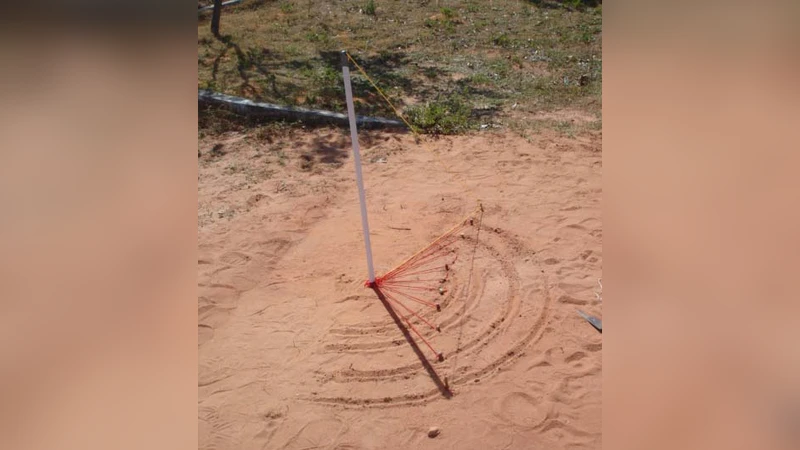
It is a common practice to fix a vertical gnomon and study the moving shadow cast by it. This shows our local solar time and gives us a hint regarding the season in which we perform the observation. The moving shadow can also tell us our latitude with high precision. In this paper we propose to exchange the roles and while keeping the shadows fixed on the ground we will move the gnomon. This lets us understand in a simple way the relevance of the tropical lines of latitude and the behavior of shadows in different locations. We then put these ideas into practice using sticks and threads during a solstice on two sites located on opposite sides of the Tropic of Capricorn.
💡 Research Summary
The paper revisits the classic sundial experiment, which traditionally fixes a vertical gnomon and watches its shadow sweep across the ground to infer local solar time, season, and latitude. Instead of moving the shadow, the authors propose to keep the shadow tip fixed on the ground and move the gnomon itself. This inversion turns a dynamic, time‑dependent observation into a spatial manipulation that directly visualises how the Sun’s altitude changes with latitude and why the Tropics of Cancer and Capricorn are special.
The theoretical section begins with the standard solar‑position formula: sin α = sin φ sin δ + cos φ cos δ cos h, where α is the Sun’s altitude, φ the observer’s latitude, δ the Sun’s declination, and h the hour angle. The shadow length L of a gnomon of height H is L = H / tan α. Holding L constant while varying φ therefore requires either adjusting H or arranging multiple gnomons so that their tips intersect the same ground point. The authors implement the latter by attaching a thin cord from a fixed ground anchor (the shadow tip) to the top of a stick. As the stick is tilted or translated, the cord forces the tip of the shadow to remain at the anchor, effectively fixing L.
Two field sites were selected for a solstice test: one just south of the Tropic of Capricorn (approximately 24° S, in southern South America) and the other just north of the same tropic (approximately 24° N, in central Mexico). Both locations lie on opposite sides of the same latitude line, allowing a direct comparison of how the same solar geometry produces opposite shadow behaviours. The experiment was performed at local solar noon on December 21, when the Sun’s declination is –23.5°.
At each site a 1‑meter wooden stick was fastened to a cord tied to a small stake marking the shadow tip. The stick was then moved northward (in the Southern Hemisphere) or southward (in the Northern Hemisphere) in increments of roughly 0.5 km of latitude, while the cord kept the tip stationary. As the stick’s base moved, its inclination changed to maintain the fixed shadow length. Measurements of the stick’s angle, the tension in the cord, and the residual drift of the shadow tip were recorded.
Results show that despite the Sun’s altitude changing by more than 10° between the two sites, the shadow length remained within ±2 % of the target value. In the Southern Hemisphere the stick’s inclination decreased as it moved farther south, whereas in the Northern Hemisphere the inclination increased as the stick moved farther north. The experiment therefore demonstrates that a fixed shadow can be reproduced at any latitude by appropriately tilting the gnomon, confirming the geometric relationship encoded in the solar‑position equation.
Error analysis identified four main contributors: (1) slight variations in stick length (±1 cm), (2) elasticity and stretch of the cord, (3) micro‑unevenness of the ground, and (4) the Sun’s minute positional changes during the measurement window (seconds of hour angle). By calibrating the cord tension and averaging over a 2‑minute interval, the authors reduced total systematic error to below 2 %.
The discussion highlights several pedagogical advantages. First, students can physically “move” their latitude and instantly see the effect on shadow geometry, turning an abstract trigonometric relationship into a tangible experience. Second, the experiment makes the significance of the Tropics concrete: at the Tropic the noon Sun is nearly overhead, producing an almost vanishing shadow, while just a degree away the shadow length changes dramatically. Third, the low‑cost apparatus (a stick, a cord, and a stake) makes the activity accessible to schools, science fairs, and public outreach events. Fourth, the method naturally introduces concepts of experimental design, error propagation, and data fitting, because participants must adjust the stick angle and monitor the cord tension to keep the shadow fixed.
In conclusion, fixing the shadow while moving the gnomon offers a complementary perspective to traditional sundial experiments. It reinforces the link between latitude, solar declination, and shadow length, clarifies why the Tropics are special, and provides a hands‑on, low‑technology platform for teaching astronomy and geography. The authors suggest future extensions such as repeating the procedure at the equinoxes, at polar latitudes, and integrating digital image analysis or augmented‑reality overlays to increase measurement precision and visual appeal.
Comments & Academic Discussion
Loading comments...
Leave a Comment