Compactly accessible categories and quantum key distribution
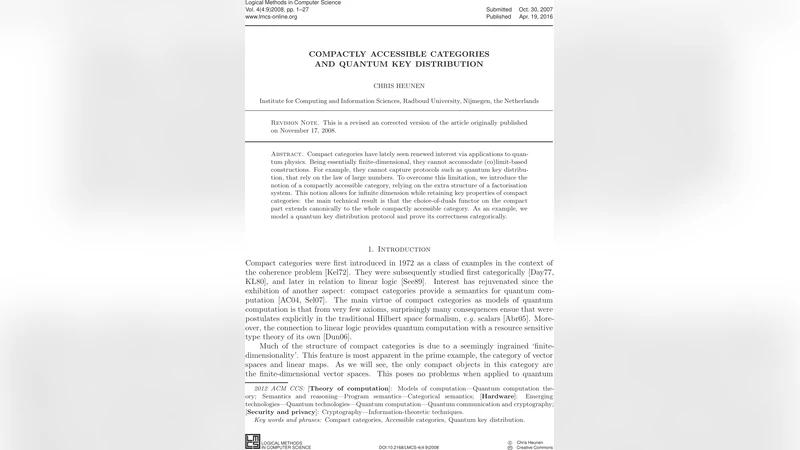
Compact categories have lately seen renewed interest via applications to quantum physics. Being essentially finite-dimensional, they cannot accomodate (co)limit-based constructions. For example, they cannot capture protocols such as quantum key distribution, that rely on the law of large numbers. To overcome this limitation, we introduce the notion of a compactly accessible category, relying on the extra structure of a factorisation system. This notion allows for infinite dimension while retaining key properties of compact categories: the main technical result is that the choice-of-duals functor on the compact part extends canonically to the whole compactly accessible category. As an example, we model a quantum key distribution protocol and prove its correctness categorically.
💡 Research Summary
The paper addresses a fundamental limitation of compact closed categories in the context of quantum information theory. While compact categories are celebrated for their elegant treatment of duality, tensor products, and internal homs—features that make them ideal for modelling finite‑dimensional quantum circuits—they inherently exclude constructions that rely on infinite‑dimensional objects or on (co)limit‑based arguments. This exclusion becomes acute when one tries to formalise protocols such as quantum key distribution (QKD), which depend on the law of large numbers, asymptotic error correction, and privacy amplification.
To overcome this barrier the authors introduce compactly accessible categories (CACs). A CAC is a category C equipped with a factorisation system ((\mathcal{E},\mathcal{M})) satisfying two crucial constraints:
- Accessibility – C is λ‑accessible for some regular cardinal λ, and every λ‑presentable object is compact. In other words, the “small” objects that generate the whole category are already compact, guaranteeing that the familiar compact‑category machinery is available on a dense subcategory.
- Factorisation behaviour – Morphisms in (\mathcal{E}) (the “epic” class) are required to preserve compactness; they only appear between compact objects. Morphisms in (\mathcal{M}) (the “monic” class) are limit‑preserving and may connect arbitrary objects. This dichotomy mirrors the way quantum operations (unitary channels, state preparations) are typically reversible or “pure”, while classical post‑processing and noise are often irreversible.
The compact part (\mathcal{C}_c\subseteq\mathcal{C}) consists of all compact objects together with the (\mathcal{E})‑morphisms between them. On (\mathcal{C}_c) the usual choice‑of‑duals functor ((-)^{\ast}:\mathcal{C}_c^{op}\to\mathcal{C}_c) is defined by the standard evaluation and co‑evaluation maps satisfying the triangle identities. The main technical theorem shows that this functor extends canonically to the whole CAC. The extension is built by factoring any morphism (f:X\to Y) as (f=m\circ e) with (e\in\mathcal{E}, m\in\mathcal{M}) and then defining (f^{\ast}=e^{\ast}\circ m^{\ast}). Because (\mathcal{E})‑maps live between compact objects, their duals are already known; (\mathcal{M})‑maps preserve limits, ensuring that the dual of a limit‑cone is a colimit‑cocone. Consequently, the extended duality respects the Yoneda‑Lemma‑style isomorphisms and the pivotal Yank‑Lemma (the categorical analogue of the snake equation) across the entire category.
With this machinery in place the authors turn to a concrete case study: the BB84 quantum key distribution protocol. They model the protocol as a string diagram in the CAC:
- State preparation (Alice’s random basis choice) is represented by an (\mathcal{E})‑morphism (p: I\to H) where (H) is the 2‑dimensional Hilbert space object.
- Quantum transmission is an (\mathcal{E})‑morphism (t:H\to H) possibly followed by an (\mathcal{M})‑morphism modelling channel noise.
- Measurement (Bob’s random basis) is an (\mathcal{M})‑morphism (m:H\to B) where (B) is a classical bit object (non‑compact).
- Classical post‑processing (basis reconciliation, error correction, privacy amplification) is expressed using colimits of the infinite tensor power (\bigotimes_{i=1}^{\infty} H). Because the CAC is λ‑accessible, the infinite tensor product is obtained as a filtered colimit of finite‑dimensional compact tensors, guaranteeing the existence of the required limit/colimit structures.
The law of large numbers, which underpins the security analysis of QKD, appears categorically as the convergence of the filtered diagram of finite‑length strings to the infinite‑length colimit. The duality extension ensures that the evaluation maps used in the security proof (e.g., the inner product between the actual key state and the ideal secret key) are well‑defined even when the key length tends to infinity.
The security proof itself is reformulated in categorical terms. The authors show that any adversarial operation factors through the same ((\mathcal{E},\mathcal{M})) system: the adversary’s quantum attack is an (\mathcal{E})‑morphism (hence cannot clone or perfectly distinguish non‑orthogonal states because of the compact duality), while any classical leakage is an (\mathcal{M})‑morphism subject to Shannon‑type information‑theoretic bounds. By composing these morphisms with the extended duality, they demonstrate that the overall diagram commutes in a way that reproduces the standard trace‑distance bound used in QKD security proofs. In other words, the categorical diagram guarantees that the adversary’s advantage is negligible in the limit of long keys, exactly as the conventional probabilistic analysis does.
Beyond the BB84 example, the paper sketches several avenues for future work. The CAC framework could be applied to quantum error‑correcting codes, where syndrome extraction and recovery are naturally expressed as (\mathcal{M})‑maps on infinite‑dimensional code spaces. It also suggests a pathway to categorical quantum machine learning, where training data may be modelled as colimits of finite‑dimensional feature spaces. Moreover, the authors hint at generalising the factorisation system (e.g., using weak factorisation systems or orthogonal factorisation systems) to capture more exotic quantum processes such as indefinite causal order.
In summary, the authors have identified a precise categorical obstruction to modelling asymptotic quantum protocols within compact closed categories, introduced a robust new structure—compactly accessible categories—grounded in a well‑behaved factorisation system, proved that the pivotal duality functor extends canonically, and demonstrated the practical power of the theory by giving a fully categorical model and security proof of a standard QKD protocol. This work bridges the gap between finite‑dimensional categorical quantum mechanics and the infinite‑dimensional, statistical nature of real‑world quantum information tasks, opening a promising research direction for both category theory and quantum cryptography.
Comments & Academic Discussion
Loading comments...
Leave a Comment