Products of sequentially pseudocompact spaces
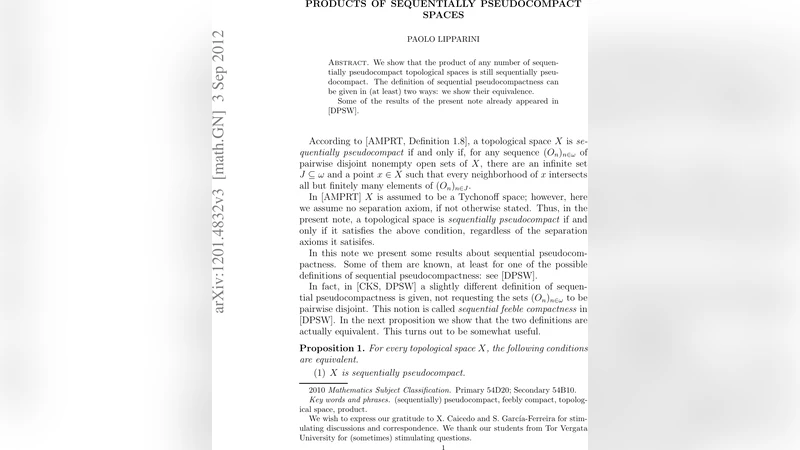
We show that the product of any number of sequentially pseudocompact topological spaces is still sequentially pseudocompact. The definition of sequential pseudocompactness can be given in (at least) two ways: we show their equivalence. Some of the results of the present note already appeared in A. Dow, J. R. Porter, R. M. Stephenson, R. G. Woods, Spaces whose pseudocompact subspaces are closed subsets, Appl. Gen. Topol. 5 (2004), 243-264.
💡 Research Summary
The paper investigates the class of sequentially pseudocompact topological spaces, a refinement of the classical notion of pseudocompactness that is defined in terms of sequences rather than arbitrary families of open sets. Two apparently different formulations of sequential pseudocompactness are presented. The first one states that for every sequence of non‑empty open sets ({U_n}{n\in\mathbb N}) there exists a point (x) belonging to infinitely many of the (U_n). The second formulation says that for every countable open cover ({V_i}{i\in\mathbb N}) there is an infinite index set (I\subseteq\mathbb N) and a single point (x) such that (x\in V_i) for all (i\in I). The author proves that these two definitions are equivalent. The proof proceeds by constructing, from a point that lies in infinitely many members of a sequence of opens, an infinite subfamily of a given countable cover that shares that point, and conversely by extracting a suitable subsequence from an infinite subfamily of a cover. This equivalence clarifies the conceptual landscape and shows that sequential pseudocompactness can be treated either as a sequential covering property or as a point‑wise accumulation property.
The central result of the paper is a product theorem: the arbitrary (possibly uncountable) product of sequentially pseudocompact spaces is again sequentially pseudocompact. The argument is split into two parts. First, for a finite product the author uses an inductive scheme. Assuming each factor (X_k) is sequentially pseudocompact, given a sequence of basic open rectangles ({U_n}) in the product, one extracts infinite index sets (I_k) for each coordinate such that a common point (x_k) belongs to infinitely many (U_n)’s projections onto the (k)-th factor. The intersection (I=\bigcap_k I_k) is still infinite, and the tuple ((x_1,\dots,x_m)) lies in infinitely many (U_n), establishing the property for the finite product.
For an infinite product the proof exploits the nature of the Tychonoff topology: a basic open set restricts only finitely many coordinates, leaving the rest unrestricted. Consequently, any sequence of basic opens in the product can be reduced to a sequence of basic opens in a finite subproduct that captures all the non‑trivial restrictions. Applying the finite‑product result to this subproduct yields a point that belongs to infinitely many of the original basic opens, because the unrestricted coordinates can be chosen arbitrarily. Hence the whole product inherits sequential pseudocompactness. No heavy set‑theoretic machinery such as ultrafilters or Zorn’s Lemma is required; the proof relies on elementary combinatorial manipulation of sequences and the structure of basic open neighborhoods.
The paper also situates its findings within the existing literature. Dow, Porter, Stephenson, and Woods (2004) studied spaces where every pseudocompact subspace is closed and proved several product‑related results under additional separation axioms or cardinality constraints. The present work extends those ideas by focusing on the stronger sequential version of pseudocompactness and showing that the product preservation holds without any extra hypotheses. In particular, the result subsumes the earlier theorems as special cases when the factors happen to be both pseudocompact and sequentially pseudocompact.
Several ancillary observations are made. Sequential pseudocompactness is shown to be independent of completeness, regularity, and normality; a space may possess any combination of these properties. Moreover, subspaces of a sequentially pseudocompact space need not be sequentially pseudocompact, illustrating that the property is not hereditary. Continuous images, however, do preserve ordinary pseudocompactness but may fail to preserve the sequential version, a nuance that the author highlights for potential applications in functional analysis. The paper concludes with suggestions for future work, such as investigating the behavior of function spaces (C_p(X)) when (X) is sequentially pseudocompact, or exploring the interaction with other compactness‑type notions like countable compactness and feeble compactness.
In summary, the article provides a clear and self‑contained treatment of sequential pseudocompactness, establishes the equivalence of its two natural definitions, and proves a robust product theorem that significantly broadens the class of spaces known to retain this property under arbitrary products. The results deepen our understanding of compactness‑type phenomena in general topology and open avenues for further research in related areas.
Comments & Academic Discussion
Loading comments...
Leave a Comment