An Improved Discrete Bat Algorithm for Symmetric and Asymmetric Traveling Salesman Problems
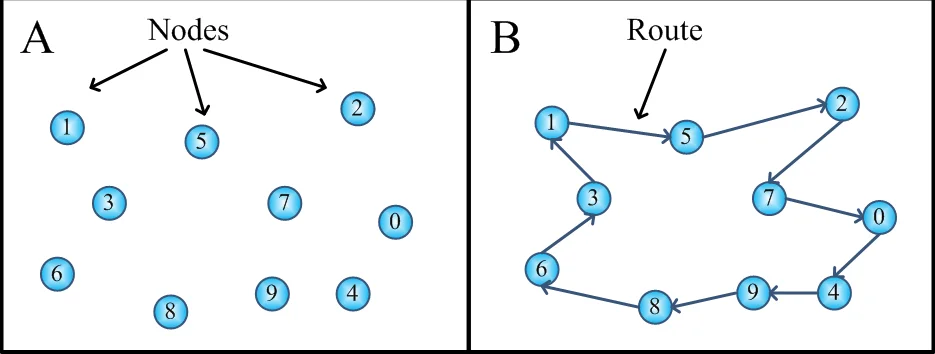
Bat algorithm is a population metaheuristic proposed in 2010 which is based on the echolocation or bio-sonar characteristics of microbats. Since its first implementation, the bat algorithm has been used in a wide range of fields. In this paper, we present a discrete version of the bat algorithm to solve the well-known symmetric and asymmetric traveling salesman problems. In addition, we propose an improvement in the basic structure of the classic bat algorithm. To prove that our proposal is a promising approximation method, we have compared its performance in 37 instances with the results obtained by five different techniques: evolutionary simulated annealing, genetic algorithm, an island based distributed genetic algorithm, a discrete firefly algorithm and an imperialist competitive algorithm. In order to obtain fair and rigorous comparisons, we have conducted three different statistical tests along the paper: the Student’s $t$-test, the Holm’s test, and the Friedman test. We have also compared the convergence behaviour shown by our proposal with the ones shown by the evolutionary simulated annealing, and the discrete firefly algorithm. The experimentation carried out in this study has shown that the presented improved bat algorithm outperforms significantly all the other alternatives in most of the cases.
💡 Research Summary
The paper introduces a discrete version of the Bat Algorithm (BA) and an improved variant (IBA) for solving both symmetric and asymmetric Traveling Salesman Problems (TSP and ATSP). The classic BA, originally designed for continuous optimization, is adapted to a permutation‑based search space by representing each bat’s position as a city tour. The distance between two bats is measured with the Hamming distance, which directly reflects the number of mismatched positions in two permutations. This distance is used to guide the echolocation‑inspired update of frequencies, loudness, and pulse‑rate, which are re‑interpreted for the discrete domain: frequency controls the intensity of permutation modifications, loudness determines the probability of accepting a new tour, and pulse‑rate influences the balance between global and local search.
The key innovation of IBA lies in a “situational‑dependent movement” scheme. Instead of applying the same update rule to all bats, each bat selects its move operator (2‑opt, 3‑opt, insertion, or simple adjacent swap) based on the quality of its current solution relative to the swarm’s average. High‑quality bats perform more aggressive global perturbations, while low‑quality bats focus on fine‑grained local refinements. Additionally, when a bat discovers a new personal best, its loudness is sharply reduced, encouraging convergence, and its pulse‑rate is gradually increased to favor exploitation. This adaptive, bat‑specific behavior introduces diversity and prevents premature stagnation, addressing a known limitation of the original BA.
The experimental study uses 37 benchmark instances drawn from TSPLIB, covering both symmetric and asymmetric cases. For each instance, 30 independent runs are performed. IBA’s performance is compared against five well‑known metaheuristics: a standard Genetic Algorithm (GA), Evolutionary Simulated Annealing (ESA), an Island‑based Distributed GA (IDGA), a Discrete Firefly Algorithm (DFA), and a Discrete Imperialist Competitive Algorithm (DICA). All algorithms are given the same computational budget (maximum 10 000 iterations or 300 seconds). Evaluation metrics include average tour length, standard deviation, best‑found solution, and convergence speed.
Statistical analysis employs three rigorous tests: Student’s t‑test (α = 0.05) to compare pairwise means, Holm’s step‑down procedure to control the family‑wise error rate, and the Friedman test for multiple‑algorithm ranking. Results show that IBA consistently yields lower average tour lengths than all competitors, with statistically significant differences confirmed by all three tests. The advantage is especially pronounced on asymmetric instances, where IBA’s adaptive move selection helps escape difficult local minima. Standard deviations are also the smallest, indicating robust performance across runs. Convergence plots reveal that IBA reduces the objective rapidly within the first 10–20 % of iterations and then stabilizes, outperforming ESA and DFA in both speed and final quality.
The authors conclude that the proposed improvements—Hamming‑distance‑based guidance and situational movement operators—effectively transform the BA into a powerful discrete optimizer for permutation problems. They suggest future work on extending IBA to other combinatorial domains such as Vehicle Routing, Job Shop Scheduling, and multi‑objective formulations, as well as exploring hybridizations with local search or machine‑learning‑based parameter adaptation.
Comments & Academic Discussion
Loading comments...
Leave a Comment