Measurements of high-frequency acoustic scattering from glacially-eroded rock outcrops
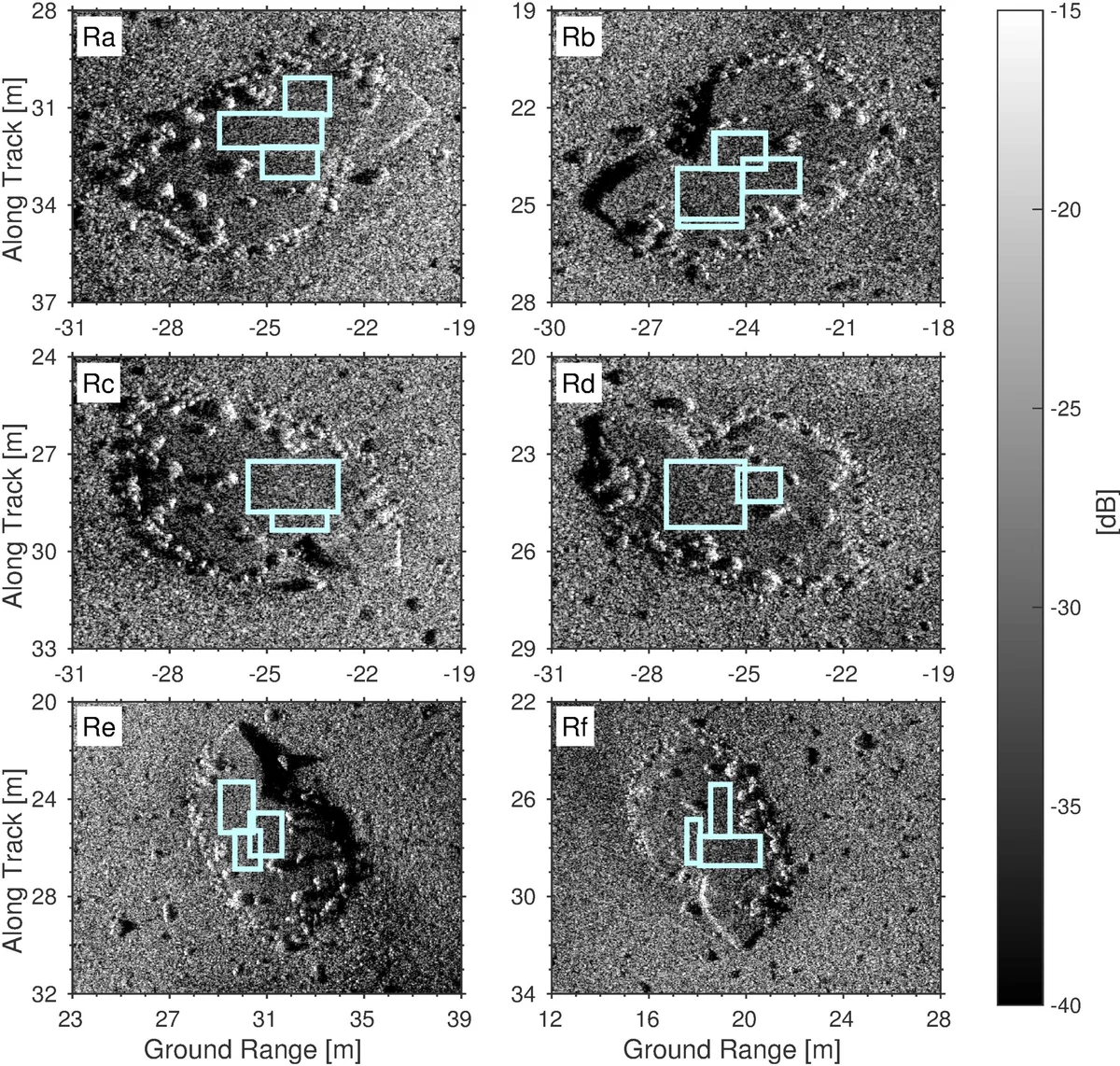
Measurements of acoustic backscattering from glacially-eroded rock outcrops were made off the coast of Sandefjord, Norway using a high-frequency synthetic aperture sonar (SAS) system. A method by which scattering strength can be estimated from data collected by a SAS system is detailed, as well as a method to estimate an effective calibration parameter for the system. Scattering strength measurements from very smooth areas of the rock outcrops agree with predictions from both the small-slope approximation and perturbation theory, and range between -33 and -26 dB at 20$^\circ$ grazing angle. Scattering strength measurements from very rough areas of the rock outcrops agree with the sine-squared shape of the empirical Lambertian model and fall between -30 and -20 dB at 20$^\circ$ grazing angle. Both perturbation theory and the small-slope approximation are expected to be inaccurate for the very rough area, and overestimate scattering strength by 8 dB or more for all measurements of very rough surfaces. Supporting characterization of the environment was performed in the form of geoacoustic and roughness parameter estimates.
💡 Research Summary
This paper presents the first comprehensive acoustic back‑scattering measurements from glacially‑eroded rock outcrops using a high‑frequency synthetic aperture sonar (SAS) system operating at 100 kHz. The study was conducted off the coast of Sandefjord, Norway, where two contrasting surface types were investigated: a gently undulating “stoss” side formed by glacial abrasion and a stepped “lee” side created by glacial plucking. Because the HISAS‑1030 SAS had not been calibrated for absolute source strength (s₀) or receiver sensitivity (sᵣ), the authors devised a calibration method that determines the effective product s₀·sᵣ by minimizing the discrepancy between measured back‑scatter strength and theoretical predictions for known surface conditions.
Environmental characterization was performed in two parts. First, geo‑acoustic parameters of the underlying monzonite bedrock were estimated using an effective‑medium approach. Mineral composition data from previous studies were combined with the Hashin‑Shtrikman‑Walpole bounds to obtain compressional and shear phase speeds (≈5.9–6.8 km s⁻¹ and ≈3.2–3.35 km s⁻¹, respectively), bulk density (≈2700 kg m⁻³), and attenuation factors (δₚ≈0.02, δₜ≈0.04) at the operating frequency. Second, surface roughness was quantified on two in‑air rock outcrops using a digital stereo photogrammetry system. Two acquisition modes (high‑resolution with ≈0.16 mm voxel size and low‑resolution with ≈0.36 mm voxel size) yielded height fields that were processed into two‑dimensional power spectra via Thomson’s multitaper method. These spectra provided the statistical roughness descriptors (spectral exponent and correlation length) required as inputs for scattering models.
The measured SAS data were sorted by grazing angle, and back‑scatter strength (σ̂) was computed for each angle bin. For the smooth stoss surfaces, σ̂ values ranged from –33 dB to –26 dB at a grazing angle of 20°, in excellent agreement with both the Small‑Slope Approximation (SSA) and first‑order Perturbation Theory (PT). This confirms that, when surface slopes are modest and the roughness spectrum is dominated by low spatial frequencies, linear scattering theories accurately predict the acoustic response even at 100 kHz.
In contrast, the rough lee surfaces produced σ̂ values between –30 dB and –20 dB at the same grazing angle. These measurements followed a sine‑squared dependence on grazing angle, matching the empirical Lambertian model (σ ∝ sin²θ). Both SSA and PT substantially over‑predicted the back‑scatter (by ≥ 8 dB) for these rough surfaces, indicating that the assumptions of small slopes and single‑scattering break down. The discrepancy is attributed to large surface gradients, shadowing, multiple scattering, and possible contributions from sub‑wavelength weathering pits that are not captured by linear theories.
The authors discuss the implications of these findings for sonar‑based seafloor mapping. Accurate back‑scatter predictions for rock outcrops require models that incorporate non‑linear effects for rough terrain, while smoother rock can be handled with existing linear approximations. The effective‑medium geo‑acoustic parameters derived from mineral composition proved sufficiently realistic for forward modeling, suggesting that similar approaches can be applied in regions where direct acoustic measurements are unavailable.
In summary, the paper demonstrates that high‑frequency SAS can be successfully calibrated and used to obtain quantitative back‑scatter strength from glacially‑eroded rock outcrops. It validates linear scattering theories for smooth rock surfaces, highlights their limitations for very rough terrain, and provides a robust dataset of geo‑acoustic and roughness parameters that can be employed in future acoustic modeling and seafloor classification efforts.
Comments & Academic Discussion
Loading comments...
Leave a Comment