Community Detection with Node Attributes and its Generalization
Community detection algorithms are fundamental tools to understand organizational principles in social networks. With the increasing power of social media platforms, when detecting communities there are two possi- ble sources of information one can u…
Authors: Yuan Li
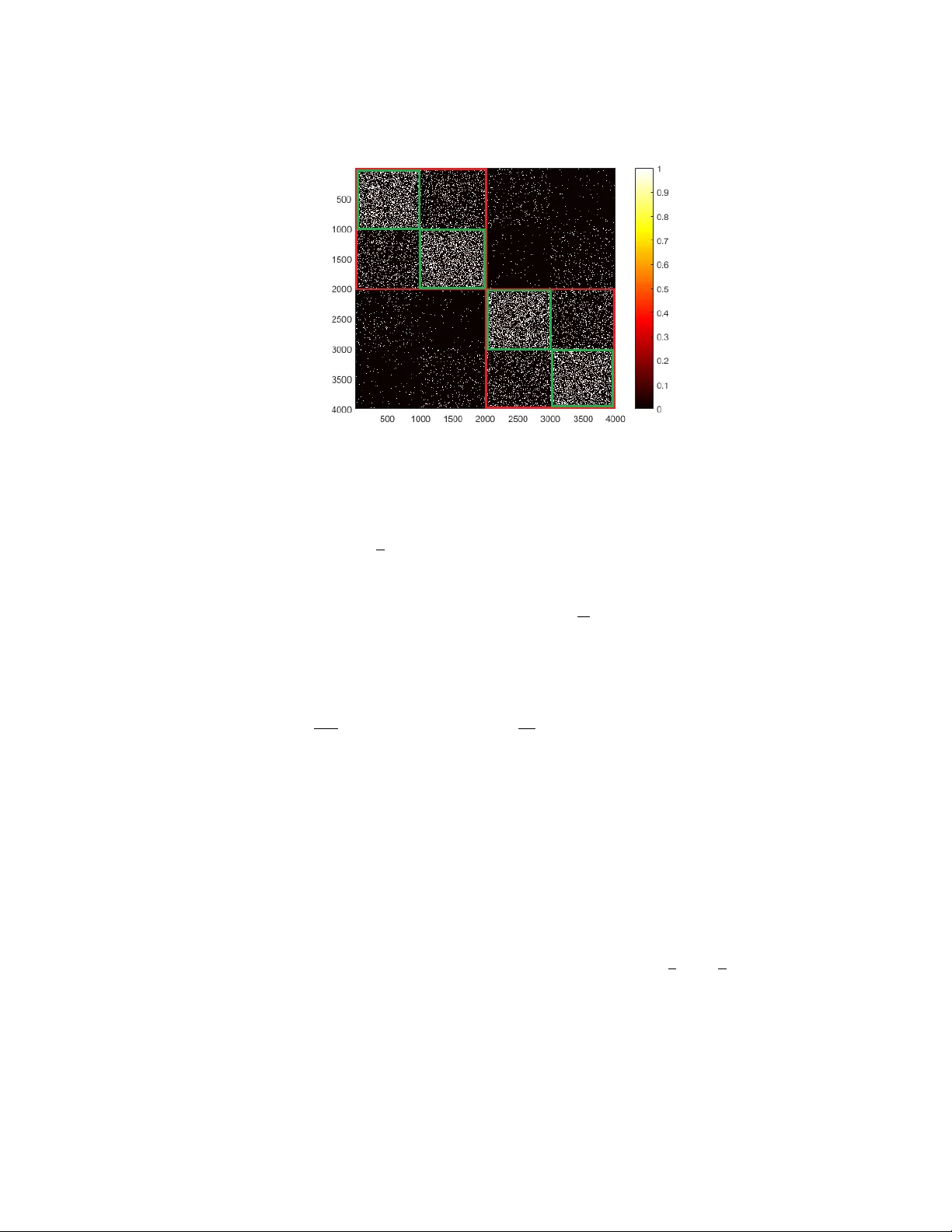
No v em b er 5, 2018 Comm unit y Detection with No de A ttributes and Its Generalization Y. Li Dep artment of Statistics Northwestern University, Evanston, USA Comm unit y detection algorithms are fundamental tools to understand organizational principles in so cial net w orks. With the increasing p o w er of so cial media platforms, when detecting comm unities there are tw o p ossi- ble sources of information one can use: the structure of so cial net work and no de attributes. Ho wev er structure of so cial net works and node attributes are often in terpreted separately in the researc h of comm unit y detection. When these t w o sources are in terpreted sim ultaneously , one common as- sumption shared b y previous studies is that no des attributes are correlated with comm unities. In this pap er, w e presen t a mo del that is capable of com bining topology information and no des attributes information with- out assuming correlation. This new mo del can recov er communities with higher accuracy even when no de attributes and comm unities are uncorre- lated. W e deriv e the detectability threshold for this mo del and use Belief Propagation (BP) to mak e inference. This algorithm is optimal in the sense that it can reco v er communit y all the w ay down to the threshold. This new model is also with the p otential to handle edge con tent and dynamic settings. 1 In tro duction Comm unit y detection is one of the critical issues when understanding social net works. In many real-world net w orks (e.g. F aceb o ok, Twitter), in addition to top ology of so- cial netw ork, con ten t information is a v ailable as w ell. Ev en though different sources of information ab out so cial netw orks can b e collected via so cial media, no de attributes and the structure of netw orks are often interpreted separately in the research of com- m unit y detection. Usually the primary atten tion of algorithms has only fo cused on the top ology of the so cial netw orks while on the other hand, the decision of commu- nit y assignmen ts has b een made solely based on no de attributes. The partial use of data is tremendously inefficien t. Sometimes, esp ecially when the net w ork is sparse, algorithms which are incapable of incorp orating m ultiple data sources are often para- lyzed and unsuccessful in recov ering communit y assignment. It is of great in terests to study ho w to incorp orate top ology features and no de attributes in to one algorithm. Sev eral pap ers address comm unit y detection with node attributes under the as- sumption that the observed no de attributes are highly correlated with communi- ties. The tw o main approaches are: heuristic measure-based mo dels and probabilis- tic inference-based mo dels. The heuristic measure-based models combine topology structure and no de attributes in a heuristic function. L. Akoglu et al. [1] prop osed a parameter-free identification of cohesiv e subgroups (PICS) in attributed graphs b y minimizing the total enco ding costs.Y. Zhou et al. [2] prop osed SA-Cluster based on structural and attribute similarities through a unified distance measure.The proba- bilistic inference-based approach usually assumes that the netw orks are generated b y random pro cesses and uses probabilistic generative mo dels to combine b oth topology and attributes. J. Y ang et al. [3] developed Communities from Edge Structure and No de Attributes (CESNA) for detecting o v erlapping net w orks comm unities with no de attributes. In CESNA model, the links are generated by pro cess of BigCLAM and no de attributes can be estimated b y separate logistic mo dels. B.F. Cai et al. [4] pro- p osed a p opularity-productivity sto c hastic blo ck model with a discriminative frame- w ork (PPSB-DC) as the probabilistic generative mo del. Y.Chen et al. [5] adopted Ba y esian method and developed Ba y esian nonparametric attribute (BNP A) mo del. A nonparametric metho d w as in tro duced to determine the num b er of communities automatically . These probabilistic generativ e models can b e further categorized based on t wo different wa ys of mo deling the sto c hastic relationship b etw een attributes X, comm unities F and graph G. CESNA and BNP A assume that communities generate b oth the net work as w ell as attributes (Figure 1 (c) ) how ev er PPSB-DC assumes that comm unities can b e predicted based on attributes and then netw ork are generated based on comm unities (Figure 1 (d) ). Ev en though many studies hav e shown that so cial ties are not made random but constrained by so cial p osition [6] [7], it is p ossible that the observed no de attributes ma y not contribute m uch to so cial p osition so that they are uncorrelated with com- 1 m unities. When communities and no de attributes are not correlated, adding no des attributes in to the ab o v e mo dels will not giv e more information ab out communities. In this paper we prop ose an approac h that allo ws us to go beyond the similarity b et w een comm unities and no de attributes. One assumption w e rely on is that no de attributes will lead to heterogeneit y in the degree of no des (Figure 1 (e)). The idea of including heterogeneity in the degree in SBM was first in tro duced by W ang and W ong [8] and later revisited by Karrer [9]. By including this heterogeneit y , our approac h is able to solv e the more challenging problem where no de attributes and comm unities are uncorrelated. Our in tuition is tha t the no de attributes label not only the no des but the edges as well. Due to heterogeneit y in the degree, differen t types of edges carry different information of communities, therefore our approac h should be able to reco v er the comm unities more accurately . Another imp ortant problem of in terests is to understand to which extend the extra information of no de attributes will improv e the p erformance, especially when comm unities and node attributes are not correlated. Here we are fo cusing on the detectabilit y threshold for our new mo del. E. Mossel et al. [10] ha v e pro ven that there exists a phase transition in the detectability of communities for tw o equal size comm unities in sto c hastic block mo del. S. Heimlic her et al. [12] inv estigated the phase transition phenomena in more general con text of lab elled sto chastic blo c k mo del and generalized the detectabilit y threshold. A. Ghasemian et al. [13] derived the detectabilit y threshold in dynamic sto chastic blo ck mo del as a function of the rate of c hange and the strength of the communities. In this paper we deriv e the detectability thresholds for communit y structure in sto c hastic blo c k model with no de attributes and compare it with the original thresholds while no information of no de attributes is a v ailable. 2 Mo del The sto chastic blo ck mo del (SBM) is a classic probabilistic generative mo del of com- m unit y structure in static netw orks [14] [15] [16]. Here, w e develop a generativ e model b y extending SBM to include heterogeneit y due to no de attributes in the degree of no des. In our mo del, we first assign no des with different no des attributes to dif- feren t comm unities and then generate the topology of netw ork based on b oth the comm unit y assignment and the no de attributes (Figure 1 (e)). The graphical mo del in Figure 1 (e) can b e seen as an extension of the graphic model in Figure 1 (d). The main reason for generalizing the graphic mo del in Figure 1 (d) instead of the graphic mo del in Figure 1 (c) is that the graphic mo del in Figure 1 (d) is a combination of graphical mo dels in Figure 1 (a) and Figure 1 (b), whic h are corresponding graphical mo dels for clustering problem and comm unit y detection in sto c hastic block mo del. Therefore we find the graphic mo del in Figure 1 (d) is a better candidate to combine 2 Figure 1: W a ys of mo deling the sto chastic relationship betw een attributes X, com- m unities F and graph G. Circles represen t latent communit y assignmen t and squares represen ts observ ed v ariables. top ology information and no de attributes information. In our mo del, w e also assume that all the no de attributes are categorical v ariables. Finally w e correct the degree of no des based on no de attributes, whic h leads to sub-comm unities structure (Figure 2). This assumption allows heterogeneit y in communities and generalize the communit y in SBM. W e formally describ e the generativ e pro cess of a graph G = { V , E , x 1 , x 2 , . . . , x m } under sto c hastic blo ck mo del with no de attributes, where x represen ts attributes, as follo ws. First, w e construct an one-to-one map of node attributes from m-dimensional p oin t { x 1 , x 2 , . . . , x m } to 1-dimensional p oint { X r } , where m is the num b er of different t yp es of observed attributes and r is from 1 to R . Then we assign eac h of the n no des i ∈ V in to R group according to no de attributes and the n umber of no des in eac h group is n r . Using a prior q k,r , w e assign n r no des in attributes category r in to K comm unities. W e then generate the ( i, j )th element in adjacency matrix A ccording to a Bernoulli distribution with probabilit y P { k i ,r i } , { k j ,r j } , where k i is the communit y assignmen t for no de i , r i is the attributes category for no de i and P { k i ,r i } , { k j ,r j } is the probabilit y of forming an edge b etw een a node from comm unity k i with attributes X r i and a no de from communit y k j with attributes X r j .The full likelihoo d of graph under SBM with no de attribute is: P ( E , k | X , P ) = ( Y i q k i ,r i )( Y i,j ∈ E P { k i ,r i } , { k j ,r j } Y i,j / ∈ E (1 − P { k i ,r i } , { k j ,r j } )) (1) 3 Figure 2: heat map of blo c k matrix, red squares represen t t wo primary comm unities, green squares represen t sub-comm unities in primary communities. Since P { k i ,r i } , { k j ,r j } = O ( 1 n ), sometimes its easier to work with the rescale matrix c { k i ,r i } , { k j ,r j } . When t wo no des are from group K 1 , K 2 with category of attributes a, b , the rescale matrix c { K 1 ,a } , { K 2 ,b } = nP { K 1 ,a } , { K 2 ,b } . F or subsequen t analysis, we will fo cus on the choice of uniform prior q k,r = 1 K since w e are interested in the detectabilit y threshold when attributes are not correlated with communities. W e will also limit ourselv es to an algorithmically difficult case of blo c k mo del, where ev ery group k has the same a verage degree conditional on the t yp e of edge: c ab = n b K 2 X k 1 X k 2 P { k 1 ,a } , { k 2 ,b } = n b K X k 2 P { k 1 ,a } , { k 2 ,b } for an y k 1 . (2) If this is not the case, reconstruction can b e ac hieved b y lab eling no des based on their degrees. 3 Detectabilit y threshold in SBM with no de at- tributes The b est-known rigorous detectability threshold in sparse SBM has b een derived b y E. Mossel et al. [10]. In the sparse partition mo del, where p = a n , q = b n and a > b > 0 , the clustering problem is solv able in p olynomial time if ( a − b ) 2 > 2( a + b ). Ho wev er for K ≥ 3 it is still an op en question to find a rigorous detectability threshold in SBM. The Kesten-Stigum (KS) threshold in statistical ph ysics can b e treated as a non-rigorous threshold for K ≥ 3 [17] [18]. Let G b e generated b y SBM( n, k , a, b ) and 4 define S N R = | a − b | √ k ( a +( k − 1) b ) . If S N R > 1 then the clustering problem is solv able and the Kesten-Stigum (KS) threshold can b e ac hieved in p olynomial time. In the sparse regime, | E | = O ( n ), the graph generated by SBM is lo cally treelik e in the sense that all most all no des in the gian t comp onen t ha ve a neighborho o d whic h is a tree up to distance O ( l og ( n )). Therefore the threshold for reconstruction on tree can pro vide go o d insigh t in to reconstruction on SBM. As men tioned b efore, one in tuition is that no de attributes lab el the edges, there- fore we consider a m ulti-t yp e branching pro cess of edges to generate the tree that ap- pro ximates the graph generated by SBM with no de attributes. By defining a Marko v c hain on the infinite tree T = ( V , E , X ), we can derive the construction thresholds on SBM with no de attributes. T o construct the m ulti-t yp e branching pro cess, w e first lab el the edge by the categories of no de attributes at the tw o ends of the edge as L { X a , X b } , where X a is the attributes for the no de that is closer to the ro ot, X b is the attributes for the no de at the far-end and a, b is from 1 to R . So there are R 2 differen t t yp es of edges. Map { X a , X b } to ( a − 1) ∗ R + b and relab el the L { X a , X b } t yp e edge as L { ( a − 1) ∗ R + b } . Let R 2 ∗ R 2 dimensional matrix C b e the matrix describing the exp ected num b er of c hildren, where c ij is the exp ected n um b er of t yp e L { i } edges induced by one type L { j } edge. Note that one L { X a 1 , X b 1 } type of edge will giv e birth to L { X a 2 , X b 2 } t yp e of edges if and only if b 1 = a 2 . Let x = [ i − 1 R ] + 1 and y = i − [ i − 1 R ] and z = j − [ j − 1 R ], c ij = ( 0 if x 6 = z , c xy if otherwise . (3) When moving outw ard a type L { X a , X b } edge, the K ∗ K sto chastic transition matrix σ asso ciate with the edge can b e defined as: σ k 1 k 2 ab = n b K P { k 1 ,a } , { k 2 ,b } c ab . (4) The largest eigenv alue for the K ∗ K stochastic transition matrix σ is 1 and let the second largest eigen v alue be λ ab . Define m ij in the R 2 ∗ R 2 matrix M 1 as c ij ∗ λ 2 [ i − 1 R ]+1 ,i − [ i − 1 R ] . The robust reconstruction is p ossible when the absolute v alue of largest eigen v alue for matrix M 1 exceeds 1 [13][11]. 4 Belief propagation T o reco ver the comm unity assignmen ts in SBM with no de attributes, w e use Ba yesian inference to learn the laten t communit y: P ( k | E , X , P ) = P ( k , E | X , P ) P g P ( E | g , X , P ) , (5) 5 where k is the estimated group assignmen t and g is the original group assignmen t. The distribution is too complex to compute directly since P g P ( E | g , X , P ) runs ov er exp onen tial n um b er of terms. In the regime | E | = O ( n ), the graph is lo cally treelik e therefore b elief propagation, whic h is exact to calculate the marginal probabilit y of communit y assignmen t on a tree, can b e applied to calculate Ba y esian inference efficien tly . W ell sho w that BP is an optimal algorithm in the sense that it can reach the detectabilit y thresholds for SBM with no de attributes. T o write the b elief propagation equation, w e define conditional marginal proba- bilit y , denoted as ψ i → j k i , which is the probability that node i belongs to group k i in the absence of no de j. W e can compute the messenger from i to j as: ψ i → j k i = 1 Z i → j q k i r i Y l ∈ ∂ i \ j [ X k l c A il { k l ,r l } , { k i ,r i } (1 − c 1 − A il { k l ,r l } , { k i ,r i } n ) ψ l → i k i ] , (6) where A il is the ( i, l )th element in the adjacency matrix for the graph generated by SBM with node attributes, ∂ i denotes all the no des connected to i and Z i → j is a normalization constan t ensuring ψ i → j k i to be a probabilit y distribution. The marginal probabilit y ψ i k i can b e calculated as: ψ i k i = 1 Z i q k i r i Y l ∈ ∂ i [ X k l c A il { k l ,r l } , { k i ,r i } (1 − c 1 − A il { k l ,r l } , { k i ,r i } n ) ψ l → i k i ] , (7) where Z i is a normalization constant ensuring ψ i k i to b e a probability distribution. In SBM with no de attributes, w e ha ve in teractions b etw een all pairs of no des, therefore w e ha ve n ( n − 1) messengers to up date for one iteration. T o reduce the computational complexit y to O ( n ), w e follow past w ork on BP for SBM citeDecelle. At the cost of making O ( 1 n ) approximation to the messenger, when there is no edge b etw een i and j , the messenger from i to j can b e calculated as: ψ i k i → j = ψ i k i . (8) No w only messengers sen t on edges are needed to b e calculated. By introducing an external field, the messenger from i to j when there is an edge b et w een i and j can b e appro ximated as: ψ i → j k i = 1 Z i q k i r i e − h k i r i Y l ∈ ∂ i [ X k l c { k i ,r i } , { k l ,r l } ψ l → i k i ] , (9) where the external field h k i r i can b e defined as: h k i r i = 1 n X l X k l c { k i ,r i } , { k l ,r l } ψ l k l . (10) Its w orth noting that ψ i → j k i = q k i r i is a fixed p oin t in (9). 6 5 Phase transition in BP and sim ulation In this section, w e will study the stabilit y of the fixed p oint under random p erturba- tions. As discussed ab o v e, in the sparse regime, the graph generated by SBM with no de attributes is lo cally treelik e. Here consider such a tree with d lev els. On the lea v e m d the fixed p oint is perturb ed as ψ m d k m d = q k m d r m d + m d k m d , where m d k m d is i.i.d. random v ariable. Then the influence of p erturbation on lea ve m d to the ro ot m 0 can b e calculated as: m 0 = Y { ab } T d ab ab m d , (11) where d ab is the n umber of type L { X a , X b } edges on the path from leav e m d to the ro ot m 0 and T ab is the transfer matrix for type L { X a , X b } edges, whic h, b y follo wing the calculation in [19], can b e defined as: T k 1 k 2 ab = q k 1 a ( k σ k 1 k 2 ab − 1) . (12) As d → ∞ , d ab → ∞ as w ell,therefore m 0 ≈ Q all { ab } υ d ab ab m d ,where υ ab is the largest eigen v alue for T ab . No w let us consider the v ariance at ro ot m 0 induced b y the random p erturbation on all lea v es at level d . Since the influence of each leaf is indep endent, the v ariance of the root can b e written as: V ar ( m 0 ) = X all the path ( r ∼ m d ) Y { ab } υ 2 d ab ab V ar ( m d ) . (13) When the v ariances on lea v es are amplified exp onentially , the fixed point is un- stable and BP algorithm is able to reco v er the communit y assignment with high probabilit y , otherwise the p erturbation on lea ves will v anish and the fixed point in stable under BP algorithm. F rom eq.(13), when m d is i.i.d. , to determine the phase transition in BP , it’s sufficient to calculate Z d = P allthepath ( r ∼ m d ) Q all { ab } υ 2 d ab ab . This calculation can be done b y viewing this summation as a w eigh t associated multi- t yp e branching pro cess. Consider thus a m ulti-t yp e branching pro cess with P ossion distribution with mean c ab if the paren t-c hild edge in the corresp onding m ulti-t yp e branc hing pro cess b elongs to type L { X a , X b } . The v ariance amplified along the tree generated b y the ab ov e multi-t yp e branching process and the exp ected v alues of the v ariance at lev el d can b e calculated as: E ( Z d | m 0 ) = 1 T M d 2 e m 0 , (14) where the ( i, j )th elemen t of M 2 is c ij υ 2 [ i − 1 R ]+1 ,i − [ i − 1 R ] , e m 0 is an R 2 -dimensional unit v ector with the r th elemen t equal to 1 and r is the no de attribute type of the ro ot no de m 0 . When the largest eigen v alue of M 2 exceeds 1, the fixed p oint of BP is unstable and the comm unity is detectable. Noting that λ ab = υ ab , therefore BP is an 7 optimal algorithm in the sense that it can reach the detectability threshold in SBM with no de attributes ev en when no de attributes and communities are not correlated. Next, w e compare the detectabilit y thresholds for SBM with no de attributes with the detectabilit y threshold for the original SBM without information of node at- tributes. In the follo wing discussion, we will limit ourselv es to the case where n r = n R , q k i ,r i = 1 K and C { k i ,r i } , { k j ,r j } satisfy equation (15), c { k i ,r i } , { k j ,r j } = a if k i = k j and r i = r j b if k i = k j and r i 6 = r j c if otherwise , (15) where a ≥ b ≥ c . F or SBM with no de attributes, the comm unit y is detectable if ξ 1 = ( a − c ) 2 a + ( K − 1) c + ( R − 1) ( b − c ) 2 b + ( K − 1) c > K R. (16) F or SBM without information of no de attributes, the communit y is detactable if ξ 2 = ( a + ( R − 1) b − Rc ) 2 a + ( R − 1) b + ( K − 1) Rc > K R. (17) By simple calculation, it can b e shown that ξ 1 ≥ ξ 2 , therefore even in the situation where the observ ed no de attributes are uncorrelated with communities, including no de attributes in to mo del will giv e us more infomation ab out comm unities. W e conduct the following sim ulation to verify the claim of phase transition in BP . Considering for simplicit y only tw o comm unities and tw o node attributes, w e generate a series of graphs b y SBM with no de attributes for 4000 no des and v arious choice of ( a, b ) when con trolling a verage degree to b e 5. W e use η = a b to represn t differen t c hoices of ( a, b ) and = c b to represen t the strength of communities. When = 0 the clusterings are maximally strong while at = 1 the clusterings are w eak. The accuracy of reconstruction is measure b y ov er l ap matric in tro duced b y [19]. In figure 3, w e plot ov er l ap metric against for different v alues of η and for each curv e, w e use a vertical dash line in the same color as the corresponding curve to indicate the detectabilit y threshold. Figure 3 sho ws that BP can reco ver comm u- nities that are p ositiv ely correlated with true comm unities all the wa y down to the detectabilit y thresholds for v arious c hoice of ( , η ). The algorithm has larger ov er l ap metric with smaller . 6 Conclusion In this paper, we consider a mo del that uses information of no des attributes in a differen t wa y suc h that this approach will provide more information of latent com- m unities b ey ond the information carried b y SBM even when no de attributes are not 8 Figure 3: Overlap as a function of for v arious v alues of η . Dash lines mark the theoretical detectabilit y thresholds for the c hoice of ( , η ). correlated with communities. W e hav e derived a theoretical detectability threshold for SBM with no de attributes, which coincides with phase transition in BP . W e also conduct a n umerical analysis of the phase transition in BP . While constricted to the t w o symmetric comm unities with t w o no de attributes, this condition is sufficient to illustrate ho w the information of no de attributes affects detectabilit y ev en the no de attributes are not correlated with comm unities. A nature extension will include edge con ten ts and dynamic settings into the mo del. Our approac h can b e applied to this case b y including different t yp e of edges in to the multi-branc hing pro cess. On the theoretical front, it has been conjectured [10] that, for K ≥ 5, theres a regime that the clustering problem is solv able but not in p olynomial time. Emman uel Abb e and Colin Sandon [20] ha ve dev elop ed a non- efficien t algorithm that is sho wn to break do wn KS threshold at K = 5 in SBM. As a future work, w ell try to dev elop an algorithm that can break do wn the detectability threshold in our mo del for large n umbers of groups. A CKNO WLEDGEMENTS I am grateful to Professor W enxin Jiang and Professor Noshir Contractor for helpful discussion. 9 References [1] Akoglu, Leman, et al. ”PICS: Parameter-free Iden tification of Cohesive Sub- groups in Large A ttributed Graphs.” SDM. 2012. [2] Zhou, Y ang, Hong Cheng, and Jeffrey Xu Y u. ”Graph clustering based on struc- tural/attribute similarities.” Pro ceedings of the VLDB Endo wmen t 2.1 (2009): 718-729. [3] Y ang, Jaew on, Julian McAuley , and Jure Lesk o v ec. ”Communit y detection in net w orks with node attributes.” Data mining (ICDM), 2013 ieee 13th interna- tional conference on. IEEE, 2013. [4] Chai, Bian-fang, et al. ”Combining a p opularity-productivity sto chastic blo c k mo del with a discriminativ e-con ten t mo del for general structure detec- tion.”Ph ysical review E 88.1 (2013): 012807. [5] Chen, Yi, et al. ”Netw ork structure exploration in net works with no de at- tributes.” Ph ysica A: Statistical Mec hanics and its Applications (2016). [6] McPherson, Miller, Lynn Smith-Lovin, and James M. Co ok. ”Birds of a feather: Homophily in so cial net w orks.” Ann ual review of so ciology (2001): 415-444. [7] Centola, Damon, et al. ”Homophily , cultural drift, and the co-ev olution of cul- tural groups.” Journal of Conflict Resolution 51.6 (2007): 905-929. [8] W ang, Y uc h ung J., and George Y. W ong. ”Sto chastic blo ckmodels for directed graphs.” Journal of the American Statistical Asso ciation 82.397 (1987): 8-19. [9] Karrer, Brian, and Mark EJ Newman. ”Sto c hastic blo c kmo dels and comm unit y structure in net w orks.” Ph ysical Review E 83.1 (2011): 016107. [10] Mossel E, Neeman J, Sly A. Sto c hastic blo c k mo dels and reconstruction. arXiv preprin t arXiv:1202.1499. 2012 F eb 7. [11] Janson, Sv ante, and Elchanan Mossel. ”Robust reconstruction on trees is deter- mined b y the second eigen v alue.” Annals of probability (2004): 2630-2649. [12] Heimlicher, Simon, Marc Lelarge, and Laurent Massouli. ”Communit y detection in the lab elled sto c hastic blo c k mo del.” arXiv preprin t arXiv:1209.2910 (2012). [13] Ghasemian, Amir, et al. ”Detectabilit y thresholds and optimal algo- rithms for comm unit y structure in dynamic net works.” arXiv preprin t 10 [14] Holland, P aul W., Kathryn Blac kmond Lask ey , and Sam uel Leinhardt. ”Sto chas- tic blo c kmo dels: First steps.” So cial netw orks 5.2 (1983): 109-137. [15] F aust, Katherine, and Stanley W asserman. ”Blockmodels: In terpretation and ev aluation.” So cial net works 14.1 (1992): 5-61. [16] Snijders, T om AB, and Krzysztof No wic ki. ”Estimation and prediction for sto c hastic blo c kmo dels for graphs with laten t blo c k structure.” Journal of clas- sification 14.1 (1997): 75-100. [17] Kesten, Harry , and Bernt P . Stigum. ”Additional limit theorems for indecompos- able multidimensional Galton-W atson pro cesses.” The Annals of Mathematical Statistics 37.6 (1966): 1463-1481. [18] Kesten, Harry , and Bern t P . Stigum. ”Limit theorems for decomp osable multi- dimensional Galton-W atson processes.” Journal of Mathematical Analysis and Applications 17.2 (1967): 309-338. [19] Decelle, Aurelien, et al. ”Asymptotic analysis of the stochastic blo ck mo del for mo dular netw orks and its algorithmic applications.” Ph ysical Review E84.6 (2011): 066106. [20] Abb e, Emmanuel, and Colin Sandon. ”Detection in the sto chastic blo c k mo del with m ultiple clusters: proof of the achiev ability conjectures, acyclic BP , and the information-computation gap.” arXiv preprin t 11
Original Paper
Loading high-quality paper...
Comments & Academic Discussion
Loading comments...
Leave a Comment