Two kinds of derived categories, Koszul duality, and comodule-contramodule correspondence
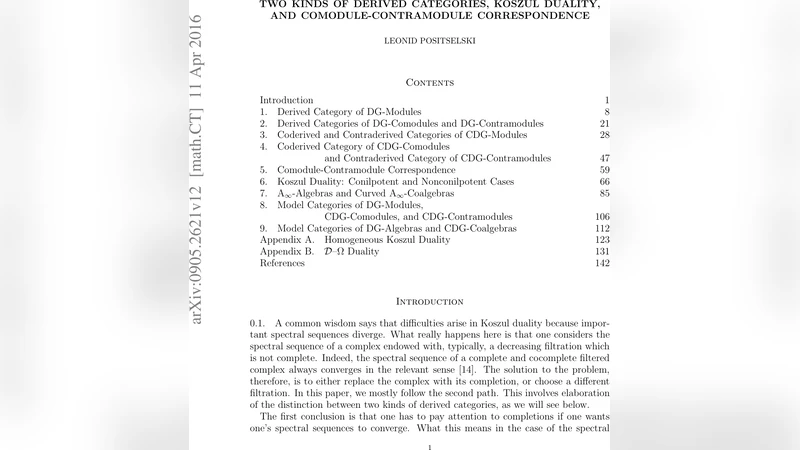
This paper can be thought of as an extended introduction to arXiv:0708.3398; nevertheless, most of its results are not covered by loc. cit. We consider the derived categories of DG-modules, DG-comodules, and DG-contramodules, the coderived and contraderived categories of CDG-modules, the coderived categories of CDG-comodules, and the contraderived categories of CDG-contramodules. The equivalence between the latter two categories (the comodule-contramodule correspondence) is established. Nonhomogeneous Koszul duality or “triality” (an equivalence between exotic derived categories corresponding to Koszul dual (C)DG-algebra and CDG-coalgebra) is obtained in the conilpotent and nonconilpotent versions. Various $A_\infty$-structures are considered, and a number of model category structures are described. Homogeneous Koszul duality and $D$-$\Omega$ duality are discussed in the appendices.
💡 Research Summary
The paper serves as an extensive introduction to the author’s earlier work (arXiv:0708.3398) while presenting many results that go beyond that preprint. Its main purpose is to develop a unified framework for several “exotic’’ derived categories that arise when one works with differential graded (DG) algebras, curved DG (CDG) algebras, and their (co)module and contramodule analogues, and then to relate these categories via Koszul duality and a comodule‑contramodule correspondence.
The first part recalls the classical derived category of DG‑modules over a DG‑algebra (A). The author then introduces DG‑comodules over a DG‑coalgebra and DG‑contramodules, explaining how the usual homotopy and derived constructions extend to these settings. The discussion emphasizes the role of injective and projective resolutions, the existence of enough injectives/projectives, and the formation of triangulated structures.
Next, the paper moves to curved DG (CDG) objects. A CDG‑module over a CDG‑algebra ((A,d,h)) carries both a differential and a curvature term (h). Because curvature destroys the usual exactness of the standard bar/cobar constructions, the author defines two new derived categories: the coderived category (\mathsf{D}^{\mathrm{co}}(C\text{-comod})) for CDG‑comodules and the contraderived category (\mathsf{D}^{\mathrm{ctr}}(C\text{-contra})) for CDG‑contramodules. These categories are obtained by localizing the homotopy category with respect to “co‑acyclic’’ or “contra‑acyclic’’ complexes, respectively, and they contain objects that are invisible in the ordinary derived category.
The central theorem of the paper is the comodule‑contramodule correspondence: for any CDG‑coalgebra (C), the coderived category of CDG‑comodules and the contraderived category of CDG‑contramodules are naturally equivalent. The proof is constructive: one builds explicit functors using the cobar and bar constructions (the “cobar‑cobar’’ adjunction) and shows that they induce mutually inverse equivalences after passing to the appropriate localizations. This result generalizes earlier work on the equivalence between derived categories of modules over a Koszul algebra and its Koszul dual coalgebra, but now works in the curved setting where curvature may be non‑zero.
Having established the correspondence, the author turns to non‑homogeneous Koszul duality, also called “triality”. In the classical (homogeneous) Koszul duality one has an equivalence between the derived category of a quadratic DG‑algebra and that of its quadratic DG‑coalgebra. Here the author treats two broader situations:
-
Conilpotent case – when the CDG‑coalgebra (C) is conilpotent (its coradical filtration exhausts (C)). In this setting the cobar construction yields a DG‑algebra that is Koszul dual to (C), and the derived category of DG‑modules over this algebra is equivalent to both the coderived category of CDG‑comodules and the contraderived category of CDG‑contramodules.
-
Non‑conilpotent case – when (C) is not conilpotent. The author introduces a completion of the cobar construction and a suitable filtration, obtaining three triangulated categories (DG‑modules, CDG‑comodules, CDG‑contramodules) that are mutually equivalent. This three‑way equivalence is the “triality’’ and extends Koszul duality to a far larger class of algebras and coalgebras, including many examples arising in representation theory and algebraic geometry.
The paper also investigates (A_\infty)‑structures on the objects involved. By allowing higher multiplications, the author shows that the comodule‑contramodule correspondence and the triality persist for (A_\infty)‑algebras and (A_\infty)‑coalgebras, thus providing a flexible homotopical framework that accommodates deformations and homotopy‑invariant constructions.
From a homotopical‑algebra viewpoint, the author equips each of the exotic derived categories with a model category structure. The weak equivalences are the co‑acyclic (or contra‑acyclic) morphisms, fibrations are degreewise surjections (or appropriate analogues), and cofibrations are defined via the lifting properties. These model structures make the equivalences above Quillen equivalences, ensuring that the homotopy categories coincide with the previously defined coderived and contraderived categories.
The appendices treat the classical homogeneous Koszul duality (DG‑algebra vs. DG‑coalgebra) and the (D)–(\Omega) duality, which relates the de Rham complex ( \Omega^\bullet ) of a smooth algebraic variety to its algebra of differential operators ( D ). The author revisits these dualities using the language of CDG‑modules, showing how they fit into the broader picture developed in the main text.
In summary, the paper builds a comprehensive theory that unifies several derived categories associated with DG and CDG structures, proves a deep equivalence between coderived and contraderived categories (the comodule‑contramodule correspondence), extends Koszul duality to both conilpotent and non‑conilpotent settings via triality, and enriches the whole framework with (A_\infty)‑structures and model category techniques. These results have significant implications for homological algebra, representation theory, and derived algebraic geometry, providing new tools for handling curved objects and for transferring information across seemingly disparate homological contexts.
Comments & Academic Discussion
Loading comments...
Leave a Comment