Quantifying the Diaspora of Knowledge in the Last Century
Academic research is driven by several factors causing different disciplines to act as “sources” or “sinks” of knowledge. However, how the flow of authors’ research interests – a proxy of human knowledge – evolved across time is still poorly understood. Here, we build a comprehensive map of such flows across one century, revealing fundamental periods in the raise of interest in areas of human knowledge. We identify and quantify the most attractive topics over time, when a relatively significant number of researchers moved from their original area to another one, causing what we call a “diaspora of the knowledge” towards sinks of scientific interest, and we relate these points to crucial historical and political events. Noticeably, only a few areas – like Medicine, Physics or Chemistry – mainly act as sources of the diaspora, whereas areas like Material Science, Chemical Engineering, Neuroscience, Immunology and Microbiology or Environmental Science behave like sinks.
💡 Research Summary
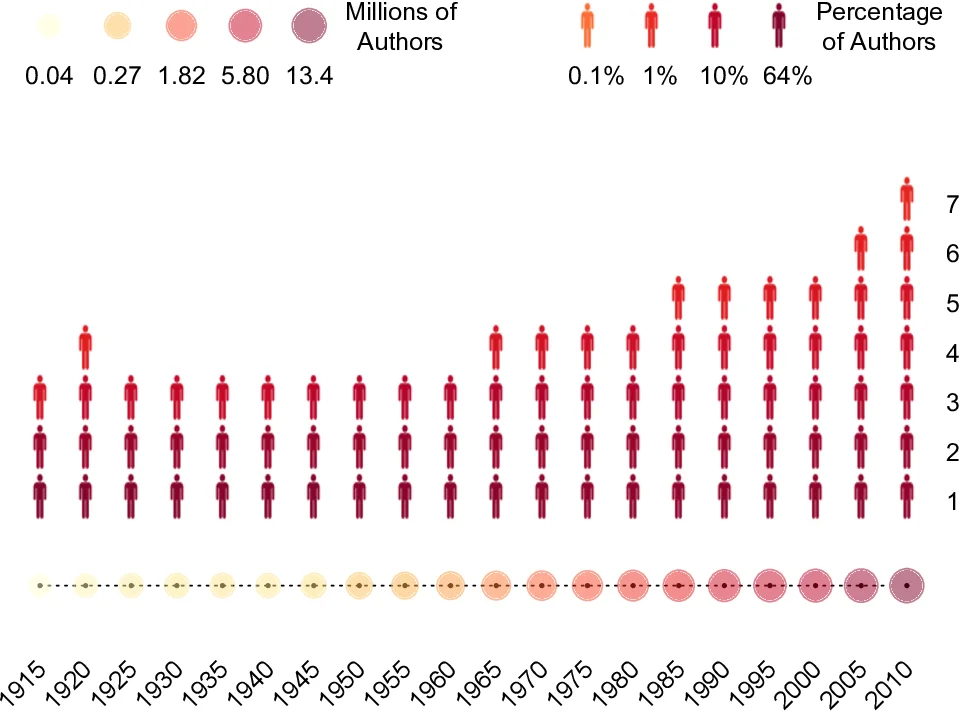
The paper presents a novel quantitative analysis of how researchers’ interests have migrated across scientific disciplines over the past century, coining the term “knowledge diaspora” to describe this phenomenon. Using the Microsoft Academic Graph (MAG), the authors extracted over 35 million journal articles spanning 1910–2014 and divided the timeline into non‑overlapping five‑year snapshots. Because the original MAG field‑of‑study classification based on keywords proved unreliable, they re‑classified each article by the journal in which it appeared, employing the SCImago Journal & Country Rank taxonomy. This yielded 306 fine‑grained topics nested within 27 broader areas. Journals assigned to multiple topics generated multiplex layers in the network.
For each snapshot, the authors built a tripartite network linking authors (A), papers (P), and journals (J). By selecting, for each author, the layer (topic) where they were most active, they collapsed the tripartite structure into a bipartite author‑journal network per snapshot. They then linked author replicas across consecutive snapshots, forming a time‑varying, weighted, directed multiplex tensor G. To focus on the flow of interests rather than individual publications, they projected G onto a smaller tensor H that retained only inter‑snapshot author connections, and finally aggregated over authors to obtain a topic‑time tensor M. In this representation, an edge from topic t at time τ to topic t′ at time τ + 5 years carries a weight equal to the number of authors who switched their primary research area from t to t′ during that interval.
The central metric is the relative change in incoming flow for each topic, denoted δₜ(τ). For a given snapshot τ, δₜ(τ) is the average over all other topics of the proportional change in the number of authors moving into t compared with the previous snapshot. This measure captures both large absolute migrations and small but sharply rising influxes, making it sensitive to emerging fields. The topic with the highest δₜ(τ) in each period is identified as the most attractive discipline at that time.
Results reveal distinct historical phases. In the earliest period (1910‑1930) author movement was negligible; scholars largely remained within their initial fields. By the mid‑20th century (1950‑1970) cross‑disciplinary flows intensified, especially among physics, chemistry, and the nascent field of condensed‑matter physics, reflecting post‑World‑War II funding for nuclear research and the rise of solid‑state physics. The 1990s and early 2000s saw a dramatic surge of researchers entering biomedical domains—genetics, molecular biology, pharmacology, immunology, and microbiology—coinciding with the Human Genome Project, biotech investment, and public health crises such as HIV/AIDS and emerging influenza strains. In the most recent decade (2010‑2014) topics related to materials science, chemical engineering, neuroscience, environmental science, and energy became strong sinks, mirroring global policy emphasis on sustainability, climate change, and renewable energy.
Quantitatively, the authors find that Medicine, Physics, and Chemistry act as dominant “sources,” accounting for roughly 45 % of total author flow, whereas areas such as Materials Science, Chemical Engineering, Neuroscience, Immunology/Microbiology, and Environmental Science function as prominent “sinks,” receiving disproportionately high inbound migration. This asymmetry suggests a structural pattern where foundational disciplines continuously supply talent, while applied or policy‑driven fields experience episodic influxes driven by external funding priorities and societal challenges.
Methodologically, the study addresses author name disambiguation by excluding the top 0.1 % of prolific authors (more than 17 journal papers per year), thereby reducing the risk of conflating distinct individuals with identical names. It also acknowledges limitations: (1) reliance on journal‑based classification may not fully capture the interdisciplinary nature of early‑century publications; (2) the exclusion of conference proceedings, patents, and other non‑journal outputs may omit important channels of knowledge transfer; (3) the multiplex model assumes that the most active layer per author adequately represents their research focus, which may oversimplify multi‑topic scholars.
Overall, the paper contributes a comprehensive, data‑driven framework for mapping the temporal dynamics of scientific knowledge migration. By linking large‑scale bibliometric data to historical and policy events, it provides empirical evidence that major geopolitical, economic, and technological shifts leave measurable imprints on the scholarly landscape. The approach could be extended to forecast emerging “sink” disciplines, inform funding agencies about potential talent pipelines, and deepen our understanding of how the structure of science evolves in response to external forces.
Comments & Academic Discussion
Loading comments...
Leave a Comment