SciChallenge: Using Student-Generated Content and Contests to Enhance the Interest for Science Education and Careers
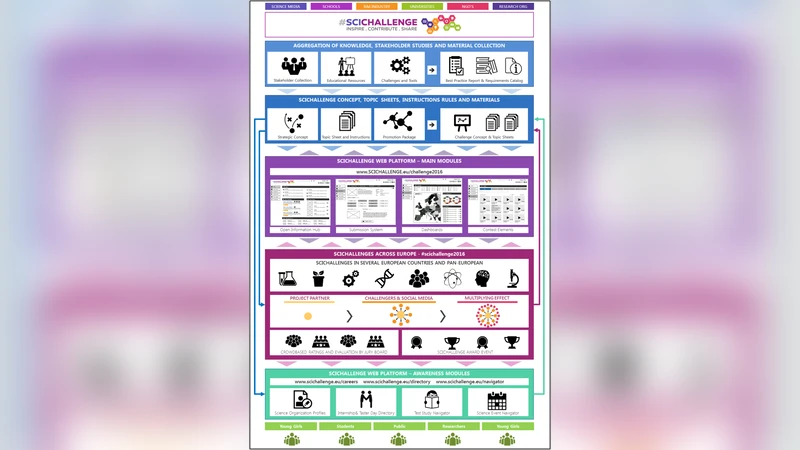
Science education will play a vital role in shaping the present and future of modern societies. Thus, Europe needs all its talents to increase creativity and competitiveness. Young boys and girls especially have to be engaged to pursue careers in Science, Technology, Engineering and Mathematics (STEM). However, statistics still show that enrolment rates in STEM-based degree programs are decreasing. This will lead to a workforce problem in the industrial sector as well as in research and development, especially in many of the new member countries. This paper highlights a recently funded EU-research project SciChallenge (www.scichallenge.eu), which focuses on the development of novel concepts to get young people excited about science education. It uses a contest-based approach towards self-produced digital education materials from young people for young people. In cooperation with partner schools, teachers, and other youth-oriented institutions, the contest participants (individuals or groups) between the ages of 10 and 20 years generate creative digital materials (videos, slides, or infographics). The participants upload their content in social media channels and the submissions are aggregated on the SciChallenge Web Platform. The winners receive prizes funded by science-oriented industry and other stakeholders. Intelligent cross-sectoral positioning of various awareness modules on the SciChallenge Open Information Hub is expected to increase awareness on science careers. Through a strong involvement of related organizations and industries, we expect to open new opportunities for young people in regards to internships or taster days in STEM disciplines. Additionally, aggregated information on science events (such as, slams, nights, festivals) is shared. With this multi-level approach, SciChallenge may boost the attractiveness of science education and careers among young people.
💡 Research Summary
The paper presents SciChallenge, a recently funded European Union research project that seeks to reverse the declining enrollment in STEM (Science, Technology, Engineering, Mathematics) degree programs by engaging young people through a contest‑based, student‑generated content model. Target participants are individuals or groups aged 10 to 20 years. They are invited to create digital educational materials on scientific topics—such as short videos, slide decks, or infographics—and to publish these creations on mainstream social‑media channels. All submissions are automatically harvested and displayed on the dedicated SciChallenge Web Platform, which functions as a central repository, search engine, and showcase for peer‑to‑peer learning.
The contest operates on a regular cycle, with thematic or age‑specific categories. Evaluation combines expert juries and algorithmic scoring, focusing on scientific accuracy, creativity, communicative clarity, and digital production quality. Winners receive monetary prizes and, crucially, access to industry‑sponsored opportunities: internships, “day‑in‑the‑lab” experiences, mentorship programmes, and potential pathways to STEM careers. By linking prizes to real‑world work placements, the project aligns student motivation with tangible professional outcomes, thereby strengthening the pipeline from education to employment.
A second pillar of SciChallenge is the Open Information Hub, an aggregating service that curates information about science‑related events—science slams, night‑time labs, festivals, and outreach activities—across participating regions. This hub not only raises awareness of existing STEM experiences but also encourages cross‑sector collaboration among schools, youth organisations, research institutes, and private companies.
The authors argue that this multi‑level approach addresses several systemic issues: (1) it cultivates digital literacy and scientific communication skills simultaneously, (2) it leverages peer‑learning dynamics by having “students teach students,” (3) it provides industry with a socially responsible channel to showcase its commitment to education while scouting future talent, and (4) it supplies policymakers with granular data on youth engagement in STEM, informing future educational strategies.
Challenges identified include ensuring content quality and evaluation transparency, protecting participants’ privacy while handling large volumes of user‑generated data, and maintaining long‑term engagement beyond the initial contest incentive. The paper suggests that future work should focus on quantitative assessment of learning outcomes, longitudinal tracking of participants’ career trajectories, and the development of sustainable incentive structures (e.g., digital badges, portfolio integration with higher‑education admissions).
In summary, SciChallenge exemplifies an innovative, ecosystem‑based model that transforms young people from passive recipients of science education into active creators and ambassadors. By integrating contest mechanics, digital platforms, industry partnerships, and event networking, the project aspires to boost the attractiveness of STEM education and careers across Europe, ultimately contributing to a more competitive and creative knowledge economy.
Comments & Academic Discussion
Loading comments...
Leave a Comment