Towards the Design of Effective Freehand Gestural Interaction for Interactive TV
As interactive devices become pervasive, people are beginning to looking for more advanced interaction with televisions in the living room. Interactive television has the potential to offer a very engaging experience. But most common user tasks are still challenging with such systems, such as menu selection or text input. And little work has been done on understanding and sup-porting the effective design of freehand interaction with an TV in the living room. In this paper, we perform two studies investi-gating freehand gestural interaction with a consumer level sensor, which is suitable for TV scenarios. In the first study, we inves-tigate a range of design factors for tiled layout menu selection, including wearable feedback, push gesture depth, target size and position in motor space. The results show that tactile and audio feedback have no significant effect on performance and prefer-ence, and these results inform potential designs for high selection performance. In the second study, we investigate a common TV user task of text input using freehand gesture. We design and evaluate two virtual keyboard layouts and three freehand selec-tion methods. Results show that ease of use and error tolerance can be both achieved using a text entry method utilizing a dual circle layout and an expanding target selection technique. Finally, we propose design guidelines for effective, usable and com-fortable freehand gestural interaction for interactive TV based on the findings.
💡 Research Summary
**
This paper investigates how to design effective free‑hand gestural interaction for interactive television (TV) in the living‑room setting, where users typically sit several meters away from a large screen and cannot rely on handheld devices. The authors conduct two controlled laboratory studies using a consumer‑grade depth sensor (Microsoft Kinect v1) to evaluate design parameters for two core TV tasks: tiled‑menu selection and free‑hand text entry.
Study 1 – Tile‑layout menu selection
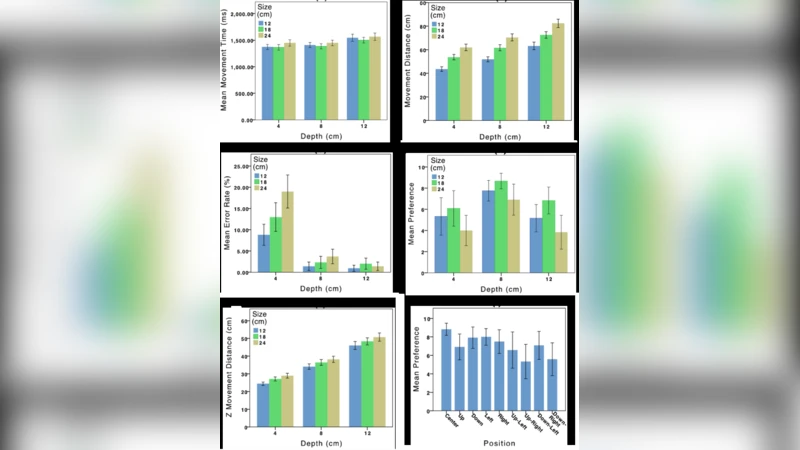
A 3 × 3 grid of square tiles (sizes 12 cm, 18 cm, 24 cm) is displayed on a 50‑inch 3D plasma TV. Participants (N = 12, ages 24‑37) select highlighted tiles by performing a forward “push” gesture of a specified depth (4 cm, 8 cm, 12 cm). The experiment manipulates four independent variables: (1) wearable feedback (tactile vibration vs. audio click), (2) push depth, (3) tile size, and (4) tile position (nine locations). Each participant completes 486 trials across all conditions. Performance metrics are selection time, error rate, and subjective preference (0‑10 Likert).
Key findings: (a) Neither tactile nor audio feedback significantly improves speed or accuracy (p > 0.05), suggesting that at typical TV viewing distances the added sensory cues are too weak to overcome the sensor’s limited resolution. (b) A push depth of 8 cm yields the fastest average selection time (≈1.12 s) and lowest error rate (≈4 %). Shallower pushes (4 cm) suffer from ambiguous depth detection; deeper pushes (12 cm) increase arm fatigue and travel distance. (c) Tile size of 18 cm is optimal; smaller tiles demand fine‑grained hand control, while larger tiles increase the required hand travel in motor space. (d) Central tiles are selected most quickly and accurately; peripheral and diagonal tiles incur longer times and higher errors, reflecting the ergonomic cost of moving the hand away from the natural shoulder‑height resting position.
Study 2 – Free‑hand text entry
The second study explores two virtual keyboard layouts: a conventional grid (QWERTY‑style) and a “dual‑circle” layout where letters are arranged on two concentric circles. Three selection techniques are evaluated: (1) click (push‑depth activation), (2) expanding target (visual and spatial enlargement of the target when the hand approaches), and (3) cross (a dwell‑time based selection where the hand must cross the target area). Participants again perform a series of short phrase entries after a brief practice period. Metrics include words‑per‑minute (wpm), error percentage, perceived fatigue, and preference ratings.
Results: The dual‑circle layout combined with the expanding‑target technique achieves the highest entry speed (average 5.2 wpm) and the lowest error rate (≈6.8 %). The expansion mechanism compensates for the Kinect’s low spatial resolution by enlarging the selectable region as the hand nears it, thus reducing the need for precise depth discrimination. The grid‑layout with click activation performs worst (≈3.4 wpm, 12 % errors) because depth detection errors directly translate into missed selections. The cross method yields intermediate speeds (≈4.0 wpm) but incurs higher fatigue due to the required dwell time. Subjective feedback indicates that users find the visual expansion intuitive and that the dual‑circle arrangement is easier to memorize.
Design Guidelines
From the two studies the authors derive practical guidelines for free‑hand gestural UI design on interactive TVs:
- Feedback – In low‑resolution, mid‑range scenarios, visual cues (e.g., target highlighting, expansion) are more beneficial than auditory or tactile feedback.
- Push depth – An optimal forward displacement of roughly 6–10 cm (8 cm used in the experiments) balances detection reliability with ergonomic comfort.
- Target size – Tiles or keys sized around 15–20 cm in motor space provide the best trade‑off between precision and travel distance.
- Layout geometry – Circular or dual‑circle arrangements align better with natural arm extensions for text entry than dense rectangular grids.
- Target expansion – Dynamically enlarging a target as the hand approaches mitigates sensor noise and improves both speed and accuracy.
- Ergonomics – Keep hand‑to‑shoulder angles within 0–30° and minimize the number of required pushes to reduce fatigue during prolonged TV sessions.
Conclusion
The paper delivers the first comprehensive empirical evaluation of free‑hand gestural interaction for interactive TV, focusing on two ubiquitous tasks: menu navigation and text entry. It demonstrates that, contrary to many mobile touch‑screen studies, additional tactile or audio feedback does not meaningfully enhance performance when the interaction distance is large and the sensor resolution is limited. Instead, careful tuning of push depth, target size, and spatial layout, together with visual expansion techniques, yields substantial gains in speed, accuracy, and user satisfaction. The proposed guidelines are directly applicable to low‑cost 3D camera platforms (Kinect, ASUS Xtion) and can inform the design of future “walk‑up‑and‑use” TV interfaces, as well as other large‑display environments such as digital signage or smart‑room control panels. Future work should explore multi‑user scenarios, hybrid modalities (speech + gesture), and adaptive UI scaling based on real‑time sensor confidence.
Comments & Academic Discussion
Loading comments...
Leave a Comment