Anomalous capillary filling and wettability reversal in nanochannels
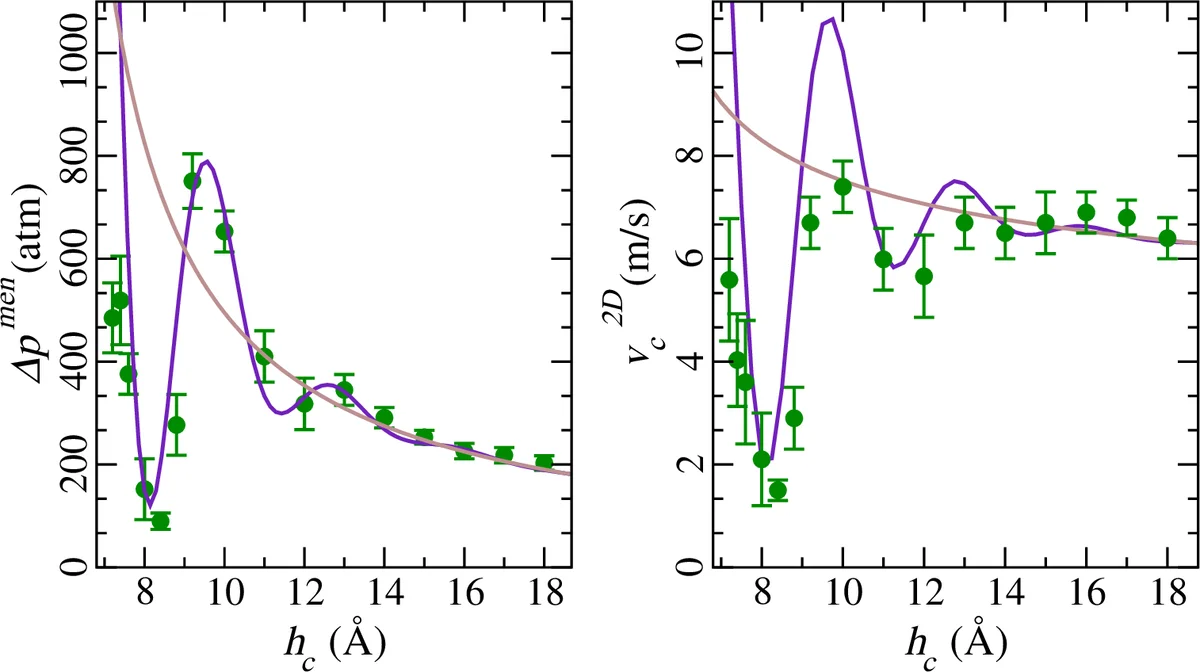
This work revisits capillary filling dynamics in the regime of nanometric to subnanometric channels. Using molecular dynamics simulations of water in carbon nanotubes, we show that for tube radii below one nanometer, both the filling velocity and the Jurin rise vary non-monotonically with the tube radius. Strikingly, with fixed chemical surface properties, this leads to confinement-induced reversal of the tube wettability from hydrophilic to hydrophobic for specific values of the radius. By comparing with a model liquid metal, we show that these effects are not specific to water. Using complementary data from slit channels, we then show that they can be described using the disjoin-ing pressure associated with the liquid structuring in confinement. This breakdown of the standard continuum framework is of main importance in the context of capillary effects in nanoporous media, with potential interests ranging from membrane selectivity to mechanical energy storage.
💡 Research Summary
This paper revisits the classic problem of capillary filling, focusing on the nanometric to sub‑nanometric regime where the tube dimensions approach the size of individual fluid molecules. Using extensive molecular dynamics (MD) simulations, the authors first examine water confined in carbon nanotubes (CNTs) with radii ranging from 3.9 Å to 24 Å (length 10 nm). The standard continuum description combines the Laplace pressure jump across the meniscus, Δp_men = 2γ cosθ / a, with the entrance‑loss pressure given by the Sampson formula, Δp_ent = C η Q / a³. Assuming plug‑flow inside the tube, the resulting capillary velocity is v_c = 4Δγ / (π C η), which, apart from the weak radius dependence of the Sampson coefficient C, predicts a radius‑independent filling speed.
The MD protocol separates a dynamic stage (removing a plug at the tube entrance and measuring the linear increase of the number of water molecules inside the tube) from a static stage (freezing the piston to stop the meniscus and measuring the force on it to obtain Δp_men). For each radius, five independent simulations are performed to obtain averages and standard deviations.
Results show that for tube radii larger than ≈1 nm (a_c > 15 Å) the simulated capillary velocities and meniscus pressure jumps agree well with the continuum prediction. However, for smaller radii the behavior becomes highly non‑monotonic. Notably, local maxima of v_c appear at a_c ≈ 5.1 Å and 3.9 Å, while at a_c ≈ 4.3 Å and 4.7 Å the velocity becomes negative, indicating a reversal of the capillary flow (the liquid is expelled rather than drawn in). The static measurements of Δp_men display the same oscillatory pattern, confirming that the anomaly originates from the driving pressure term rather than from entrance hydrodynamics.
To test whether this phenomenon is specific to water, the authors repeat the study with a model liquid metal (based on an embedded‑atom method for gold). Despite the metal’s vastly larger surface tension (≈777 mN m⁻¹) and higher viscosity (≈30 mPa s), the same non‑monotonic velocity and pressure trends are observed, including negative velocities for the same narrow radius window (≈4.3–4.7 Å). This demonstrates that the effect is generic and stems from fluid structuring under extreme confinement rather than from hydrogen‑bonding or other water‑specific interactions.
Complementary simulations in slit‑shaped nano‑channels further support the interpretation. The authors invoke the concept of disjoining pressure—an additional pressure contribution arising from molecular layering and density oscillations near solid walls. In sub‑nanometric confinement, these oscillations produce alternating regions of excess and deficit pressure, effectively modulating the apparent contact angle. At certain radii the effective Δγ becomes negative, leading to a wettability reversal from hydrophilic to hydrophobic even though the chemical surface chemistry is unchanged.
The discussion highlights the practical implications. In nanoporous membranes, energy‑storage devices, or any technology relying on capillary-driven transport, the assumption of a monotonic relationship between pore size and capillary uptake can be dramatically wrong at the sub‑nanometer scale. Design strategies must therefore incorporate a quantitative description of the disjoining pressure or, more generally, of confinement‑induced fluid structuring.
In conclusion, the paper provides compelling evidence that capillary filling in ultra‑narrow channels cannot be captured by classical continuum models alone. The observed anomalous filling velocities, pressure jumps, and wettability reversals are rooted in the molecular ordering of the confined liquid, which adds a radius‑dependent disjoining pressure term to the Laplace pressure. This insight opens new avenues for tailoring fluid transport in nanofluidic systems by deliberately exploiting or avoiding specific pore sizes where the structuring effects become dominant.
Comments & Academic Discussion
Loading comments...
Leave a Comment