On the existence of kings in continuous tournaments
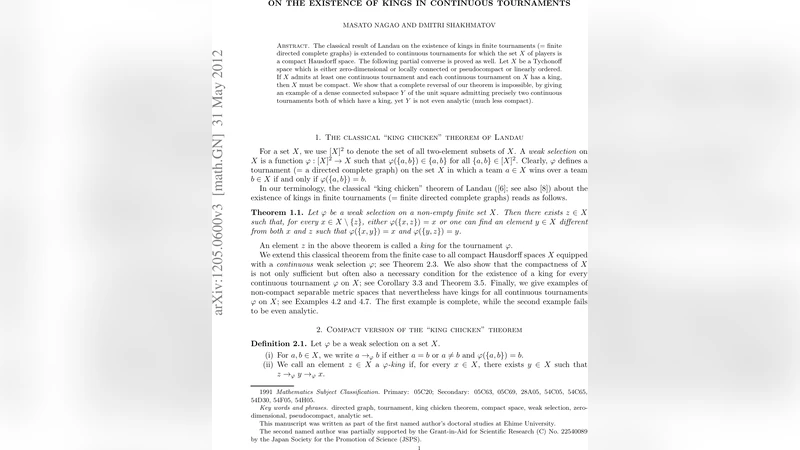
The classical result of Landau on the existence of kings in finite tournaments (=finite directed complete graphs) is extended to continuous tournaments for which the set X of players is a compact Hausdorff space. The following partial converse is proved as well. Let X be a Tychonoff space which is either zero-dimensional or locally connected or pseudocompact or linearly ordered. If X admits at least one continuous tournament and each continuous tournament on X has a king, then X must be compact. We show that a complete reversal of our theorem is impossible, by giving an example of a dense connected subspace Y of the unit square admitting precisely two continuous tournaments both of which have a king, yet Y is not even analytic (much less compact).
💡 Research Summary
The paper lifts Landau’s classical theorem on the existence of kings in finite tournaments to the setting of continuous tournaments, where the set of players X is a compact Hausdorff space. A continuous tournament is defined as a continuous map T : X × X → {0,1} such that for every distinct pair (x,y) exactly one of T(x,y)=1 or T(y,x)=1 holds, i.e., the direction of each edge is prescribed continuously. The authors first prove that if X is compact Hausdorff, then every continuous tournament on X possesses at least one king. The proof proceeds by considering, for each point x, the set of points that x beats directly and the closure of this set. Compactness guarantees that the family of these closed “dominance” sets has a non‑empty intersection; any point in the intersection reaches every other point in at most two steps, thus qualifying as a king. This argument mirrors Landau’s original combinatorial proof but replaces finiteness with topological compactness, invoking the finite intersection property and the closedness of dominance sets.
The second major contribution is a partial converse. The authors identify four broad classes of Tychonoff spaces—zero‑dimensional, locally connected, pseudocompact, and linearly ordered—such that if a space X belongs to any of these classes and every continuous tournament on X has a king, then X must be compact. For each class they construct a counter‑example tournament when X is non‑compact, showing that a king cannot exist. In the zero‑dimensional case they use a clopen basis to build an infinite family of disjoint clopen sets and define a tournament that forces a cyclic dominance among them, preventing any point from dominating all others within two steps. In the locally connected case they exploit the existence of infinitely many separated connected components or an unbounded component to arrange a continuous cyclic orientation. For pseudocompact spaces they employ an infinite open cover with no finite subcover and assign a directional hierarchy along the cover, again breaking the king property. Finally, for linearly ordered spaces they use the order itself as the tournament direction; non‑compactness implies the lack of a greatest or least element, which precludes a king.
These constructions demonstrate that, under fairly mild topological hypotheses, the “king‑for‑all‑tournaments” property forces compactness, thereby extending the classical finite result in a robust topological direction.
The paper also shows that a full converse cannot hold in general. The authors present a dense, connected subspace Y of the unit square
Comments & Academic Discussion
Loading comments...
Leave a Comment