Nuclear norm penalization and optimal rates for noisy low rank matrix completion
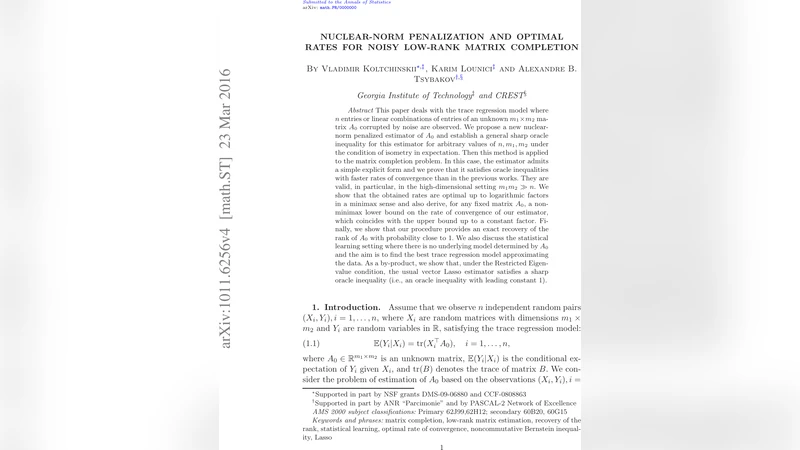
This paper deals with the trace regression model where $n$ entries or linear combinations of entries of an unknown $m_1\times m_2$ matrix $A_0$ corrupted by noise are observed. We propose a new nuclear norm penalized estimator of $A_0$ and establish a general sharp oracle inequality for this estimator for arbitrary values of $n,m_1,m_2$ under the condition of isometry in expectation. Then this method is applied to the matrix completion problem. In this case, the estimator admits a simple explicit form and we prove that it satisfies oracle inequalities with faster rates of convergence than in the previous works. They are valid, in particular, in the high-dimensional setting $m_1m_2\gg n$. We show that the obtained rates are optimal up to logarithmic factors in a minimax sense and also derive, for any fixed matrix $A_0$, a non-minimax lower bound on the rate of convergence of our estimator, which coincides with the upper bound up to a constant factor. Finally, we show that our procedure provides an exact recovery of the rank of $A_0$ with probability close to 1. We also discuss the statistical learning setting where there is no underlying model determined by $A_0$ and the aim is to find the best trace regression model approximating the data.
💡 Research Summary
The paper studies the trace‑regression framework in which one observes noisy linear measurements of an unknown matrix (A_{0}\in\mathbb R^{m_{1}\times m_{2}}). Each observation takes the form
\
Comments & Academic Discussion
Loading comments...
Leave a Comment