The Minimum Backlog Problem
We study the minimum backlog problem (MBP). This online problem arises, e.g., in the context of sensor networks. We focus on two main variants of MBP. The discrete MBP is a 2-person game played on a graph $G=(V,E)$. The player is initially located …
Authors: Michael A. Bender, S, or P. Fekete
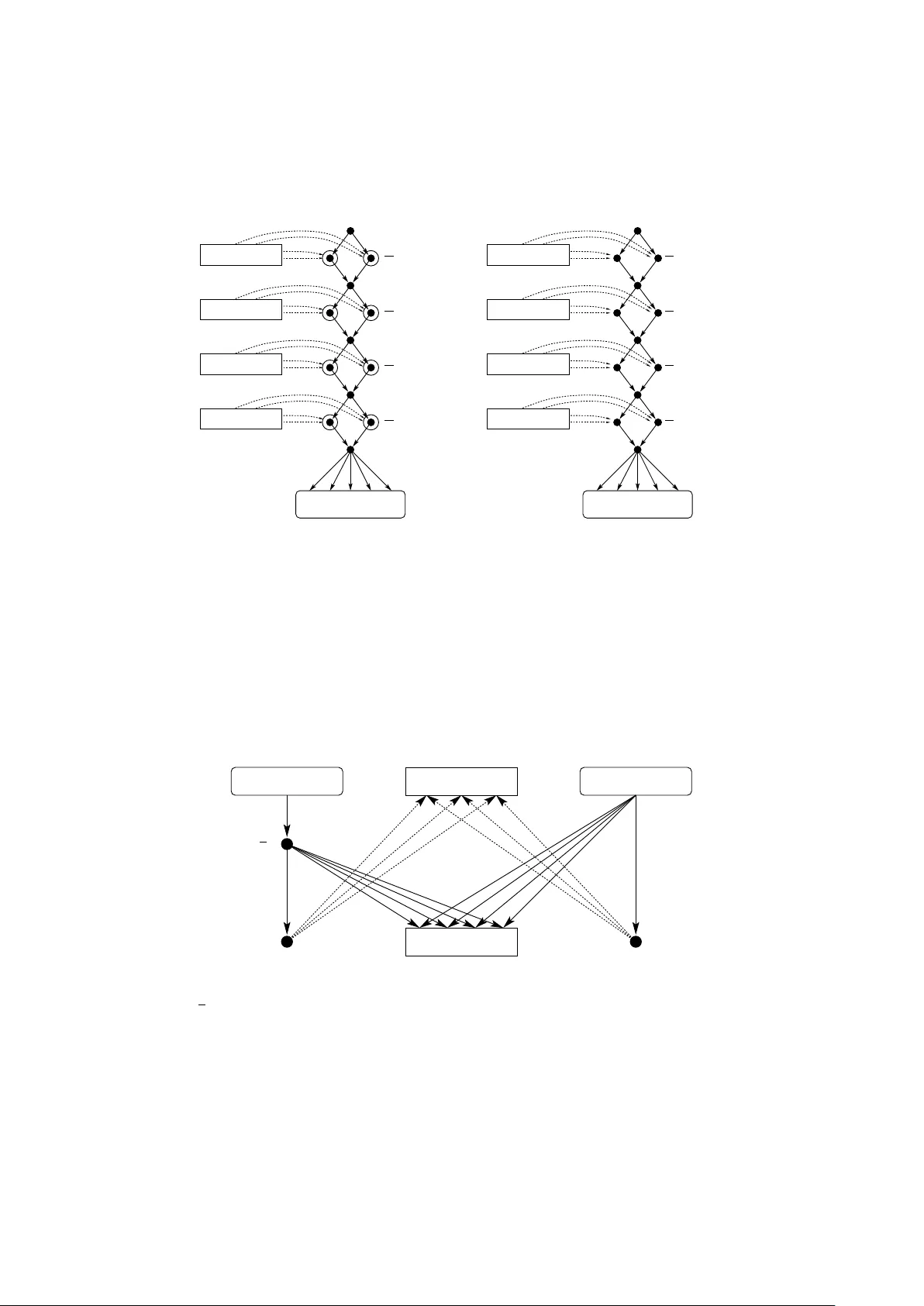
The Minim um Bac klog Problem Mic hael A. Bender, S´ andor P . F ek ete, Alexander Kr¨ oller, Vincenzo Liberatore, Joseph S. B. Mitc hell, V alentin P olishch uk, Jukk a Suomela Abstract W e study the minim um backlog problem (MBP). This online problem arises, e.g., in the con text of sensor netw orks. W e fo cus on t wo main v ariants of MBP . The discr ete MBP is a 2-p erson game play ed on a graph G = ( V , E ). The player is initially lo cated at a v ertex of the graph. In eac h time step, the adversary p ours a total of one unit of water in to cups that are lo cated on the vertices of the graph, arbitrarily distributing the water among the cups. The play er then mov es from her curren t vertex to an adjacent vertex and empties the cup at that vertex. The play er’s ob jective is to minimize the b acklo g , i.e., the maximum amount of w ater in any cup at any time. The ge ometric MBP is a con tinuous-time version of the MBP: the cups are p oin ts in the tw o-dimensional plane, the adversary p ours water contin uously at a constant rate, and the pla yer mov es in the plane with unit sp eed. Again, the pla yer’s ob jective is to minimize the backlog. W e sho w that the c omp etitive r atio of any algorithm for the MBP has a low er b ound of Ω( D ), where D is the diameter of the graph (for the discrete MBP) or the diameter of the p oint set (for the geometric MBP). Therefore w e fo cus on determining a strategy for the play er that guarantees a uniform upper bound on the absolute v alue of the backlog. F or the absolute v alue of the backlog there is a trivial lo wer b ound of Ω( D ), and the deamortization analysis of Dietz and Sleator giv es an upp er bound of O ( D log N ) for N cups. Our main result is a tigh t upp er b ound for the geometric MBP: w e show that there is a strategy for the play er that guaran tees a backlog of O ( D ), indep enden tly of the num b er of cups. W e also study a lo c alize d v ersion of the discrete MBP: the adversary has a lo cation within the graph and must act lo cally (filling cups) with respect to his position, just as the play er acts lo cally (emptying cups) with resp ect to her p osition. W e prov e that deciding the v alue of this game is PSP ACE-hard. 1 In tro duction W e study the minim um bac klog problem ( MBP ). This is an online problem in whic h an agent mov es around a domain and services a set of lo cations, “empt ying” a buffer at each lo cation in an effort to make sure that no buffer gets to o full. The MBP is related to the k -serv er problem [8, 14, 15, 19, 20, 24] (with k = 1), in whic h requests are popping up at p oin ts in a metric space, and the k serv ers need to minimize the distance tra veled to satisfy the requests. Ho wev er, in the MBP , the ob jective is not to minimize the trav eled distance, but to minimize the b acklo g , i.e., the maximum amoun t of data residing in an y buffer at any p oint in time. 1.1 Motiv ation A practical motiv ation for the MBP arises in the con text of a sensor net work that, e.g., performs motion-tracking for a set of ob jects that mov e within the sensor field. Eac h sensor acquires data about nearby ob jects. The total rate of data accumulation within the netw ork remains appro ximately constant, assuming a relativ ely fixed set of ob jects being monitored; how ev er, the distribution of the data rate ov er the field is non uniform and unpredictable. If the system is used for a field study where the data is not analyzed un til the end of the exp eriment, it may be m uc h more energy-efficien t to store the bulk of the data lo cally on a memory card and let someone or something gather the data b y physically visiting the sensor device (or a neighborho o d of the device) [10, 16, 17, 21, 25]. During the exp eriment, e ac h sensor only needs to rep ort the amount of data in its lo cal buffer. The ob jective of the data gatherer is to visit the sensors in an effective order, so that no sensor’s storage device is ov erfull. An analogous problem arises in scheduling battery recharging/replacemen t in a field of wireless devices whose p ow er consumption v aries unpredictably with time and lo cation. 1.2 Discrete MBP W e will now formalize three versions of the MBP that w e study in this pap er. W e start with the discrete MBP . In this problem, w e hav e an un weigh ted directed graph G = ( V , E ) with an (initially empt y) cup on eac h vertex. There is a pla y er , who mo ves from v ertex to vertex along the edges of the graph emptying cups, and there is an adv ersary (not located anywhere in particular), who refills the cups with water. W e talk ab out filling cups with water b ecause of historical preceden t [11]. The follo wing game is play ed for an indefinite (but finite) n umber of rounds. In eac h round, the tw o opp onen ts do the follo wing: • The adversary p ours a total of one unit of water into the cups. The adv ersary is free to distribute the unit of water in an y wa y he likes. The adversary may base his decision on the current location of the pla yer and the curren t water levels in all of the cups. • The pla yer mov es along an edge and empties the cup in its new location. The pla yer can see the amoun t of w ater that the adversary has p oured into eac h cup, and the pla yer can use this information to mak e the decisions. 1 The problem is online, i.e., the play er do es not know how the water is distributed in the future. Th us, the play er’s decision of which edge to tra verse may b e based only on the amoun t of the water that has b een p oured into all cups so far, but not on the future distribution of w ater. The ob jective of the play er is to minimize the bac klog , whic h is defined to b e the maxim um amount of water in any cup at any time. 1.3 Geometric MBP It is straightforw ard to generalize the MBP to w eighted, contin uous scenarios. In this pap er w e will mainly fo cus on the following version whic h we call the geometric MBP ; this version is of particular in terest for sensor-net work applications. Let P ⊆ R 2 b e a finite planar set. There is a cup on eac h p oint of P . The t wo-pla y er game pro ceeds as follo ws in a con tinuous manner: • The adv ersary p ours w ater into the cups P ; the total rate at which the w ater is p oured in to the cups is 1. • The pla yer mo ves in the plane with unit sp eed, starting at an arbitrary p oint. Whenev er the play er visits a cup, the cup is emptied. Again, this is an online problem, and the goal of the play er is to minimize the bac klog. 1.4 Lo calized MBP In the discrete and geometric v ersions of the MBP , the actions of the pla yer are restricted b y her lo cation. T o keep the game fair, we may also consider the following v ariant in which the actions of the adversary are also restricted b y his lo cation; we call it the lo calized MBP . The game is a fairly straightforw ard adaptation of the discrete MBP; how ever, some of the details need more care, as w e will b e in terested in deciding the exact v alue of this game. The localized MBP is a t wo-pla y er game pla yed on a directed graph G = ( V , E ). Eac h vertex is a cup that carries some in teger load (w ater level). An instance of the lo calized MBP consists of the graph, the initial loads of the cups, and the distinct starting p ositions of the t wo play ers. A t each time step, b oth the play er and the adversary are lo cated at some vertices. The pla yer starts the game, and b oth participants take turns in moving from their resp ectiv e current p osition along an outgoing edge to an adjacent no de (they are not allo wed to stay in place): • A mo ve by the play er ends with her removing the load from the vertex she reac hed. • A mov e b y the adv ersary ends with him increasing the load on the vertex he reac hed by one unit. The game ends when the pla y er steps onto the v ertex curren tly o ccupied b y the adv ersary , or when the adversary manages to get the load on some vertex to a pre- sp ecified target v alue . The pla yer wins if she can keep the adversary from reaching the target v alue; the adversary wins if he can reac h the target v alue. 2 1.5 Results Throughout this work, we write N for the num b er of cups, and D for the maximum distance b et ween the cups (i.e., the diameter of the graph G or the set P ). W e start with the follo wing simple observ ations (Section 3): • Discr ete and ge ometric MBP, c omp etitive analysis : The competitive ratio of an y algorithm for the problem may be as bad as Ω( D ). Therefore w e will fo cus on absolute b ounds on the bac klog in this pap er. • Discr ete and ge ometric MBP, lower b ounds : The adv ersary can guaran tee a bac klog of Ω( D ). F or the discrete version, the adv ersary can also guarantee a bac klog of Ω(log N ). • Discr ete and ge ometric MBP, upp er b ounds : The pla yer can guarantee a backlog of O ( D log N ). Our main results are as follows: • Ge ometric MBP, upp er b ounds (Sections 5 and 6): W e show that the play er can ac hieve a bac klog of O ( D ), indep endently of the num b er of cups. This is optimal up to constan ts. • L o c alize d MBP, har dness (Section 7): W e show that deciding the v alue of the game is PSP ACE-hard, even for the smallest nontrivial target v alue of 2. 2 Bac kground and Related W ork This style of problem, with a pla yer empt ying one cup at a time and an adversary distributing w ater among cups, is a classic problem, whic h has b een indep endently disco vered and rediscov ered many times. How ever, in previous form ulations, there is no issue of lo cality—that is, the pla yer can empty an y single cup (or, depending on the form ulation, an y feasible subset of cups) in any time step, independently of her previous actions. The earliest reference to cup empt ying of whic h we are a ware is the work of Dietz and Sleator [11], who used it as a technique for deamortizing data structures. They pro ved that if there are N cups, and the play er alw ays empties the fullest one, then no cup ever contains more than ln N w ater; they also sho wed that this b ound is optimal. The b ound leads to an optimal, worst-case-constan t algorithm for the order-main tenance problem. This deamortization technique has b een used many times since. Adler et al. [1] used cup emptying as a tec hnique for analyzing scheduling algorithms. In particular, they show ed ho w to use cup empt ying to pro duce “fair” job schedules. Chrobak et al. [7] introduced a generalization of cup emptying and applied it to m ultipro cessor scheduling with conflicts b et ween tasks; there is subsequent work by , e.g., Bar-No y et al. [3], Koga [18], and Rote [23]. In the problem, the play er can empty more than one cup at a time, but there is a conflict graph b etw een cups. If t wo cups conflict, only one of them can b e emptied at a time. Here there is a graph, but there is still no issue of lo cality . 3 More recen t work by Bo dlaender et al. [6] considers a generalization of the game on an un weigh ted, undirected graph G = ( V , E ), in whic h one mov e b y the adversary consists of arbitrarily distributing one unit of w ater among a subset S ⊆ V , while a mov e of the play er is to empty all cups of an independent set. They sho w that the v alue of the game (the largest p ossible filling lev el of a cup that the adversary can force, and to which the pla yer can limit the sequence) lies b etw een the natural logarithm of the clique num b er and the natural logarithm of the c hromatic n umber, settling the v alue of the game for all p erfect graphs. They also consider the game on the simplest non-p erfect graphs, i.e., o dd holes and o dd an ti-holes, and show that a natural greedy strategy is generally not optimal. Bodlaender et al. [5] consider another v ariant on a ring graph with N no des, where the play er may empty an arbitrary group of c consecutiv e cups in eac h round, and compute the exact v alues for all N ≤ 12. T o the b est of our knowledge, in all previous w ork on cup emptying, there is no concept of lo calit y of the pla yer with resp ect to the cups. In contrast, the minimum bac klog problem studied in this pap er is sp ecifically cup emptying with a play er who mo ves around in graphs or geometric domains. It is imp ortan t to note that although the motiv ation for studying cup emptyi ng in metric spaces came from online vehicle routing, the lo cality shows up in non-geometric con texts as w ell. F or instance, in a job scheduling problem, there may b e a (set-up) cost asso ciated with switc hing from executing one job to executing another. This, in particular, mak es the T rav eling Salesman Problem, which originated as a geometric problem, applicable also to sc heduling tasks [2, 9, 26]. Hence, although we state our problem and results in purely geometric terms, they are also relev ant in some more general sc heduling applications. 3 Preliminary Observ ations W e start with preliminary observ ations on the discrete and geometric v ersions of the MBP . 3.1 Comp etitiv e Analysis is Doomed It w ould b e natural to try to give a comp etitive algorithm for the MBP . Unfortunately , an online algorithm with a go o d comp etitive ratio is not p ossible, unless we restrict ourselv es to the case of N = O (1) or D = O (1). Indeed, consider either of the follo wing scenarios, b oth of whic h hav e N cups and a diameter of D = N − 1: 1. discr ete MBP : graph G is a path on N v ertices, 2. ge ometric MBP : set P consists of the p oin ts (1 , 0) , (2 , 0) , . . . , ( N , 0). Num b er the cups b y 1 , 2 , . . . , N so that cups 1 and N are the endpoints of the diameter. Supp ose that the adv ersary picks a random p ermutation of the cups 2 through N − 1, and for the first N − 2 time steps p ours a unit of water per step in to the cups according to the p erm utation. Then, the adv ersary picks one of the endp oin ts of the path and p ours the water there forever. The b est offline strategy w ould b e to rush to the endp oin t and sta y there—this yields a maximum bac klog of 1. On the other hand, without prior knowledge of the “drenc hed” endp oint, any algorithm will put the play er far from the endp oint (since the adversary may choose the endp oin t that is farthest 4 from the curren t pla y er position), thus, making the p erformance of the algorithm Ω( N ) = Ω( D ). Giv en that the comp etitiv e ratio of an online algorithm for the problem ma y b e v ery high, w e concentrate on pro viding uniform upp er b ounds on the performance, i.e., on giving univ ersal b ounds on the amoun t of water in any cup at an y time. 3.2 Simple Lo w er Bounds The p erformance of any algorithm has a low er b ound of Ω( D ): the adv ersary can simply pour water at the rate of 1 / 2 in to the cups at the ends of the diameter. The same holds for both the discrete MBP and the geometric MBP . T o get another low er b ound, the adversary ma y pic k a set of K cups such that the distance b etw een an y t wo cups in the set is at least d , for some num ber d . The adv ersary will then p our the w ater ev enly in to never-emptied cups from the set. After dK steps, one of the cups will hav e Ω d K + d K − 1 + · · · + d = Ω( d ln K ) units of w ater. In particular, for the discrete MBP with N cups, w e can alw a ys choose d = 1 and K = N , and hence the adv ersary can ensure a backlog of Ω( max ( D , log N )). There are also some families of graphs in whic h the adversary can guarantee a backlog of Ω( D log N ): consider, for example, sub divisions of star graphs. 3.3 Simple Upp er Bounds As for the upp er b ounds, which is the main focus of the paper, a na ¨ ıv e algorithm has a p erformance of O ( C ), where C is the length of the shortest closed path visiting all cups. T o find a b etter upp er b ound, let us first consider the discr ete MBP on a c omplete gr aph (or, put otherwise, a game in whic h the pla yer can empt y any single cup in eac h round). In tuitively , alw ays emptying the fullest cup is optimal, and a simple exchange argumen t v alidates this intuition. Dietz and Sleator [11] analyze the p erformance of this strategy . Lemma 3.1 (Dietz and Sleator [11, Theorem 5]) . In the discr ete MBP on a c omplete gr aph with N vertic es, if the player always empties the ful lest cup, then no cup ever c ontains mor e than ln N units of water. W e can apply the same strategy in the discrete and geometric MBP: the pla yer rep eatedly w alks to the fullest cup (whic h takes at most D time units) and empties it. A simple application of Lemma 3.1 shows that the bac klog of this strategy will b e b ounded b y O ( D log N ), where N is the num b er of cups. This is the upper b ound that we set out to b eat in this pap er. Recall from Section 3.2 that we cannot necessarily do an y b etter in the discrete MBP . Ho wev er, w e show that in the geometric MBP the pla yer alwa ys has a strategy that guarantees a bac klog of O ( D ), indep endently of the num ber of cups. 5 4 Algorithmic T ec hniques W e will no w start to develop the algorithmic tec hniques that w e will use to design our strategy for the geometric MBP . There are tw o main ingredients: 1. the ( τ , k )-game (Section 4.1), 2. F ew’s lemma (Section 4.2). The ( τ , k )-game is a purely combinatorial tw o-pla yer game; w e do not make an y references to the geometric setting that we hav e in the geometric MBP . On the other hand, F ew’s lemma is a purely geometric result; there is no game-theoretic element in the statemen t of the result. Section 5 shows how to put the t wo ingredients together in order to design a strategy for the geometric MBP . 4.1 The ( τ , k )-game The ( τ , k )-game is a straigh tforward generalisation of the empt y-the-fullest strategy on a complete graph (recall Lemma 3.1). F or each τ ∈ R , k ∈ N w e define the ( τ , k ) -game as follo ws. There is a set of cups, initially empt y , not lo cated in an y particular metric space. A t each time step the follo wing takes place, in this order: 1. The adv ersary p ours a total of τ units of w ater into the cups. The adv ersary is free to distribute the water in any wa y he lik es. 2. The play er empties k ful lest cups. The game is discrete—the play er and the adv ersary tak e turns making mov es during discrete time steps. The following lemma bounds the amoun t of w ater in an y cup after r steps of the game; this is a direct extension of a result of Dietz and Sleator [11]. Lemma 4.1. The water level in any cup after r c omplete time steps of the ( τ , k ) -game is at most H r τ /k , wher e H r is the r th harmonic numb er. Pr o of. W e follo w the analysis of Dietz and Sleator [11, Theorem 5]. Consider the w ater levels in the cups after time step j . Let X j ( i ) b e the amount of water in the cup that is i th fullest, and let S j = ( r − j ) k +1 X i =1 X ( i ) j b e the total amount of w ater in ( r − j ) k + 1 fullest cups at that time. Initially , j = 0, X ( i ) 0 = 0, and S 0 = 0. Let us consider what happ ens during time step j ∈ { 1 , 2 , . . . , r } . The adv ersary p ours τ units of w ater; the total amount of water in ( r − ( j − 1)) k + 1 fullest cups is therefore at most S j − 1 + τ after the adversary’s mov e and b efore the pla yer’s mov e (the w orst case b eing that the adv ersary p ours all w ater into ( r − ( j − 1)) k + 1 fullest cups). Then the pla yer empties k cups. These k fullest cups cont ained at least a fraction k / (( r − ( j − 1)) k + 1) of all w ater in the ( r − ( j − 1)) k + 1 fullest cups; the remaining ( r − j ) k + 1 cups are now the fullest. W e obtain the inequalit y S j ≤ 1 − k ( r − ( j − 1)) k + 1 ( τ + S j − 1 ) 6 or S j ( r − j ) k + 1 ≤ τ ( r − ( j − 1)) k + 1 + S j − 1 ( r − ( j − 1)) k + 1 . Therefore the fullest cup after time step r has the w ater level at most X (1) r = S r k ( r − r ) + 1 ≤ τ 1 k + 1 + τ 2 k + 1 + . . . + τ r k + 1 + S 0 r k + 1 ≤ τ k 1 1 + 1 2 + . . . + 1 r . 4.2 F ew’s Lemma Let us next introduce the geometric ingredient that we will need. The follo wing result is b y F ew [13]: Lemma 4.2 (F ew [13, Theorem 1]) . Given n p oints in a unit squar e, ther e is a p ath thr ough the n p oints of length not exc e e ding √ 2 n + 1 . 75 . W e make use of the following corollary: Corollary 4.3. L et S b e a D × D squar e. L et i ∈ { 0 , 1 , . . . } . L et Q ⊆ S b e a planar p oint set with | Q | = 25 i and diam ( Q ) = D . F or any p oint p ∈ S ther e exists a close d tour of length at most 5 i +1 D that starts at p , visits al l p oints in Q , and r eturns to p . Pr o of. If i > 0, b y Lemma 4.2, there is tour of length at most q 2(25 i + 1) + 1 . 75 + √ 2 D ≤ 5 i +1 D that starts at p , visits all p oints in Q , and returns to p . If i = 0, there is a tour of length 2 √ 2 D ≤ 5 D through p and | Q | = 1 p oints. 5 Geometric MBP: Pla y er’s Strategy No w we are ready to presen t an asymptotically optimal algorithm for the geometric MBP . The pla yer’s strategy is comp osed of a n umber of coroutines, whic h we lab el with i ∈ { 0 , 1 , . . . } . The coroutine i is in vok ed at times (10 L + ` ) τ i for eac h L ∈ { 0 , 1 , . . . } and ` ∈ { 1 , 2 , . . . , 10 } . Whenev er a low er-n umbered coroutine is in vok ed, higher- n umbered coroutines are susp ended until the lo wer-n um b ered coroutine returns. 5.1 P arameters W e choose the v alues τ i as follo ws. F or i ∈ { 0 , 1 , 2 , . . . } , let k i = 25 i , τ i = (2 / 5) i · 10 D k i = 10 i · 10 D . F or L ∈ { 0 , 1 , . . . } and ` ∈ { 1 , 2 , . . . , 10 } , define ( i, L, ` ) -water to be the water that w as p oured during the time in terv al [ 10 Lτ i , (10 L + ` ) τ i ]. 7 5.2 Coroutine i The coroutine i performs the following tasks when inv ok ed at time (10 L + ` ) τ i : 1. Determine which k i cups to empty . The coroutine chooses to empt y k i cups with the largest amoun t of ( i, L, ` )-water. 2. Cho ose a cycle of length at most τ i / 2 i +1 whic h visits the k i cups and returns bac k to the original p osition. This is p ossible due to Corollary 4.3 b ecause 5 i +1 D = τ i / 2 i +1 . 3. Guide the play er through the c hosen cycle. 4. Return. Observ e that when a coroutine returns, the play er is bac k in the lo cation from which the cycle started. Therefore inv ocations of lo wer-n um b ered coroutines do not interfere with any higher-num ber coroutines whic h are currently susp ended; they just delay the completion of the higher-n umbered coroutines. The completion is not delay ed for to o long. Indeed, consider a time p erio d [ j τ i , ( j + 1) τ i ] b etw een consecutiv e in vocations of the coroutine i . F or h ∈ { 0 , 1 , . . . , i } , the coroutine h is in vok ed 10 i − h times during the p erio d (recall the definition of τ i in Section 5.1). The cycles of the coroutine h hav e total length at most 10 i − h τ h / 2 h +1 = τ i / 2 h +1 . In grand total, all coroutines 0 , 1 , . . . , i in vok ed during the time perio d tak e time i X h =0 τ i / 2 h +1 < τ i . Therefore all coroutines inv ok ed during the time p erio d are able to complete within it. This pro ves that the execution of the coroutines can b e sc heduled as describ ed. 6 Geometric MBP: Analysis W e now analyse the bac klog under the strategy of Section 5. F or an y p oints in time 0 ≤ t 1 ≤ t 2 ≤ t 3 , w e write W ([ t 1 , t 2 ] , t 3 ) for the maxim um p er-cup amount of water that w as p oured during the time in terv al [ t 1 , t 2 ] and is still in the cups at time t 3 . W e need to show that W ([ 0 , t ] , t ) is b ounded b y a constant that do es not dep end on t . T o this end, we first b ound the amoun t of ( i, L, ` )-w ater present in the cups at the time (10 L + ` + 1) τ i . Then w e b ound the maximum p er-cup amount of water at an arbitrary momen t of time b y decomp osing the water into ( i, L, ` )-w aters and a small remainder. W e make use of the following simple prop erties of W ([ · , · ] , · ). Consider an y four p oin ts in time 0 ≤ t 1 ≤ t 2 ≤ t 3 ≤ t 4 . First, the backlog for old water is nonincreasing: W ([ t 1 , t 2 ] , t 4 ) ≤ W ([ t 1 , t 2 ] , t 3 ). Second, we can decomp ose the bac klog into smaller parts: W ([ t 1 , t 3 ] , t 4 ) ≤ W ([ t 1 , t 2 ] , t 4 ) + W ([ t 2 , t 3 ] , t 4 ). 8 6.1 ( i, L, ` )-W ater at Time (10 L + ` + 1) τ i Let i ∈ { 0 , 1 , . . . } , L ∈ { 0 , 1 , . . . } , and ` ∈ { 1 , 2 , . . . , 10 } . Consider ( i, L, ` )-w ater and the activities of the coroutine i when it w as in vok ed at the times (10 L + 1) τ i , (10 L + 2) τ i , . . . , (10 L + ` ) τ i . The crucial observ ation is the follo wing. By the time (10 L + ` + 1) τ i , the coroutine i has, in essence, play ed a ( τ i , k i )-game for ` rounds with ( i, L, ` )-w ater. The difference is that the coroutine cannot empty the cups immediately after the adversary’s mov e; instead, the cup-emptying takes place during the adv ersary’s next mov e. T emp orarily , some cups ma y b e fuller than in the ( τ i , k i )-game. Ho wev er, once w e wait for τ i time units to let the coroutine i complete its clean-up tour, the maximum lev el of the w ater that has arrived b efore the b eginning of the clean-up tour is at most that in the ( τ i , k i )-game. The fact that the emptying of the cups is delay ed can only h urt the adversary , as during the clean-up tour the pla yer may also accidentally undo some of the cup-filling that the adversary has p erformed on his turn. The same applies to the interv ening lo wer-n um b ered coroutines. Therefore, b y Lemma 4.1, we hav e W 10 Lτ i , (10 L + ` ) τ i , (10 L + ` + 1) τ i ≤ H ` · τ i /k i < 3 τ i /k i , (1) using the fact that H ` < 3 for ev ery ` ≤ 10. 6.2 Decomp osing Arbitrary Time t Let t b e an arbitrary instan t of time. W e can write t as t = T τ 0 + for a nonnegativ e in teger T and some remainder 0 ≤ < τ 0 . F urthermore, we can represen t the integer T as T = ` 0 + 10 ` 1 + · · · + 10 N ` N for some integers N ∈ { 0 , 1 , . . . } and ` i ∈ { 1 , 2 , . . . , 10 } . Since the range is 1 ≤ ` i ≤ 10, not 0 ≤ ` i ≤ 9, this is not quite the usual decimal representation; we chose this range for ` i to mak e sure that ` i is nev er equal to 0. W e also need partial sums L i = ` i +1 + 10 ` i +2 + · · · + 10 N − i − 1 ` N . Put otherwise, for eac h i ∈ { 0 , 1 , . . . , N } w e hav e T = ` 0 + 10 ` 1 + · · · + 10 i ` i + 10 i +1 L i and therefore t = + ` 0 τ 0 + ` 1 τ 1 + · · · + ` N τ N = + ` 0 τ 0 + ` 1 τ 1 + · · · + ` i τ i + 10 L i τ i (recall from Section 5.1 that 10 i τ 0 = 10 i · 10 D = τ i ). W e partition the time from 0 to t − in to long and short p erio ds. The long p erio d i ∈ { 0 , 1 , . . . , N } is of the form 10 L i τ i , (10 L i + ` i − 1) τ i and the short p erio d i is of the form (10 L i + ` i − 1) τ i , (10 L i + ` i ) τ i . See Figure 1 for an illustration. Short p erio ds are alw ays nonempty , but the long perio d i is empty if ` i = 1. 9 τ 0 τ 0 τ 1 τ 1 τ 2 τ 2 τ 3 τ 3 short p erio d 3 short p erio d 2 short p erio d 1 short p erio d 0 (10 L 3 + 1) τ 3 (10 L 3 + ` 3 − 1) τ 3 (10 L 3 + ` 3 ) τ 3 = 10 L 2 τ 2 10 L 3 τ 3 = 0 (10 L 2 + ` 2 − 1) τ 2 (10 L 2 + 1) τ 2 (10 L 2 + ` 2 ) τ 2 = 10 L 1 τ 1 t (10 L 0 + ` 0 ) τ 0 = T τ 0 = t − (10 L 0 3 + 11) τ 2 (10 L 0 3 + 10) τ 2 10 L 0 3 τ 2 long p erio d 0 long p erio d 1 long p erio d 3 long p erio d 2 . . . . . . . . . . . . Figure 1: Decomp osition of the time; in this example, N = 3. The illustration is not in scale; actually τ i = 10 τ i − 1 . 10 6.3 An y W ater at Arbitrary Time t No w w e make use of the decomp osition of an arbitrary time interv al [ 0 , t ] defined in the previous section: we ha ve long p erio ds i ∈ { 0 , 1 , . . . , N } , short p erio ds i ∈ { 0 , 1 , . . . , N } , and the remainder [ t − , t ]. Consider the long p erio d i . W e b ound the bac klog from this p erio d b y considering the p oint in time (10 L i + ` i ) τ i ≤ t . If the p erio d is nonempt y , that is, ` i > 1, then we ha ve by (1) W 10 L i τ i , (10 L i + ` i − 1) τ i , t ≤ W 10 L i τ i , (10 L i + ` i − 1) τ i , (10 L i + ` i ) τ i < 3 τ i /k i , (2) using the fact that W 10 L i τ i , (10 L i + ` i − 1) τ i , (10 L i + ` i ) τ i ≤ W 10 L i τ i , (10 L i + ` i ) τ i , (10 L i + ` i + 1) τ i . Naturally , if the p erio d is empty , then (2) holds as well. Consider a short perio d i for i > 0. It will be more con v enient to write the short p erio d in the form [ 10 L 0 i τ i − 1 , (10 L 0 i + 10) τ i − 1 ] where L 0 i = 10 L i + ` i − 1 is a nonnegativ e integer (this is illustrated in Figure 1 for i = 3). W e b ound the bac klog from this p erio d by considering the p oint in time (10 L 0 i + 11) τ i − 1 ≤ t . By (1) w e ha ve W (10 L i + ` i − 1) τ i , (10 L i + ` i ) τ i , t = W 10 L 0 i τ i − 1 , (10 L 0 i + 10) τ i − 1 , t ≤ W 10 L 0 i τ i − 1 , (10 L 0 i + 10) τ i − 1 , (10 L i + 11) τ i − 1 < 3 τ i − 1 /k i − 1 . (3) Next consider the short p erio d i = 0. W e hav e the trivial bound τ 0 for the w ater that arriv ed during the p erio d. Therefore W (10 L 0 + ` 0 − 1) τ 0 , (10 L 0 + ` 0 ) τ 0 , t ≤ τ 0 . (4) Finally , we hav e the time segmen t from t − to t . Again, we hav e the trivial b ound for the w ater that arriv ed during the time segment. Therefore W t − , t , t ≤ < τ 0 . (5) No w we can obtain an upp er b ound for the bac klog at time t . Summing up (2) , (3), (4), and (5), we hav e the maxim um backlog W 0 , t , t ≤ N X i =0 W 10 L i τ i , (10 L i + ` i − 1) τ i , t + N X i =0 W (10 L i + ` i − 1) τ i , (10 L i + ` i ) τ i , t + W t − , t , t ≤ N X i =0 3 τ i /k i + N X i =1 3 τ i − 1 /k i − 1 + 2 τ 0 11 ≤ ∞ X i =0 6 τ i /k i + 2 τ 0 = 60 D ∞ X i =0 (2 / 5) i + 20 D = 120 D ∈ O ( D ) . 7 Lo calized MBP: Hardness Recall from Section 1.4 that in the lo calized MBP the play er wins if she catches the adv ersary (or otherwise keeps the adversary from reaching the target v alue) and the adv ersary wins if he reaches the target v alue somewhere. In this section, w e pro ve the follo wing theorem: Theorem 7.1. The lo c alize d MBP is P SP ACE-har d, even for a tar get value of 2 . Pr o of. W e present a reduction from Quantified 3SA T (Q3SA T), where the Boolean form ula F , containing m clauses c 1 , c 2 , . . . , c m and n v ariables x 1 , x 2 , . . . , x n , is in conjunctiv e normal form with 3 literals p er clause; without loss of generality , w e assume that n is ev en. A Q3SA T instance I F asks for the truthfulness of the expression ∀ x 1 ∃ x 2 ∀ x 3 . . . ∃ x n : c 1 ∧ c 2 ∧ . . . ∧ c m . It is helpful to think of this as a game b etw een the play er and the adv ersary who tak e turns at setting the v ariables in ascending order of indices; the play er tries to set the o dd v ariables in a wa y that will k eep F from b eing true, while the adv ersary sets the ev en v ariables in a w ay that aims at F ending up satisfied. No w w e construct an instance of the lo calized MBP b y specifying the digraph D = ( V , A ) on whic h it is pla y ed; for more details of a somewhat related construction, see F ekete et al. [12]. The initial v ertices for pla yer and adversary are u − 1 and u 0 , resp ectiv ely , and the play er starts the game. W e use the vertex set V = { x i , x i , u i : 1 ≤ i ≤ n } ∪ { u − 1 , u 0 } ∪ { c j , c j , d j : 1 ≤ j ≤ m } and the edge set A = { ( x i , u i ) , ( x i , u i ) : 1 ≤ i ≤ n } ∪ { ( u i , x i +2 ) , ( u i , x i +2 ) : − 1 ≤ i ≤ n − 2 } ∪ { ( u n , c j ) , ( u n − 1 , c j ) , ( c j , d j ) : 1 ≤ j ≤ m } ∪ { ( c j , c k ) : 1 ≤ j ≤ m, k 6 = j } ∪ { ( c j , x i ) , ( d j , x i ) : iff c j con tains x i , 1 ≤ j ≤ m, 1 ≤ i ≤ n } ∪ { ( c j , x i ) , ( d j , x i ) : iff c j con tains x i , 1 ≤ j ≤ m, 1 ≤ i ≤ n } . W e single out the subset V C = { x 2 i − 1 , x 2 i − 1 : 1 ≤ i ≤ n/ 2 } ⊆ V of v ertices that start with an initial load of one; all other v ertices start with an initial load of zero. Note that | V | = O ( m + n ), | V C | = O ( n ), | A | = O ( m 2 + n ), so the construction is clearly p olynomial. The construction is illustrated in Figures 2 and 3. No w consider the game on D . F or easier reference, w e denote by diamonds the subgraphs induced by ( u i − 1 , x i , x i , u i ). The play er and the adv ersary tra verse the diamonds according to their chosen truth assignmen ts in the given instance of Q3SA T, i.e., the adversary trav erses x i if x i = 1 and otherwise trav erses x i ; analogously , the pla yer trav erses x i if x i = 1 and otherwise trav erses x i ; ob viously , b oth participants are forced to mov e this w ay , implying a corresponding truth assignment. After the pla yer (resp., adv ersary) arriv es at u n − 1 (resp., u n ), for eac h i exactly one of the v ertices x i or x i has a load of one. W e argue in the following that the adversary wins if and only if all clauses are satisfied. 12 x n x 4 x 2 x 6 x 4 u 4 u 2 x 2 x 6 u 6 x n u n u 0 (adv ersary) u n − 1 u 1 u 3 u 5 x 1 x 3 x 5 x n − 1 x 5 x 3 x 1 x n − 1 u − 1 (pla yer) from clauses from clauses from clauses from clauses from clauses from clauses from clauses from clauses clauses clause selectors Figure 2: The v ariable gadget: The play er chooses a truth setting for the o dd v ariables b y running from u − 1 to u n − 1 , while the adv ersary c ho oses a truth setting for the even v ariables b y running from u 0 to u n . Note that initially , the o dd-n umbered v ertices carry a load of 1 (indicated by circles), while all other v ertices start out with a load of 0. c j c j d j from u n to v ariables to other c i from u n − 1 Figure 3: A clause gadget: The play er pic ks a clause b y mo ving to a clause selector v ertex c j , which is connected to all clause no des c k for k 6 = j . This forces the adv ersary to mo ve to c j in order to av oid b eing caugh t prematurely . Then the pla yer mov es to d j , catching the adversary after he mov es to one of the three v ariable vertices corresp onding to the clause c j . The adv ersary wins if and only if that vertex already carries a load of 1, i.e., if the corresp onding v ariable satisfies the clause. 13 After arriving at vertex u n − 1 , the pla yer selects a clause c j b y moving to the corresp onding clause selector v ertex c j (recall from Section 1.4 that the pla yer starts first, and hence arriv es to u n − 1 b efore the adversary arrives at u n ). This forces the adv ersary to mov e b y ( u n , c j ) in order to a void b eing caught (note that there is no edge ( c j , c j )). As the play er has no w ay of catching the adv ersary in her next mov e, the adversary wins if the clause vertex c j is adjacent to a v ariable vertex with load one, i.e., the corresponding v ariable setting satisfies the clause. On the other hand, the pla yer can prev ent the adv ersary from reac hing a load of tw o if the clause is unsatisfied, b y moving to vertex d j , assuring herself of catching the adversary in her next mov e. This sho ws that the play er wins if and only if there is an unsatisfied clause. 8 Conclusions W e hav e studied three versions of the MBP . W e ha ve shown that the lo calized MBP is hard to play optimally , while the geometric MBP is easy to pla y near-optimally (up to constant factors in the backlog). The hardness of the discrete MBP remains an op en question. F or the geometric MBP , w e hav e sho wn that the pla yer has a strategy where the bac klog do es not dep end on the num b er of cups, but only on the diameter of the cups set. This implies that the bac klog scales linearly with the diameter of the area, and this is tigh t. An in teresting op en question is the scalability in the numb er of players . If we ha ve four play ers instead of one, we can divide the area into four parts and assign each play er to one of the parts; this effectiv ely halves the diameter and thus halv es the backlog. It remains to be inv estigated whether w e can exploit multiple pla yers in a more efficient manner. Ac kno wledgemen ts W e are v ery grateful to an anonymous referee who provided n umerous suggestions that impro ved the presen tation. This article com bines results from tw o preliminary conference articles [4, 22]. W e gratefully ackno wledge Gerhard W o eginger for discussions that lead to the formulation of this problem. W e thank Estie Arkin, Leonidas Guibas, P atrik Flor´ een and P etteri Kaski for man y helpful discussions. MAB was supported in part by NSF Gran ts CCF-0621439/0621425, CCF-0540897/ 05414009, CCF-0634793/0632838, CNS-0627645, CCF 1114809, CCF 1217708, I IS 1247726, I IS 1251137, CNS 1408695, and CCF 1439084. AK w as supp orted by DF G Grants FE407/9-1 and FE407/9-2. VL was supp orted in part b y NSF Gran ts CCR-0329910, Departmen t of Commerce TOP 39-60-04003, Department of Energy DE-F C26-06NT42853, and the W right Center for Sensor Systems Engineering. JSBM w as supported in part b y the U.S.-Israel Binational Science F oundation (2000160, 2010074), NASA (NAG2-1620), NSF (CCF-0528209, A CI-0328930, CCF-0431030, CCF-1018388, CCF-1540890), and Metron Aviation. JS w as supp orted in part by the Academ y of Finland, Grants 116547 and 118653 (ALGOD AN), and b y Helsinki Graduate Sc ho ol in Computer Science and Engineering (Hecse). 14 References [1] M. Adler, P . Berenbrink, T. F riedetzky , L. A. Goldb erg, P . Goldb erg, and M. P a- terson. A prop ortionate fair scheduling rule with go o d w orst-case p erformance. In Pr o c e e dings of SP AA , pages 101–108, 2003. [2] T. P . Bagc hi, J. N. Gupta, and C. Srisk andara jah. A review of TSP based approac hes for flo wshop scheduling. Eur op e an Journal of Op er ational R ese ar ch , 169(3):816–854, 2006. [3] A. Bar-No y , A. F reund, S. Landa, and J. S. Naor. Comp etitive on-line switc hing p olicies. In Pr o c e e dings of SOD A , pages 525–534, 2002. [4] M. A. Bender, S. P . F ekete, A. Kr¨ oller, J. S. Mitc hell, V. Liberatore, V. P olishc huk, and J. Suomela. The minim um-backlog problem. In Pr o c e e dings of MA CIS , 2007. [5] M. H. L. Bo dlaender, C. A. J. Hurkens, V. J. J. Kusters, F. Staals, G. J. W o eginger, and H. Zan tema. Cinderella versus the wick ed stepmother. In Pr o c e e dings of IFIP TC 1/WG 2.2 , pages 57–71, 2012. [6] M. H. L. Bo dlaender, C. A. J. Hurkens, and G. J. W o eginger. The cinderella game on holes and anti-holes. In Pr o c e e dings of WG , pages 71–82, 2011. [7] M. Chrobak, J. Csirik, C. Imreh, J. Noga, J. Sgall, and G. J. W o eginger. The buffer minimization problem for multiprocessor scheduling with conflicts. In Pr o c e e dings of ICALP , pages 862–874, 2001. [8] M. Chrobak and L. L. Larmore. An optimal on-line algorithm for k -serv ers on trees. SIAM Journal on Computing , 20(1):144–148, 1991. [9] S. S. Cosmadakis and C. H. P apadimitriou. The tra veling salesman problem with man y visits to few cities. SIAM J. Comput. , 13(1):99–108, 1984. [10] Y. Diao, D. Ganesan, G. Math ur, and P . Sheno y . Rethinking data managemen t for storage-cen tric sensor netw orks. In Pr o c e e dings of CIDR , 2007. [11] P . Dietz and D. Sleator. Tw o algorithms for maintaining order in a list. In Pr o c e e dings of STOC , pages 365–372, 1987. [12] S. P . F ek ete, R. Fleisc her, A. F raenkel, and M. Sc hmitt. T rav eling salesmen in the presence of competition. The or etic al Computer Scienc e , 313:377–392, 2004. [13] L. F ew. The shortest path and the shortest road through n p oin ts. Mathematika , 2:141–144, 1955. [14] A. Fiat, Y. Rabani, and Y. Ravid. Comp etitive k -serv er algorithms. In Pr o c e e dings of FOCS , pages 454–463, 1990. [15] A. Floratos and R. Boppana. The on-line k -serv er problem. T echnical Rep ort TR1997-732, NYU, Computer Science Department, 1997. [16] Y. Gu, D. Bozda˘ g, R. W. Brewer, and E. Ekici. Data harvesting with mobile elemen ts in wireless sensor net works. Computer Networks , 50(17):3449–3465, 2006. 15 [17] D. Jea, A. Somasundara, and M. Sriv asta v a. Multiple controlled mobile elemen ts (data mules) for data collection in sensor netw orks. In Pr o c e e dings of DCOSS , pages 244–257, 2005. [18] H. Koga. Balanced scheduling tow ard loss-free pack et queuing and delay fairness. In Pr o c e e dings of ISAA C , pages 61–73, 2001. [19] E. Koutsoupias and C. H. P apadimitriou. On the k -serv er conjecture. Journal of the ACM , 42(5):971–983, 1995. [20] M. S. Manasse, L. A. McGeo ch , and D. D. Sleator. Competitive algorithms for serv er problems. Journal of Algorithms , 11(2):208–230, 1990. [21] G. Mathur, P . Desnoy ers, D. Ganesan, and P . Sheno y . Ultra-low p o wer data storage for sensor net works. In Pr o c e e dings of IPSN , pages 374–381, 2006. [22] V. P olishch uk and J. Suomela. Optimal backlog in the plane. In Pr o c e e dings of ALGOSENSORS , pages 141–150, 2008. [23] G. Rote. Pursuit-ev asion with imprecise target lo cation. In Pr o c e e dings of SODA , pages 747–753, 2003. [24] D. D. Sleator and R. E. T arjan. Amortized efficiency of list up date and paging rules. Communic ations of the ACM , 28(2):202–208, 1985. [25] A. A. Somasundara, A. Ramamo orthy , and M. B. Sriv asta v a. Mobile element sc heduling for efficient data collection in wireless sensor net works with dynamic deadlines. In Pr o c e e dings of R TSS , pages 296–305, 2004. [26] M. Sviridenko. Mak espan minimization in no-w ait flow shops: A p olynomial time appro ximation scheme. SIAM J. Discr ete Math. , 16(2):313–322, 2003. 16
Original Paper
Loading high-quality paper...
Comments & Academic Discussion
Loading comments...
Leave a Comment