The Nontriviality of Trivial General Covariance: How Electrons Restrict Time Coordinates, Spinors (Almost) Fit into Tensor Calculus, and 7/16 of a Tetrad Is Surplus Structure
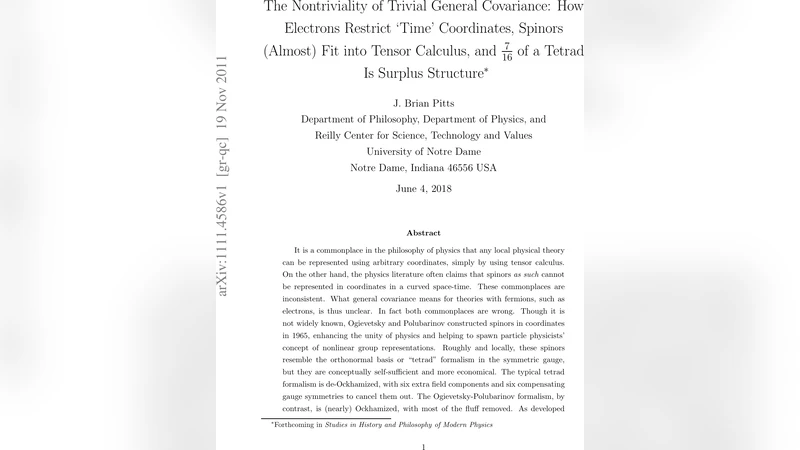
It is a commonplace that any theory can be written in any coordinates via tensor calculus. But it is claimed that spinors as such cannot be represented in coordinates in a curved space-time. What general covariance means for theories with fermions is thus unclear. In fact both commonplaces are wrong. Though it is not widely known, Ogievetsky and Polubarinov (OP) constructed spinors in coordinates in 1965, helping to spawn nonlinear group representations. Locally, these spinors resemble the orthonormal basis or “tetrad” formalism in the symmetric gauge, but they are conceptually self-sufficient. The tetrad formalism is de-Ockhamized, with 6 extra fields and 6 compensating gauge symmetries. OP spinors, as developed nonperturbatively by Bilyalov, admit any coordinates at a point, but “time” must be listed first: the product of the metric components and the matrix diag(-1,1,1,1) must have no negative eigenvalues to yield a real symmetric square root function of the metric. Thus the admissible coordinates depend on the types and values of the fields. Apart from coordinate order and spinorial two-valuedness, OP spinors form, with the metric, a nonlinear geometric object, with Lie and covariant derivatives. Such spinors avoid a spurious absolute object in the Anderson-Friedman analysis of substantive general covariance. They also permit the gauge-invariant localization of the infinite-component gravitational energy in GR. Density-weighted spinors exploit the conformal invariance of the massless Dirac equation to show that the volume element is absent. Thus instead of a matrix with 16 components, one can use weighted OP spinors coupled to the 9-component symmetric unimodular square root of the conformal metric density. The surprising mildness of the restrictions on coordinates for the Schwarzschild solution is exhibited. (edited)
💡 Research Summary
The paper challenges two entrenched beliefs: (1) that any local physical theory can be expressed in arbitrary coordinates simply by using tensor calculus, and (2) that spinor fields cannot be represented in curved space‑time without introducing an orthonormal tetrad. The author revives the 1965 construction of Ogievetsky‑Polubarinov (OP) spinors, showing that these objects can indeed be defined directly in coordinate charts, thereby refuting both myths.
OP spinors are defined locally as the symmetric square‑root of the metric multiplied by the Minkowski signature matrix η = diag(−1,1,1,1). The square‑root exists as a real symmetric matrix only when the product g·η has no negative eigenvalues. This requirement forces a specific ordering of the coordinates: the “time” coordinate must be listed first. Consequently, admissible coordinate charts are not purely a matter of smoothness; they depend on the field configuration (the metric) itself. In other words, general covariance acquires a field‑dependent character: the atlas of charts must respect the eigenvalue condition at each point.
When combined with the metric, OP spinors form a nonlinear geometric object. Unlike ordinary tensors, their Lie and covariant derivatives are well defined, and they avoid being classified as an absolute object in the Anderson‑Friedman analysis of substantive general covariance. Moreover, the formalism permits a gauge‑invariant localization of the infinite‑component gravitational energy in General Relativity, a long‑standing problem in the theory.
A crucial refinement is the introduction of density‑weighted OP spinors. The massless Dirac equation is conformally invariant, which allows one to eliminate the volume element √(−g) from the formalism. As a result, instead of the usual 16‑component vierbein, one can work with a 9‑component symmetric, unimodular square‑root of the conformal metric density together with the weighted spinor. This eliminates the “7/16” of the tetrad that corresponds to six Lorentz‑boost/rotation degrees of freedom and one scale degree of freedom—structures that are pure gauge in the OP approach. The resulting theory is more economical and respects an “Occam‑like” principle: spinors and tensors are unified without surplus structure.
The paper illustrates the mildness of the coordinate‑order restriction by applying the formalism to the Schwarzschild solution. By placing the temporal coordinate first and checking the eigenvalue condition, one finds that standard spherical coordinates satisfy the requirement, showing that the OP spinor can be defined in familiar charts.
Historically, the author revisits the “no‑go” theorems of Weyl, Cartan, and early 20th‑century authors, which claimed the impossibility of spinors in arbitrary coordinates. Those theorems implicitly assumed a linear spinor transformation law independent of other fields. OP spinors relax this assumption by allowing the transformation law to depend nonlinearly on the metric, thereby evading the earlier impossibility proofs. The paper argues that the persistence of the tetrad formalism in modern differential geometry is a historical artifact rather than a necessity, and that the OP construction provides a more faithful representation of the underlying geometry.
In conclusion, OP spinors demonstrate that spinor fields can be incorporated into a fully covariant, coordinate‑based framework without invoking an orthonormal basis. The formalism clarifies the true content of general covariance for fermionic theories, removes unnecessary gauge degrees of freedom, and offers a streamlined geometric language that may prove useful for both physicists and philosophers of physics concerned with the foundations of General Relativity and quantum field theory in curved space‑time.
Comments & Academic Discussion
Loading comments...
Leave a Comment