Weight structures vs. $t$-structures; weight filtrations, spectral sequences, and complexes (for motives and in general)
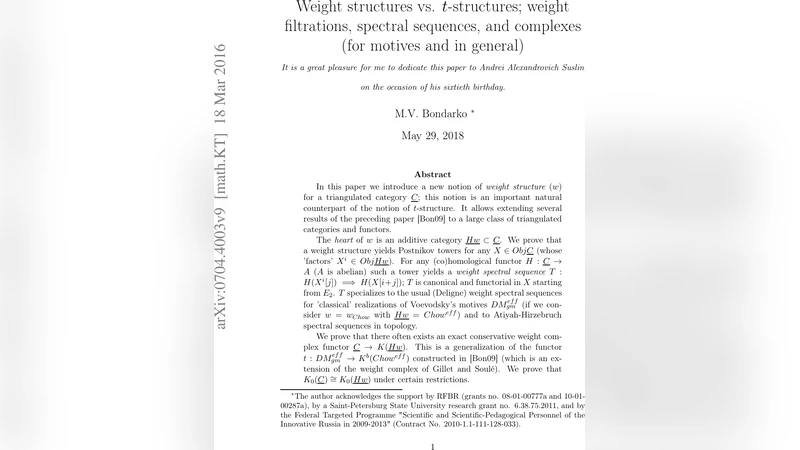
This paper is dedicated to triangulated categories endowed with weight structures (a new notion; D. Pauksztello has independently introduced them as co-t-structures). This axiomatizes the properties of stupid truncations of complexes in $K(B)$. We also construct weight structures for Voevodsky’s categories of motives and for various categories of spectra. A weight structure $w$ defines Postnikov towers of objects; these towers are canonical and functorial ‘up to morphisms that are zero on cohomology’. For $Hw$ being the heart of $w$ (in $DM_{gm}$ we have $Hw=Chow$) we define a canonical conservative ‘weakly exact’ functor $t$ from our $C$ to a certain weak category of complexes $K_w(Hw)$. For any (co)homological functor $H:C\to A$ for an abelian $A$ we construct a weight spectral sequence $T:H(X^i[j])\implies H(X[i+j])$ where $(X^i)=t(X)$; it is canonical and functorial starting from $E_2$. This spectral sequences specializes to the ‘usual’ (Deligne’s) weight spectral sequences for ‘classical’ realizations of motives and to Atiyah-Hirzebruch spectral sequences for spectra. Under certain restrictions, we prove that $K_0(C)\cong K_0(Hw)$ and $K_0(End C)\cong K_0(End Hw)$. The definition of a weight structure is almost dual to those of a t-structure; yet several properties differ. One can often construct a certain $t$-structure which is ‘adjacent’ to $w$ and vice versa. This is the case for the Voevodsky’s $DM^{eff}_-$ (one obtains certain new Chow weight and t-structures for it; the heart of the latter is ‘dual’ to $Chow^{eff}$) and for the stable homotopy category. The Chow t-structure is closely related to unramified cohomology.
💡 Research Summary
The paper introduces the notion of a weight structure on a triangulated category C, a concept that is essentially dual to the classical notion of a t‑structure but with distinct properties and applications. A weight structure consists of two full subcategories C^{w≤0} and C^{w≥0} satisfying orthogonality, stability under shifts, and the existence of distinguished triangles that decompose any object X into a piece A∈C^{w≤0} and a piece B∈C^{w≥1}. This decomposition mirrors the “stupid truncation” of complexes in the homotopy category K(B), providing an axiomatic framework for such truncations.
The heart of a weight structure, denoted Hw, is the intersection C^{w=0}=C^{w≤0}∩C^{w≥0}. In the concrete setting of Voevodsky’s triangulated category of geometric motives DM_{gm}, the heart is equivalent to the category of Chow motives (Hw≅Chow). This identification shows that weight structures capture the intrinsic “weight” filtration that appears in the theory of motives.
From a weight structure one can construct a weight complex functor
t : C → K_w(Hw),
where K_w(Hw) is a weak version of the homotopy category of complexes over the heart. Morphisms in K_w(Hw) are identified if they induce zero maps on all cohomology objects, making t a conservative and weakly exact functor. For each object X, t(X) is a canonical Postnikov tower (the “weight complex”) whose terms X^i are the weight pieces of X. This tower is functorial up to morphisms that vanish on cohomology, providing a canonical way to pass from the abstract triangulated setting to a concrete complex of objects in the heart.
Given any (co)homological functor H : C → A with A an abelian category, the authors define a weight spectral sequence
E_1^{p,q}=H(X^p
Comments & Academic Discussion
Loading comments...
Leave a Comment