The basic reproduction number as a predictor for epidemic outbreaks in temporal networks
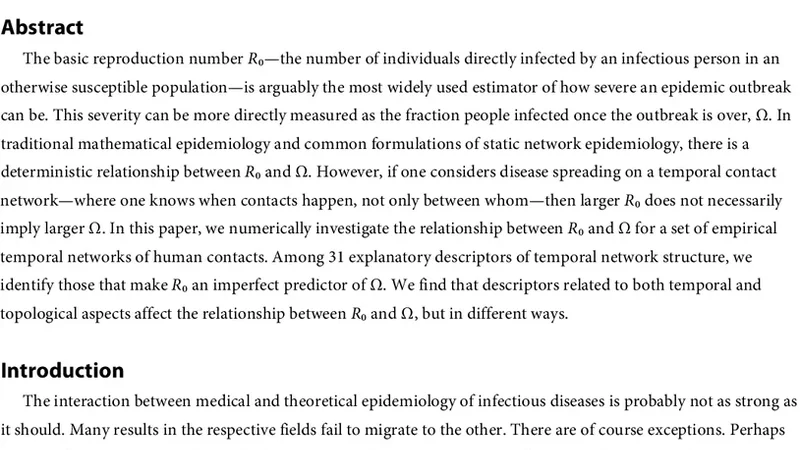
The basic reproduction number R0 – the number of individuals directly infected by an infectious person in an otherwise susceptible population – is arguably the most widely used estimator of how severe an epidemic outbreak can be. This severity can be more directly measured as the fraction people infected once the outbreak is over, {\Omega}. In traditional mathematical epidemiology and common formulations of static network epidemiology, there is a deterministic relationship between R0 and {\Omega}. However, if one considers disease spreading on a temporal contact network – where one knows when contacts happen, not only between whom – then larger R0 does not necessarily imply larger {\Omega}. In this paper, we numerically investigate the relationship between R0 and {\Omega} for a set of empirical temporal networks of human contacts. Among 31 explanatory descriptors of temporal network structure, we identify those that make R0 an imperfect predictor of {\Omega}. We find that descriptors related to both temporal and topological aspects affect the relationship between R0 and {\Omega}, but in different ways.
💡 Research Summary
The paper challenges the conventional wisdom that the basic reproduction number (R₀) uniquely determines the final size of an epidemic (Ω). While static network models and classic compartmental equations assume a deterministic, monotonic relationship—higher R₀ inevitably leads to a larger Ω—the authors demonstrate that this link can break down when disease spread occurs on temporal contact networks, where the exact timing of each interaction is known.
Using 31 empirical datasets that capture human face‑to‑face contacts in diverse settings (schools, workplaces, hospitals, conferences, etc.), the authors construct time‑ordered networks. Each edge is stamped with the moment of contact, allowing the simulation of an SIR (susceptible‑infectious‑recovered) process that respects the chronological order of interactions. For a wide range of transmission probabilities (β) and recovery rates (γ), they compute R₀ as the average number of secondary infections generated by a typical index case in an otherwise susceptible population, and Ω as the proportion of the population ever infected once the outbreak terminates.
The simulations reveal that identical R₀ values can produce dramatically different Ω outcomes across datasets. In networks characterized by “burstiness” – short periods of intense contact activity – even modest R₀ values can yield large Ω, whereas in more evenly distributed contact patterns, high R₀ may still result in limited spread. This observation suggests that temporal heterogeneity, not captured by static descriptors, can dominate epidemic outcomes.
To quantify which aspects of temporal network structure undermine the predictive power of R₀, the authors compute 31 descriptors spanning purely temporal features (e.g., inter‑contact interval variance, activity span, temporal clustering coefficient) and hybrid temporal‑topological measures (e.g., temporal betweenness, temporal path length, temporal efficiency). A multivariate regression analysis identifies seven descriptors that significantly reduce the correlation between R₀ and Ω. Four of these are strictly temporal:
- Activity span – variability in the duration of individuals’ active periods;
- Inter‑contact interval variance – dispersion of gaps between successive contacts;
- Temporal clustering coefficient – propensity for contacts to close triangles in a time‑ordered sense;
- Temporal efficiency – inverse of the average temporal distance across the network.
The remaining three descriptors combine topology and timing (temporal path length, temporal betweenness, and a composite temporal efficiency measure). Notably, high activity span and large inter‑contact interval variance can lower the R₀‑Ω correlation coefficient to below 0.6, indicating that R₀ alone becomes a poor predictor under such conditions.
Recognizing this limitation, the authors propose augmenting R₀ with a “β‑weighted average contact rate” and a “temporal network efficiency” metric. These composite indices incorporate both the intensity of transmission and the speed at which contacts propagate through time, thereby restoring a stronger monotonic relationship with Ω.
From a public‑health perspective, the findings carry several actionable implications. First, real‑time monitoring of contact timing (e.g., during large gatherings, school holidays, or shifts in work‑from‑home policies) is essential because temporal bursts can dramatically amplify outbreak size independent of R₀. Second, epidemic forecasting tools should integrate temporal network descriptors alongside traditional epidemiological parameters to better assess intervention impacts such as contact‑tracing, quarantine, or targeted closures. Third, data‑collection strategies must prioritize high‑resolution timestamps rather than merely aggregating static contact graphs, as the former provide the necessary granularity to capture burstiness and other temporal effects.
In summary, the study provides a systematic, data‑driven demonstration that the basic reproduction number is an imperfect predictor of epidemic severity when the underlying contact structure evolves over time. By identifying specific temporal and hybrid descriptors that weaken the R₀‑Ω link, the authors lay the groundwork for more nuanced modeling frameworks that can inform robust, timely, and context‑aware public‑health responses.
Comments & Academic Discussion
Loading comments...
Leave a Comment