Coordinate-invariant incremental Lyapunov functions
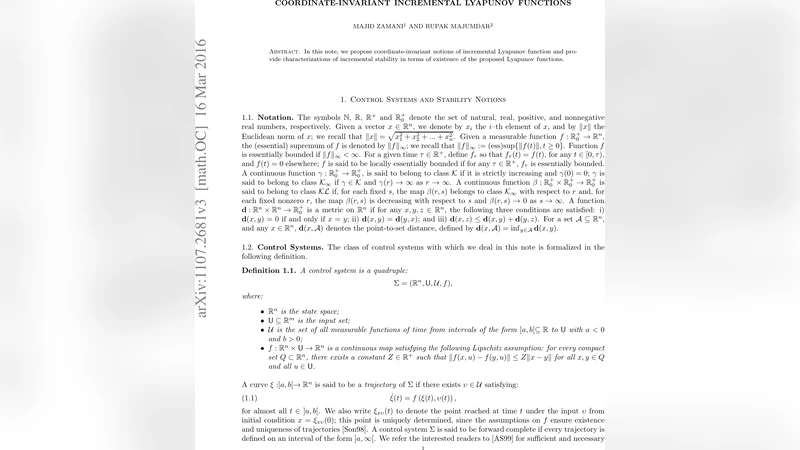
In this note, we propose coordinate-invariant notions of incremental Lyapunov function and provide characterizations of incremental stability in terms of existence of the proposed Lyapunov functions.
💡 Research Summary
The paper introduces a coordinate‑invariant framework for incremental stability analysis of control systems. Traditional incremental stability notions—incremental global asymptotic stability (δ‑GAS) and incremental input‑to‑state stability (δ‑ISS)—are usually defined with respect to the Euclidean norm, which makes them sensitive to changes of coordinates. The authors overcome this limitation by allowing an arbitrary metric d on the state space and by defining incremental Lyapunov functions that are built on this metric.
First, the authors formalize the class of control systems Σ = (ℝⁿ, U, 𝒰, f) with standard assumptions (continuity, local Lipschitzness, forward completeness). They recall the definitions of class‑K, class‑KL functions and of a metric, and introduce the incremental stability concepts δ∃‑GAS and δ∃‑ISS, where the symbol “∃” emphasizes that the underlying metric is not fixed a priori.
Definition 1.5 is the cornerstone: a δ∃‑GAS Lyapunov function V : ℝⁿ×ℝⁿ → ℝ₊ must satisfy two properties. (i) V is sandwiched between two class‑K∞ functions of the metric distance d(x, x′): α₁(d) ≤ V ≤ α₂(d). (ii) Its Lie derivative along the vector field f, evaluated on both arguments with the same input u, is upper‑bounded by –κ V for some κ > 0. The δ∃‑ISS Lyapunov function adds a third term σ(‖u – u′‖∞) to the derivative inequality, thus capturing the effect of input mismatches. Because only the existence of a metric d is required, these Lyapunov functions remain unchanged under any smooth (or even nonsmooth) coordinate transformation, which justifies the term “coordinate‑invariant”.
The paper then connects these Lyapunov functions to incremental stability via a series of lemmas and theorems. Lemma 1.9 shows that if Σ is δ∃‑GAS, then the duplicated system bΣ = (ℝ²ⁿ, U, U, b f) with state ζ =
Comments & Academic Discussion
Loading comments...
Leave a Comment