Testing Uniformity of Stationary Distribution
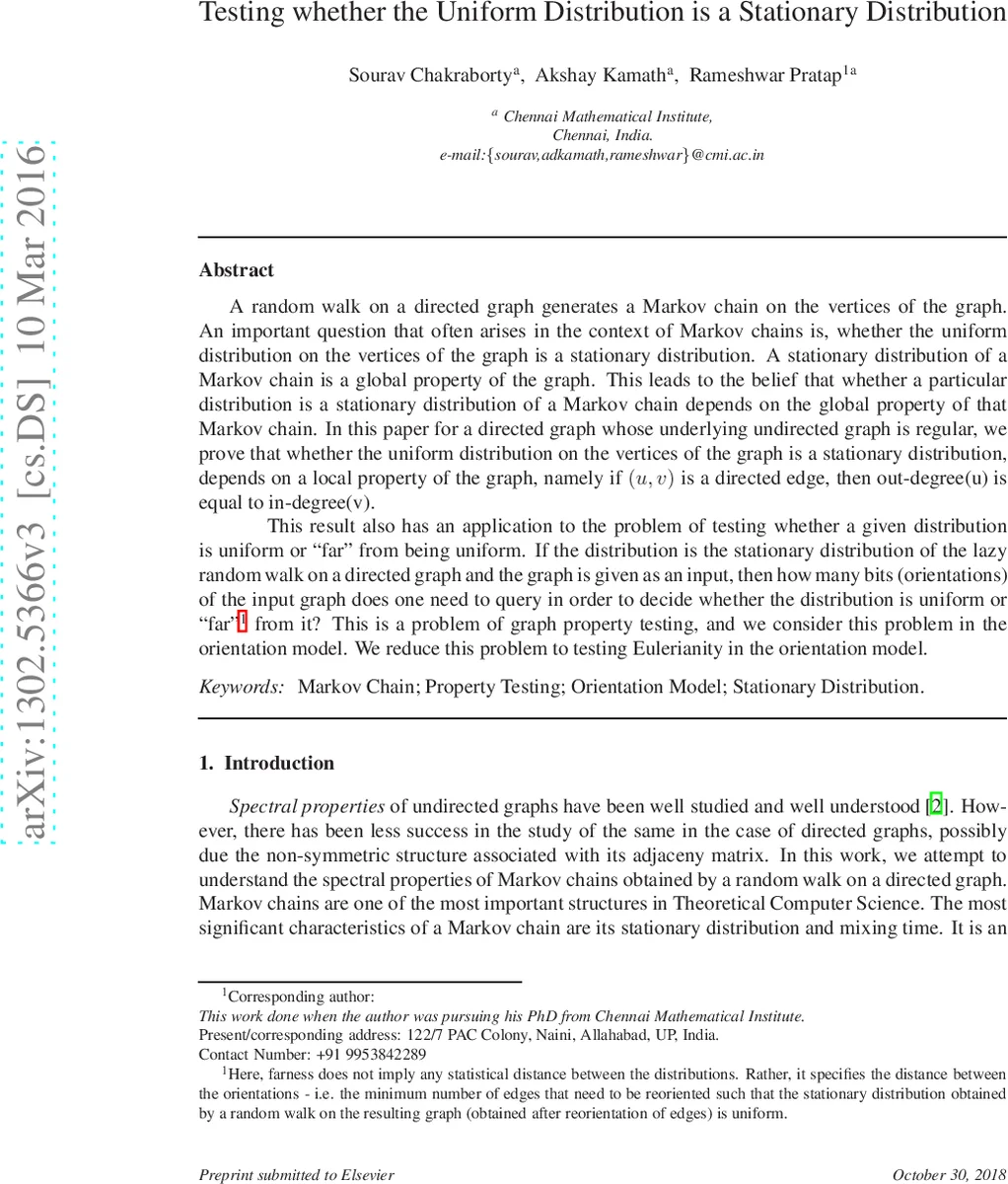
A random walk on a directed graph gives a Markov chain on the vertices of the graph. An important question that arises often in the context of Markov chain is whether the uniform distribution on the vertices of the graph is a stationary distribution of the Markov chain. Stationary distribution of a Markov chain is a global property of the graph. In this paper, we prove that for a regular directed graph whether the uniform distribution on the vertices of the graph is a stationary distribution, depends on a local property of the graph, namely if (u,v) is an directed edge then outdegree(u) is equal to indegree(v). This result also has an application to the problem of testing whether a given distribution is uniform or “far” from being uniform. This is a well studied problem in property testing and statistics. If the distribution is the stationary distribution of the lazy random walk on a directed graph and the graph is given as an input, then how many bits of the input graph do one need to query in order to decide whether the distribution is uniform or “far” from it? This is a problem of graph property testing and we consider this problem in the orientation model (introduced by Halevy et al.). We reduce this problem to test (in the orientation model) whether a directed graph is Eulerian. And using result of Fischer et al. on query complexity of testing (in the orientation model) whether a graph is Eulerian, we obtain bounds on the query complexity for testing whether the stationary distribution is uniform.
💡 Research Summary
The paper investigates a fundamental question in the theory of random walks on directed graphs: under what conditions does the uniform distribution over the vertices serve as a stationary distribution for the Markov chain induced by a simple random walk? While stationary distributions are generally regarded as global properties of a graph, the authors demonstrate that for regular directed graphs—graphs in which every vertex has the same total degree (in‑degree plus out‑degree)—the answer is governed entirely by a local degree condition.
Main Theoretical Result
Let (\vec G=(V,\vec E)) be a directed graph whose underlying undirected graph is (\Delta)-regular (i.e., for every vertex (v), (d^-(v)+d^+(v)=\Delta)). The authors prove that the uniform distribution (\pi(v)=1/|V|) is a stationary distribution of the random‑walk Markov chain iff the following two conditions hold:
- Every vertex has both positive in‑degree and positive out‑degree (so the walk never gets stuck).
- For every directed edge ((u,v)\in\vec E) we have out‑degree((u)=) in‑degree((v)).
The proof proceeds in two directions. The forward direction shows that the degree equality forces the sum of incoming transition probabilities to equal one, and similarly for outgoing probabilities, which exactly matches the stationarity equations. The reverse direction assumes uniform stationarity and introduces the notion of a degree‑alternating path. If any edge violates the degree equality, the authors construct an infinite alternating path containing infinitely many “unbalanced” edges, which leads—via Lemma 9—to a vertex with negative in‑ or out‑degree, a contradiction. Hence no such edge can exist, establishing the necessity of the local condition.
Structural Corollaries
From the main theorem, two structural characterizations follow:
- Non‑bipartite underlying graphs: The condition forces the directed graph to be Eulerian (every vertex’s in‑degree equals its out‑degree). Consequently, the uniform stationary distribution exists exactly when the directed graph is Eulerian.
- Bipartite underlying graphs: Let the bipartition be (V_1\cup V_2). Then (|V_1|=|V_2|) and all vertices in (V_1) share the same out‑degree (which equals the common in‑degree of vertices in (V_2)), and vice‑versa. This is a refined version of the Eulerian condition adapted to bipartite structure.
Application to Property Testing
The authors translate the above structural insight into an algorithmic result in the orientation model of graph property testing (introduced by Halevy et al.). In this model, the underlying undirected graph (G=(V,E)) is known, but the direction of each edge must be queried individually. The testing problem is: given query access to the orientation, decide whether the directed graph’s uniform distribution is stationary, or whether it is (\varepsilon)-far (i.e., at least an (\varepsilon) fraction of edges must be reoriented) from having that property.
Using the equivalence between uniform stationarity and Eulerianity (or the bipartite variant), the authors reduce the problem to testing whether the oriented graph is Eulerian. They then invoke the algorithm of Fischer et al. (2015), which tests Eulerianity in the orientation model with (\tilde O(\Delta/\alpha)) queries, where (\Delta) is the maximum degree and (\alpha) is the graph’s expansion parameter. Consequently, the same query complexity applies to testing uniform stationarity.
An important observation is that (1/\alpha) is proportional to the mixing time of the lazy random walk on the graph. Therefore, the query complexity of testing uniformity is directly proportional to the mixing time of the underlying Markov chain: graphs that mix quickly can be tested with fewer queries, while poorly mixing graphs require more.
Significance and Future Directions
- Theoretical Insight: The paper reveals that for regular directed graphs, a global Markov‑chain property (uniform stationarity) is completely determined by a simple local degree equality. This bridges spectral/Markov‑chain analysis with elementary combinatorial graph properties.
- Algorithmic Impact: By reducing a distribution‑testing problem to a well‑studied graph‑property test, the authors provide a sublinear‑time algorithm for a problem that, at first glance, seems to require global knowledge of the stationary distribution.
- Broader Implications: The methodology suggests that other distributional properties of random walks (e.g., convergence to a prescribed non‑uniform distribution) might also be reducible to local structural conditions, opening avenues for efficient testing in limited‑query models.
- Open Problems: Extending the characterization to non‑regular directed graphs, handling multiple parallel edges, or considering weighted random walks are natural next steps. Moreover, designing testers that work directly on the stationary distribution without explicit orientation queries could be valuable for applications where the graph is not fully known.
In summary, the paper delivers a clean combinatorial characterization of when the uniform distribution is stationary on regular directed graphs, and leverages this to obtain efficient sublinear‑query testers in the orientation model. The work deepens the connection between local graph structure, Markov‑chain stationary behavior, and property‑testing complexity.
Comments & Academic Discussion
Loading comments...
Leave a Comment