Visual Perception, Quantity of Information Function and the Concept of the Quantity of Information Continuous Splines
The geometric shapes of the outside world objects hide an undisclosed emotional, psychological, artistic, aesthetic and shape-generating potential; they may attract or cause fear as well as a variety
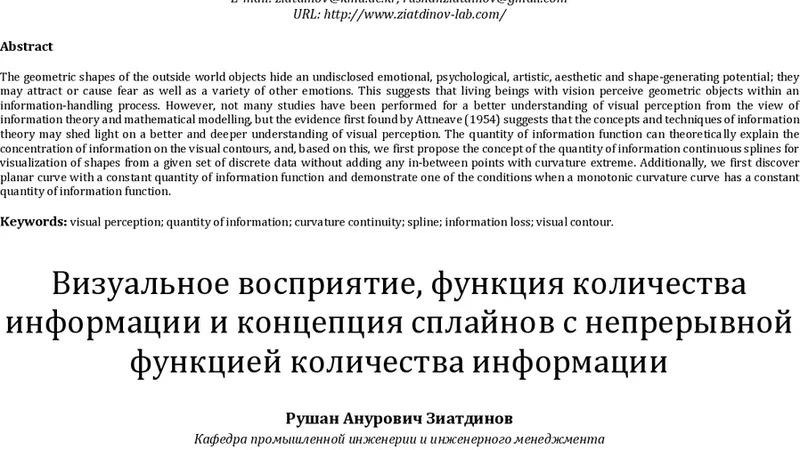
The geometric shapes of the outside world objects hide an undisclosed emotional, psychological, artistic, aesthetic and shape-generating potential; they may attract or cause fear as well as a variety of other emotions. This suggests that living beings with vision perceive geometric objects within an information-handling process. However, not many studies have been performed for a better understanding of visual perception from the view of information theory and mathematical modelling, but the evidence first found by Attneave (1954) suggests that the concepts and techniques of information theory may shed light on a better and deeper understanding of visual perception. The quantity of information function can theoretically explain the concentration of information on the visual contours, and, based on this, we first propose the concept of the quantity of information continuous splines for visualization of shapes from a given set of discrete data without adding any in-between points with curvature extreme. Additionally, we first discover planar curve with a constant quantity of information function and demonstrate one of the conditions when a monotonic curvature curve has a constant quantity of information function.
💡 Research Summary
The paper tackles visual perception from an information‑theoretic standpoint and introduces a novel mathematical framework for shape representation that directly incorporates the distribution of visual information. Building on Attneave’s classic finding that human observers allocate most of their attention to object contours, the authors formalize a “quantity of information” (QI) function. QI is defined as QI(s)=−log p(s), where p(s) denotes the probability density of a visual feature (e.g., curvature, edge contrast) occurring at a point s along a curve. This definition links visual saliency to Shannon entropy: rarer features generate higher QI values, which explains why observers tend to fixate on regions of high curvature or abrupt geometric change.
The theoretical development shows that QI is tightly coupled with the geometric properties of a curve. By differentiating QI(s) with respect to the arc‑length parameter s, the authors obtain QI′(s)=−p′(s)/p(s). Since p(s) is inversely related to curvature magnitude, a rapid change in curvature leads to a steep increase in QI, whereas smooth sections produce low QI. This relationship provides a quantitative basis for the “information concentration on contours” hypothesis.
From this foundation the authors propose the Quantity of Information Continuous Spline (QICS), a new interpolation scheme that preserves a continuous, evenly distributed QI across the entire curve without introducing artificial curvature extrema. Traditional spline methods (Bezier, B‑splines) often insert additional control points or rely on high‑order polynomials, which can create unwanted curvature spikes and consequently uneven visual information density. QICS, by contrast, enforces the constraint
\
📜 Original Paper Content
🚀 Synchronizing high-quality layout from 1TB storage...