Encipher of information on the basis of geometrical presentations
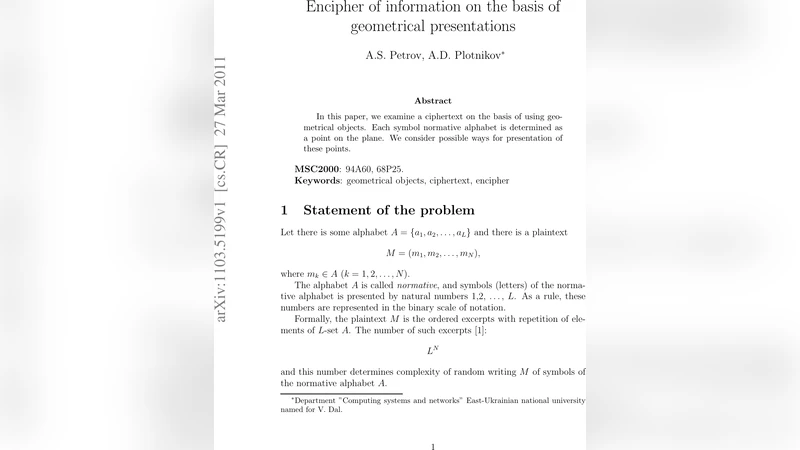
In this paper, we examine a ciphertext on the basis of using geometrical objects. Each symbol normative alphabet is determined as a point on the plane. We consider possible ways for presentation of these points.
💡 Research Summary
The paper proposes a novel way of encrypting textual data by mapping each character of a normative alphabet to a point on a two‑dimensional plane and then representing the sequence of points with geometric objects such as straight lines or ellipses. The authors start by assigning the Roman alphabet letters the natural numbers 1‑26 (with no zero) and illustrate the method using the phrase “I LOVE MY MOTHER”. Each character is converted to its numeric equivalent, which becomes the y‑coordinate, while the x‑coordinate is simply the position of the character in the plaintext. This yields a list of ordered pairs (x, y) that can be visualised as points on a Cartesian plane.
The core transformation consists of three steps: (1) pair adjacent points, (2) compute the equation of the straight line that passes through each pair, and (3) transmit the coefficients of those equations as the ciphertext. For a line in slope‑intercept form y = ax + b, the coefficients a and b are sent; for vertical lines that cannot be expressed in this form, the authors switch to the general line equation Ax + By + C = 0 and transmit the three integer coefficients. The paper provides explicit calculations for several adjacent pairs, showing how a = 0.6, b = 8.4, etc., and assembles the resulting coefficient arrays.
A key observation is that the number of transmitted coefficients is roughly equal to the length of the original message, because each character (or each pair of characters when the message length is even) generates a line and therefore at least one coefficient set. The authors note that this redundancy makes the ciphertext harder to analyse with standard Boolean‑function based attacks, but it also inflates the data size. They discuss the possibility of reducing the amount of data by grouping symbols into pairs, which halves the number of lines, but this introduces vertical lines that require the general form, and the overall benefit is limited.
To avoid the limitation of straight lines, the authors also explore using ellipses of the form y² = x³ + ax + b. While an ellipse still passes through two points, its parameterisation is more complex, and the transmission cost remains comparable to that of straight lines.
The paper presents Theorem 1, stating that the minimal dimension p in which the plaintext can be examined is p = ⌊N/3⌋, where N is the number of symbols. This theorem essentially says that at least three points are required to reconstruct the original data in the proposed geometric framework.
A further variant replaces the line‑based representation with polynomial interpolation using Lagrange polynomials. The authors split the point sequence into groups of four, construct a cubic polynomial for each group, and then transmit the polynomial coefficients. This approach yields a long list of floating‑point numbers (e.g., –93, 161, –67.5, 8.5, …). However, the authors acknowledge that recovering the original integer coordinates from these coefficients requires careful rounding, and the method quickly becomes impractical due to the explosion in the number of coefficients and the loss of precision.
In the conclusion, the authors argue that geometric representations introduce a non‑linear layer that could increase the difficulty of cryptanalysis, especially because Boolean functions describing the encryption become “practically impossible” to write down. Nevertheless, they admit that the approach suffers from excessive data overhead, the need for redundant information, and a lack of rigorous security analysis. They call for further research to address these shortcomings, possibly by integrating geometric encoding with existing symmetric ciphers or by finding more efficient ways to compress the coefficient data.
Overall, the paper offers an interesting conceptual bridge between geometry and cryptography but falls short of providing a viable, efficient, and provably secure encryption scheme. The main contributions are the formalisation of the point‑to‑line (or point‑to‑ellipse) mapping and the observation that such mappings can be combined with any symmetric cipher to add a layer of non‑linearity. Future work would need to focus on reducing the ciphertext expansion, handling numerical precision robustly, and performing a formal security reduction to standard cryptographic models.
Comments & Academic Discussion
Loading comments...
Leave a Comment