Resource allocation with costly participation
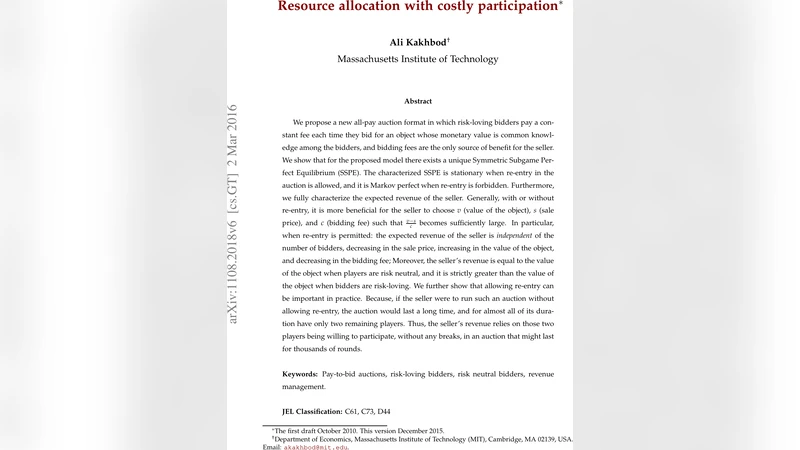
We propose a new all-pay auction format in which risk-loving bidders pay a constant fee each time they bid for an object whose monetary value is common knowledge among the bidders, and bidding fees are the only source of benefit for the seller. We show that for the proposed model there exists a {unique} Symmetric Subgame Perfect Equilibrium (SSPE). The characterized SSPE is stationary when re-entry in the auction is allowed, and it is Markov perfect when re-entry is forbidden. Furthermore, we fully characterize the expected revenue of the seller. Generally, with or without re-entry, it is more beneficial for the seller to choose $v$ (value of the object), $s$ (sale price), and $c$ (bidding fee) such that $\frac{v-s}{c}$ becomes sufficiently large. In particular, when re-entry is permitted: the expected revenue of the seller is \emph{independent} of the number of bidders, decreasing in the sale price, increasing in the value of the object, and decreasing in the bidding fee; Moreover, the seller’s revenue is equal to the value of the object when players are risk neutral, and it is strictly greater than the value of the object when bidders are risk-loving. We further show that allowing re-entry can be important in practice. Because, if the seller were to run such an auction without allowing re-entry, the auction would last a long time, and for almost all of its duration have only two remaining players. Thus, the seller’s revenue relies on those two players being willing to participate, without any breaks, in an auction that might last for thousands of rounds
💡 Research Summary
The paper introduces a novel dynamic all‑pay auction model that captures the essential features of modern “pay‑to‑bid” (or penny) auctions. A single indivisible object of common monetary value v is offered to n risk‑loving bidders. In each discrete round a bidder may either “Bid” or “No‑Bid”. Bidding incurs a small fixed fee c that is transferred to the seller; if exactly one bidder bids, that bidder wins the object and pays a predetermined sale price s. If more than one bids the auction proceeds to the next round; if no one bids the round is repeated (tie‑breaking rule). Two environments are examined: (i) re‑entry allowed – all original participants may bid in any round regardless of past actions; (ii) re‑entry forbidden – a player who ever chooses “No‑Bid” is permanently eliminated.
Bidders are modeled with Constant Absolute Risk‑Loving (CARL) utility u(x)=1−e^{−ρx}/ρ, where ρ < 0 captures the degree of risk‑loving. Under this utility the authors prove the existence of a unique symmetric subgame‑perfect equilibrium (SSPE). When re‑entry is allowed the equilibrium is stationary: every bidder uses the same mixed strategy in every round, bidding with probability p* that depends only on the ratio (v−s)/c and on ρ. When re‑entry is forbidden the equilibrium is Markov‑perfect: the bidding probability is a function of the current number of active players, and the game evolves as a Markov process that eventually reduces the participant pool.
The seller’s expected revenue R is derived in closed form. With re‑entry, R is independent of n and is increasing in v, decreasing in s and c, and increasing in the magnitude of risk‑loving (more negative ρ). In the risk‑neutral limit (ρ→0) the revenue equals the object’s value (R = v); for risk‑loving bidders R > v, implying that the “gambling” nature of the auction can generate surplus for the seller beyond the object’s intrinsic worth. The analysis also shows that making (v−s)/c sufficiently large drives the expected length of the auction toward infinity. In the no‑re‑entry case, the authors prove that with probability approaching one the auction will spend almost all of its time with exactly two remaining bidders, who must continue paying fees for a potentially very long horizon. Consequently, the seller’s revenue becomes highly dependent on the willingness of these two players to stay in the game.
The paper discusses practical implications for online auction platforms such as Swopo or DealDash. It suggests that platform designers should keep the bid fee low, set a modest sale price, and target risk‑loving consumers to maximize revenue. Moreover, allowing re‑entry is crucial: it prevents the auction from degenerating into a two‑player standoff that could collapse if either player quits, and it stabilizes revenue by keeping the participant pool large. The theoretical contributions include a tractable model with a unique SSPE, explicit revenue formulas, and a clear demonstration of how risk preferences and entry rules shape auction dynamics. Overall, the work provides a rigorous foundation for understanding and optimizing costly‑participation auctions in digital markets.
Comments & Academic Discussion
Loading comments...
Leave a Comment