Is the motion of a single SPH particle droplet/solid physically correct?
In recent years the Smoothed Particle Hydrodynamics (SPH) approach gained popularity in modeling multiphase and free-surface flows. In many situations, due to certain reasons, interface and free-surface fragmentation occurs. As a result single SPH particle solids/droplets of one phase can appear and travel through other phases. In this paper we investigate this issue focusing on a movement of such single SPH particles. The main questions we try to answer here are: is movement of such particles physically correct? What is its physical size? How numerical parameters affect on it? With this in mind we performed simple simulations of solid particles falling due to gravity in a fluid. Considering three different diameters of a single particle, we compared values of the drag coefficient and the velocity obtained through the SPH approach with the experimental and the analytical reference data. In the way to accurately model multiphase flows with free-surfaces we proposed and validated a novel SPH formulation.
💡 Research Summary
The paper investigates whether the motion of a single Smoothed Particle Hydrodynamics (SPH) particle that represents a droplet or solid in a multiphase or free‑surface flow is physically realistic, how to define its effective size, and how numerical parameters influence its dynamics. The authors begin by reviewing SPH formulations for multiphase problems and adopt the Hu‑Adams (2006) pressure and viscosity treatment. They modify the continuity equation to depend on relative particle displacement (Eq. 11‑12), which reduces density errors near free surfaces while retaining the weakly compressible SPH (WCSPH) framework with a Tait equation of state.
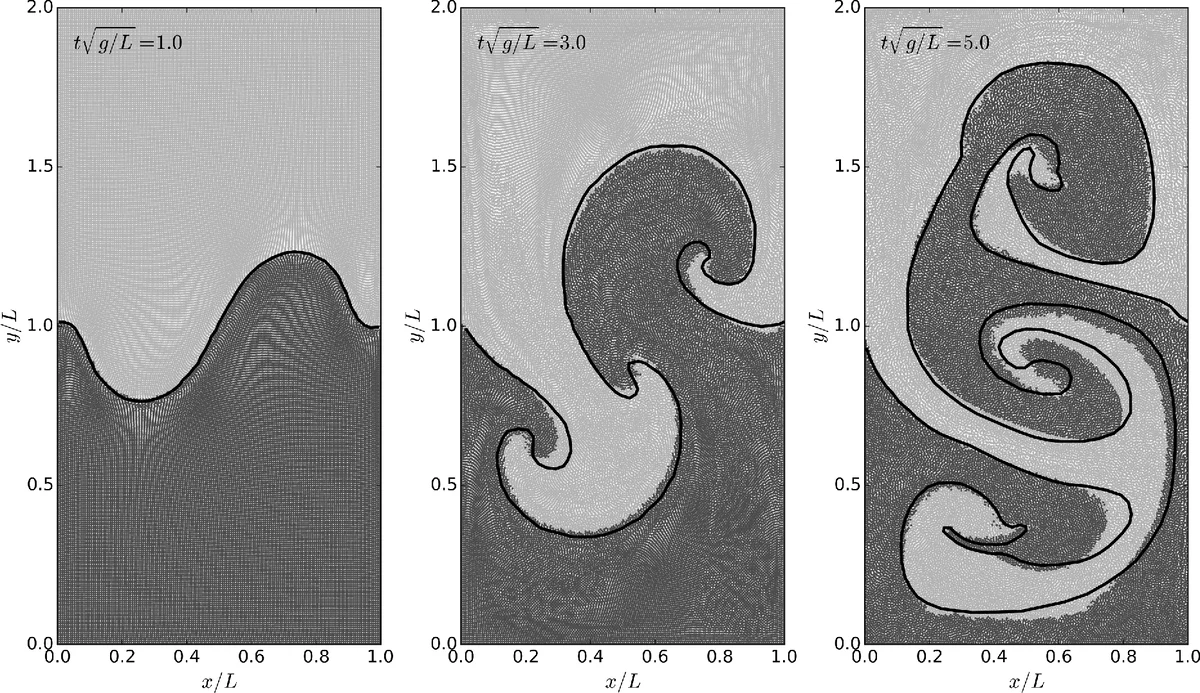
Two benchmark cases are used for validation: a Rayleigh‑Taylor instability (Re = 420) and a high‑Reynolds dam‑break scenario (Re ≈ 2000). In the dam‑break simulation, isolated SPH particles appear either as dense droplets within a lighter fluid or as fragments that escape into the air region. The authors question whether these isolated particles are numerical artifacts or physically meaningful entities, and they focus on the latter case for systematic study.
To answer this, a simple falling‑particle experiment is designed. The computational domain is filled with a fluid of density ρL; a single particle in the upper half is assigned a higher density ρS, making it a solid droplet that falls under gravity. The motion should obey the balance of gravity, buoyancy, and drag: m du/dt = Fg + Fb + Fd, with drag expressed as Fd = ½ ρL u² ACD. For low Reynolds numbers (Stokes regime) the drag coefficient is C_D = 24/Re; for higher Re the Schiller‑Naumann correlation C_D = 24 Re/(1 + 0.15 Re^0.687) is used.
A central issue is the definition of the particle diameter D, which determines Reynolds number and drag. Three possibilities are examined:
- D = Δr, the initial particle spacing,
- D = h, the smoothing length,
- D = D_Ω, derived from particle mass and density assuming a spherical volume (D_Ω = (6 m/π ρ)^{1/3}).
Simulations are performed for density ratios ρS/ρL = 2, 4, 8, and for two resolutions h/L = 1/16 and 1/32, with h/Δr ≈ 1.56 and the Wendland kernel. Velocity histories are compared to the analytical solution (Eq. 18). Results show large oscillations due to interactions with the discrete fluid particle lattice. When D = Δr, the simulated velocities deviate strongly from theory; D = D_Ω improves the match slightly; the best agreement is achieved when D = h. Drag coefficients extracted from terminal velocities follow the same trend: the Δr‑based definition underestimates C_D, the D_Ω‑based values are moderately accurate, and the h‑based values align closely with both Stokes and Schiller‑Naumann correlations, especially for faster particles where statistical scatter is reduced.
The study concludes that the apparent motion of a single SPH droplet/solid is highly sensitive to the underlying particle lattice and numerical parameters. A physically meaningful representation requires that the particle’s effective size be linked to the smoothing length h rather than the raw inter‑particle spacing. Moreover, maintaining a ratio h/Δr ≥ 2.5 and using a smooth kernel (Wendland) mitigates spurious pressure pulsations and yields reliable drag predictions. In low‑velocity, low‑resolution regimes, large fluctuations persist, indicating that the single‑particle dynamics may be dominated by numerical noise rather than true physics.
Overall, the paper provides practical guidelines for multiphase SPH simulations involving dispersed phases: define droplet/solid size via h, ensure sufficient particle resolution, and select kernels that minimize numerical artifacts. These recommendations enable more trustworthy modeling of droplets, bubbles, or solid particles within SPH frameworks, advancing the method’s applicability to complex engineering and geophysical flows.
Comments & Academic Discussion
Loading comments...
Leave a Comment