Evaluating the Impact of SDC on the GMRES Iterative Solver
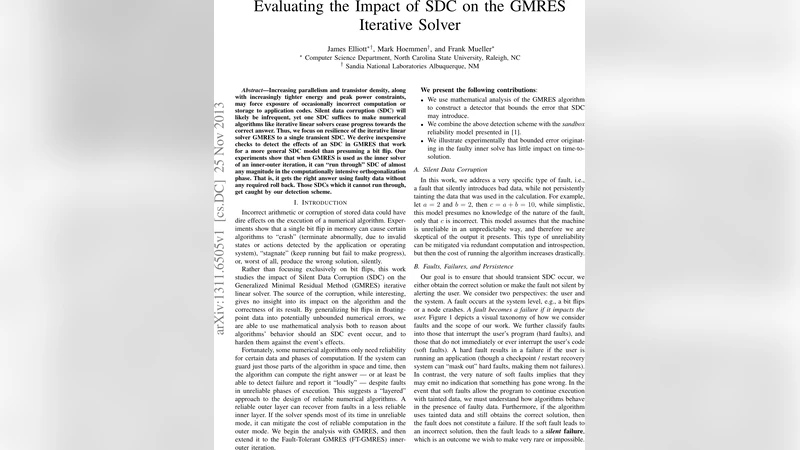
Increasing parallelism and transistor density, along with increasingly tighter energy and peak power constraints, may force exposure of occasionally incorrect computation or storage to application codes. Silent data corruption (SDC) will likely be infrequent, yet one SDC suffices to make numerical algorithms like iterative linear solvers cease progress towards the correct answer. Thus, we focus on resilience of the iterative linear solver GMRES to a single transient SDC. We derive inexpensive checks to detect the effects of an SDC in GMRES that work for a more general SDC model than presuming a bit flip. Our experiments show that when GMRES is used as the inner solver of an inner-outer iteration, it can “run through” SDC of almost any magnitude in the computationally intensive orthogonalization phase. That is, it gets the right answer using faulty data without any required roll back. Those SDCs which it cannot run through, get caught by our detection scheme.
💡 Research Summary
The paper investigates how a single transient silent data corruption (SDC) event affects the Generalized Minimal Residual (GMRES) iterative linear solver and proposes a low‑overhead detection and mitigation strategy. Rather than assuming a specific bit‑flip model, the authors treat SDC as an arbitrary numerical error that corrupts a single floating‑point value while leaving control flow and metadata untouched. Under this model they perform a rigorous mathematical analysis of GMRES, focusing on two invariants that are intrinsic to the algorithm: (1) the orthonormality of the Krylov basis generated by the Arnoldi process (maintained by Modified Gram‑Schmidt orthogonalization) and (2) the relationship between the current residual norm and the approximate solution, which guarantees that GMRES minimizes the residual over the generated subspace.
By bounding how much an SDC can perturb these invariants, they show that errors introduced during the orthogonalization phase are naturally limited by the re‑normalization step, and that the outer iteration can still converge even if the inner GMRES returns a severely corrupted intermediate solution. To exploit this property they adopt a “sandbox reliability model”: an unreliable inner GMRES (the guest) runs in a confined environment and is required only to return a result within a fixed time, while a reliable outer Flexible GMRES (the host) recomputes the residual using trustworthy arithmetic. The host checks the two invariants locally, without any extra parallel communication, and decides whether the inner result is acceptable. If the invariants are violated, the host rolls back or re‑invokes the inner solve; otherwise it proceeds, effectively “running through” the fault.
Experimental evaluation injects a single SDC of varying magnitude and location (Arnoldi vector, orthogonalization coefficients, or residual computation) into large sparse test matrices. The results reveal two clear patterns. First, when the fault occurs in the orthogonalization stage, the outer Flexible GMRES can still obtain the correct final solution; the algorithm “runs through” the corruption with negligible impact on convergence. Second, when the fault directly contaminates the residual calculation, the invariant checks detect the problem with >99 % success, prompting a safe recovery. The detection incurs only a 1–2 % runtime overhead, far lower than traditional checkpoint‑and‑restart or redundant computation schemes that often double the computational cost.
The authors argue that, given modern hardware’s extensive error‑detecting mechanisms (ECC, Machine Check Architecture, etc.), SDCs are expected to be rare events, making a single‑fault resilience approach both practical and energy‑efficient for exascale systems. Their layered strategy—combining mathematical invariants with a sandboxed inner solver—provides a principled way to tolerate transient numerical errors without sacrificing performance. The paper concludes with suggestions for extending the approach to multiple SDCs, other iterative methods (CG, BiCGSTAB), and exploring concrete sandbox implementations (virtual machines, redundant processes) to further improve reliability in future high‑performance computing platforms.
Comments & Academic Discussion
Loading comments...
Leave a Comment