Features of formation of a distributive infrastructure of e-commerce in Russia
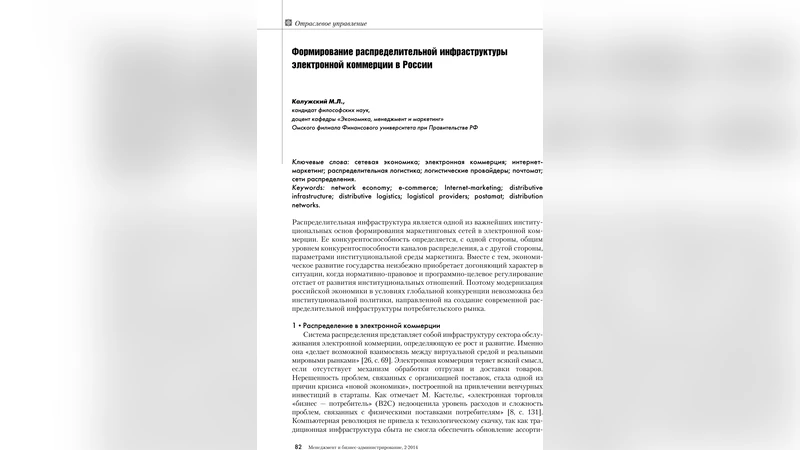
Article about objective laws of formation of a distributive infrastructure of e-commerce. The distributive infrastructure of e-commerce, according to the author, plays an important role in formation of network economy. The author opens strategic value of institutional regulation of distributive logistics for the decision problems of modernization of Russian economy.
💡 Research Summary
The paper investigates the formation of a distributive infrastructure for e‑commerce in Russia, identifying the objective laws that govern its development and highlighting its strategic importance within a network‑based economy. It begins by outlining the unique challenges posed by Russia’s vast territory, uneven regional development, and the inadequacy of traditional, centrally‑focused logistics models to meet the speed and cost expectations of modern online commerce. To address these challenges, the author proposes a hybrid, “distributive” logistics network that combines large, centrally‑located hubs with a dense layer of regional and local fulfillment points. This structure is argued to provide both scalability—allowing the system to expand rapidly as e‑commerce demand grows—and resilience—ensuring continuity despite geographic or infrastructural disruptions.
Four fundamental “laws” of infrastructure formation are articulated. The first, the demand‑supply balance law, stresses that logistics capacity must be dynamically adjustable in response to fluctuating online order volumes, requiring flexible inventory strategies and multimodal transport coordination. The second, the geographic dispersion law, mandates the strategic placement of logistics nodes across remote Siberian and Far‑Eastern regions, leveraging multimodal hubs that integrate rail, air, and maritime links to minimize transport costs. The third, the institutional‑regulatory linkage law, examines how existing Russian policies—complex customs procedures, lack of standardized logistics protocols, and underdeveloped electronic documentation—create barriers to investment and operational efficiency. The author recommends a reform framework built on transparency, predictability, and market‑friendliness, including customs automation, standardized service contracts, and the legal recognition of electronic invoices and e‑contracts, which together could cut logistics expenses by roughly 10‑15 %.
The fourth law, the technology‑driven innovation law, highlights the transformative impact of digital tracking, automated warehousing, autonomous delivery vehicles, and blockchain‑based smart contracts on network performance. Ongoing Russian pilot projects in “smart logistics” are cited as proof‑of‑concept, and scaling these initiatives nationwide would enable real‑time visibility and predictive analytics across the supply chain.
A central thesis of the paper is that institutional regulation is the key catalyst for modernizing Russia’s distributive logistics. By aligning regulations with international standards, the government can reduce uncertainty that currently deters foreign direct investment (FDI) in logistics services and technology. Such regulatory clarity would attract multinational logistics firms and technology providers, fostering competition, driving down costs, and accelerating the diffusion of best‑practice technologies.
Beyond the logistics sector, the author argues that an efficient distributive infrastructure will have broad macro‑economic effects. It will empower small and medium‑sized enterprises (SMEs) to access national markets through digital platforms, promote balanced regional development, generate employment, and create a rich data ecosystem for big‑data analytics and AI‑driven policy making. This data can inform traffic optimization, environmental sustainability measures, and the development of smart cities, thereby reinforcing the overall modernization agenda.
In conclusion, the paper asserts that Russia’s successful transition to a network economy hinges on a coordinated strategy that integrates distributive logistics infrastructure, regulatory reform, and advanced technology deployment. When these elements operate synergistically, Russia can simultaneously boost its e‑commerce competitiveness and achieve wider economic modernization.
Comments & Academic Discussion
Loading comments...
Leave a Comment