Composable Industrial Internet Applications for Tiered Architectures
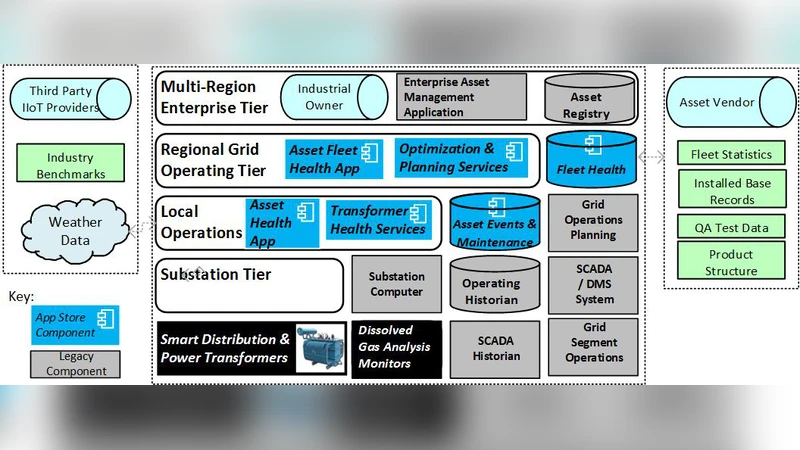
A single vendor cannot provide complete IIoT end-to-end solutions because cooperation is required from multiple parties. Interoperability is a key architectural quality. Composability of capabilities, information and configuration is the prerequisite for interoperability, supported by a data storage infrastructure and defined set of interfaces to build applications. Secure collection, transport and storage of data and algorithms are expectations for collaborative participation in any IIoT solution. Participants require control of their data ownership and confidentiality. We propose an Internet of Things, Services and People (IoTSP) application development and management framework which includes components for data storage, algorithm design and packaging, and computation execution. Applications use clusters of platform services, organized in tiers, and local access to data to reduce complexity and enhance reliable data exchange. Since communication is less reliable across tiers, data is synchronized between storage replicas when communication is available. The platform services provide a common ecosystem to exchange data uniting data storage, applications, and components that process the data. Configuration and orchestration of the tiers are managed using shared tools and facilities. The platform promotes the data storage components to be peers of the applications where each data owner is in control of when and how much information is shared with a service provider. The service components and applications are securely integrated using local event and data exchange communication channels. This tiered architecture reduces the cyber attack surface and enables individual tiers to operate autonomously, while addressing interoperability concerns. We present our framework using predictive maintenance as an example, and evaluate compatibility of our vision with an emerging set of standards.
💡 Research Summary
The paper addresses a fundamental challenge in Industrial Internet of Things (IIoT) deployments: no single vendor can deliver a complete end‑to‑end solution because multiple parties must cooperate. To enable such cooperation, the authors propose an “Internet of Things, Services and People” (IoTSP) framework that emphasizes composability, data ownership, and security. The framework consists of four main building blocks: (1) a distributed data storage layer with replicated copies in each tier, (2) an algorithm design and packaging module that encapsulates predictive models as portable packages, (3) a flexible execution environment (containers, serverless, VMs) that runs these packages where resources are available, and (4) a set of platform services that provide common event, data‑exchange, and orchestration capabilities.
A tiered architecture underpins the design. The lowest Edge tier resides close to sensors and actuators, collecting raw data and performing immediate event‑driven processing. The Regional tier aggregates data from multiple edges, runs intermediate analytics such as fault prediction, and synchronizes with the Cloud tier when connectivity permits. The Cloud tier offers large‑scale storage, high‑performance model training, and enterprise‑wide services. Because each tier can operate autonomously, the system tolerates intermittent network failures; data synchronization occurs opportunistically rather than continuously.
Security and privacy are baked into every layer. All data in transit and at rest are encrypted (TLS/DTLS), and access is governed by policies defined by the data owner. Service providers receive only the data they are explicitly authorized to use, and every access event is logged for audit. This “data‑owner‑centric” model preserves confidentiality while still allowing collaborative analytics.
The authors illustrate the framework with a predictive maintenance use case. Edge devices stream vibration and temperature readings to a local store; a regional analytics service consumes the data, applies a packaged failure‑prediction algorithm, and sends alerts to operators. When higher‑level trend analysis is needed, the regional tier pushes aggregated data to the cloud. Throughout the workflow, the equipment owner controls when and how much information is shared with each service.
Finally, the paper evaluates compatibility with emerging IIoT standards such as OPC UA, MTConnect, ISA‑95, and ISO/IEC 30141. Mapping exercises show that IoTSP’s data models and service interfaces can be aligned with these standards, reducing integration effort for legacy systems.
In summary, the IoTSP framework offers a practical, standards‑aware approach to building composable IIoT applications. By separating storage, algorithms, and execution into well‑defined, tier‑aware components, and by enforcing data‑owner‑driven security, the architecture reduces the cyber‑attack surface, supports reliable operation under unreliable network conditions, and facilitates interoperability among heterogeneous vendors. The predictive maintenance demonstration validates the concept, and the alignment with existing standards suggests a viable path toward broader industry adoption.
Comments & Academic Discussion
Loading comments...
Leave a Comment