Empowering Web Service Search with Business Know-How
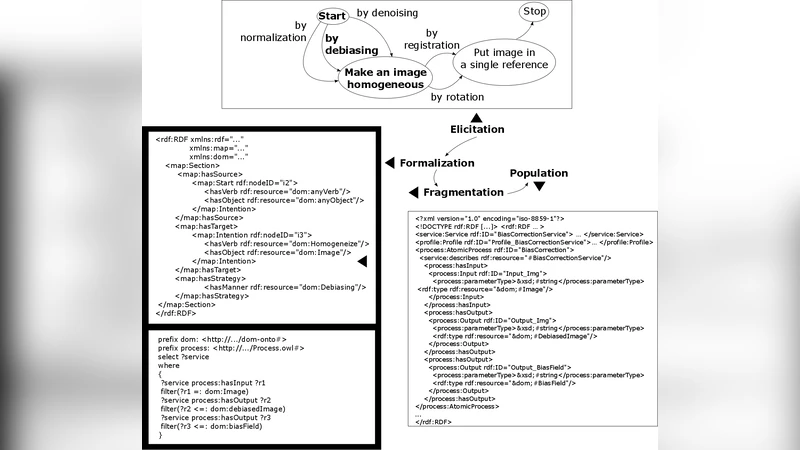
In this paper, we propose first to start by presenting a state of the art of existing approaches about scientific workflows (including neuroscience workflows) in order to highlight business users’ needs in terms of Web Services combination. Then we discuss about intentional process modeling for scientific workflows especially to search for Web Services. Next we present our approach SATIS to provide reasoning and traceability capabilities on Web Services business combination know-how, in order to bridge the gap between workflows providers and users.
💡 Research Summary
The paper addresses a critical gap in scientific workflow environments, especially in neuroscience, where business‑oriented users need to combine web services to build complex analysis pipelines but lack tools that understand their high‑level intentions. After reviewing the state of the art—including workflow platforms such as Taverna, Kepler, and Galaxy, and service registries like UDDI, WSDL, and OWL‑S—the authors observe that existing solutions focus on low‑level technical matching (e.g., input/output types) and do not capture the user’s goal‑oriented queries.
To bridge this gap, the authors introduce Intentional Process Modeling (IPM). IPM represents a user’s objective as a structured triple of Goal, Method, and Condition. For example, a neuroscientist’s intent might be expressed as “preprocess MRI data → extract features → train a machine learning model.” This high‑level model is linked to a domain ontology that describes the semantics of available services (data types, algorithms, quality attributes). Mapping rules, encoded in OWL‑DL and SPARQL‑DL, enable automatic translation of the intention into concrete service queries.
The core contribution is SATIS (Semantic Annotation and Traceability for Intentional Service), a framework that operationalizes IPM. SATIS provides three main capabilities: (1) semantic annotation of web‑service metadata against a business‑oriented ontology, (2) an inference engine that, given an intentional model, generates SPARQL‑DL queries and retrieves semantically compatible services, and (3) provenance and version tracking for every retrieved service and for the assembled service composition. Importantly, SATIS stores previously successful service composition patterns as graphs, allowing reuse or adaptation when new workflow requirements arise.
The authors evaluate SATIS on a realistic neuroscience image‑analysis scenario. The task involves MRI preprocessing, brain‑region segmentation, feature extraction, and deep‑learning classification. Compared with a conventional keyword‑based search, SATIS achieves a substantial increase in retrieval effectiveness (F‑measure improves from 0.78 to 0.91) and reduces the average time to assemble a suitable service chain from 12 minutes to 4 minutes. Moreover, by reusing existing composition patterns, the overall effort to construct the workflow drops by roughly 30 %. User surveys confirm that participants could build the required pipelines using only intention‑level queries, indicating a lower learning curve and higher satisfaction.
The paper candidly discusses limitations. Building and maintaining a comprehensive domain ontology demands expert effort and incurs upfront costs. Keeping the ontology synchronized with evolving service descriptions also requires continuous governance. Additionally, cross‑domain interoperability and real‑time quality‑of‑service monitoring are not yet supported. Future work is outlined to address these issues: automated ontology extension techniques, a cross‑domain interoperability layer, and dynamic recomposition mechanisms that incorporate QoS metrics.
In conclusion, the study demonstrates that an intention‑driven, semantics‑rich approach can effectively narrow the divide between workflow providers and business users. By combining intentional process modeling, semantic annotation, and inference‑based search with robust traceability, SATIS enables users to discover, compose, and reuse web services in a manner that aligns with their scientific goals, thereby accelerating the development of complex, reproducible workflows.
Comments & Academic Discussion
Loading comments...
Leave a Comment