Geodesic manifolds with a transitive subset of smooth biLipschitz maps
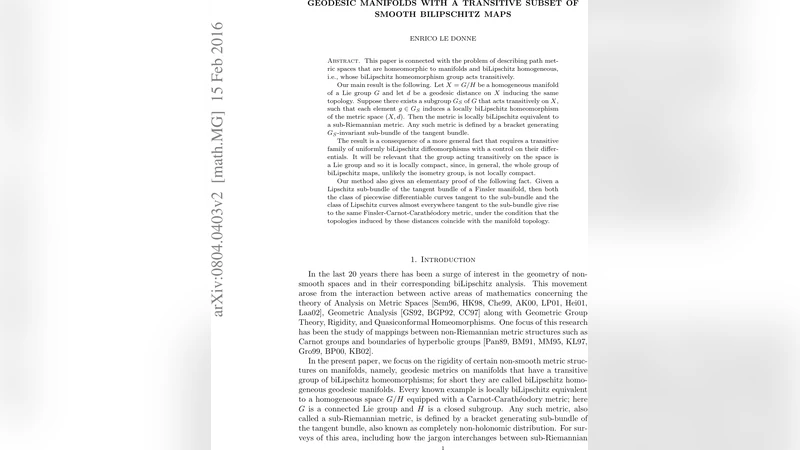
This paper is connected with the problem of describing path metric spaces that are homeomorphic to manifolds and biLipschitz homogeneous, i.e., whose biLipschitz homeomorphism group acts transitively. Our main result is the following. Let $X = G/H$ be a homogeneous manifold of a Lie group $G$ and let $d$ be a geodesic distance on $X$ inducing the same topology. Suppose there exists a subgroup $G_S$ of $G$ that acts transitively on $X$, such that each element $g \in G_S$ induces a locally biLipschitz homeomorphism of the metric space $(X,d)$. Then the metric is locally biLipschitz equivalent to a sub-Riemannian metric. Any such metric is defined by a bracket generating $G_S$-invariant sub-bundle of the tangent bundle. The result is a consequence of a more general fact that requires a transitive family of uniformly biLipschitz diffeomorphisms with a control on their differentials. It will be relevant that the group acting transitively on the space is a Lie group and so it is locally compact, since, in general, the whole group of biLipschitz maps, unlikely the isometry group, is not locally compact. Our method also gives an elementary proof of the following fact. Given a Lipschitz sub-bundle of the tangent bundle of a Finsler manifold, then both the class of piecewise differentiable curves tangent to the sub-bundle and the class of Lipschitz curves almost everywhere tangent to the sub-bundle give rise to the same Finsler-Carnot-Carath'eodory metric, under the condition that the topologies induced by these distances coincide with the manifold topology.
💡 Research Summary
The paper addresses the long‑standing problem of characterising path‑metric spaces that are homeomorphic to manifolds and enjoy bi‑Lipschitz homogeneity, i.e. the group of bi‑Lipschitz homeomorphisms acts transitively. While the classical theory of isometric homogeneity forces such spaces to be Riemannian (or sub‑Riemannian) manifolds, the bi‑Lipschitz setting is considerably weaker and the full bi‑Lipschitz group is typically not locally compact, making standard Lie‑theoretic tools unavailable.
The authors therefore impose a more restrictive hypothesis: let (X=G/H) be a homogeneous manifold of a Lie group (G) equipped with a geodesic distance (d) that induces the manifold topology. Assume there exists a subgroup (G_{S}\subset G) that (i) acts transitively on (X), (ii) consists of smooth diffeomorphisms, and (iii) each element is locally bi‑Lipschitz with a uniform bi‑Lipschitz constant and has a uniformly controlled differential. Under these conditions the main theorem states that the metric (d) is locally bi‑Lipschitz equivalent to a sub‑Riemannian (more generally sub‑Finsler) metric.
The proof proceeds by extracting from the uniform bi‑Lipschitz action a (G_{S})‑invariant sub‑bundle (\Delta\subset TX). Because the differentials of the elements of (G_{S}) preserve (\Delta) and are uniformly bounded, (\Delta) is a smooth distribution of constant rank. The authors then show that (\Delta) is bracket‑generating (i.e. the Lie algebra generated by its sections spans the whole tangent bundle). By Chow–Rashevskii’s theorem, any two points can be joined by a horizontal curve tangent to (\Delta); the associated Carnot–Carathéodory length functional defines a sub‑Riemannian distance (d_{\Delta}).
The key technical step is to compare (d) and (d_{\Delta}). Transitivity of (G_{S}) guarantees that for any pair of points there is a group element moving one to the other, and the uniform bi‑Lipschitz constant yields inequalities that bound the length of a horizontal curve in terms of the original distance and vice‑versa. Consequently there exists a constant (C\ge1) such that
\
Comments & Academic Discussion
Loading comments...
Leave a Comment