The parallel versus branching recurrences in computability logic
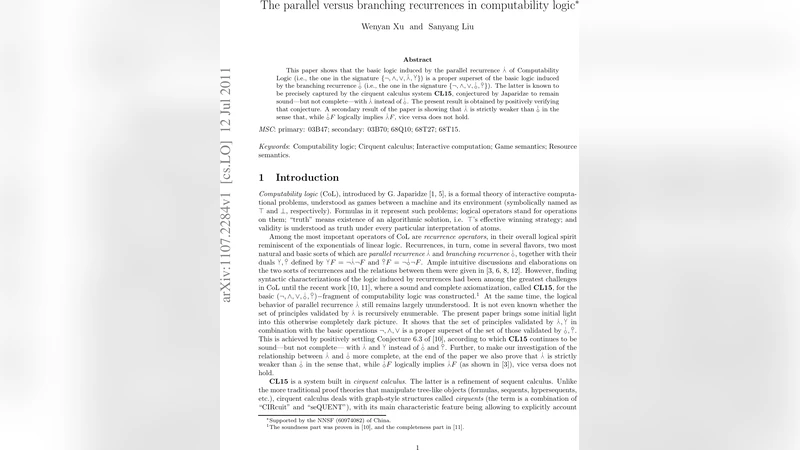
This paper shows that the basic logic induced by the parallel recurrence of Computability Logic is a proper superset of the basic logic induced by the branching recurrence. The latter is known to be precisely captured by the cirquent calculus system CL15, conjectured by Japaridze to remain sound—but not complete—with parallel recurrence instead of branching recurrence. The present result is obtained by positively verifying that conjecture. A secondary result of the paper is showing that parallel recurrence is strictly weaker than branching recurrence in the sense that, while the latter logically implies the former, vice versa does not hold.
💡 Research Summary
The paper investigates the relationship between two recurrence operators in Computability Logic (CoL): parallel recurrence (denoted ∧|) and branching recurrence (denoted ◦|). CoL treats interactive computational problems as games between a machine (⊤) and its environment (⊥); logical connectives correspond to game operations, and a formula is “true” when ⊤ has a winning strategy for every interpretation of its atoms.
The authors first recall that the fragment of CoL built from the connectives {¬, ∧, ∨, ◦|, ◦|} is precisely captured by the cirquent‑calculus system CL15, which is both sound and complete for that fragment. Cirquents are graph‑like structures that allow explicit sharing of subcomponents via under‑ and over‑groups, providing a refined proof‑theoretic framework beyond ordinary sequents.
The central contribution is to replace the branching recurrence operators in CL15 with their parallel counterparts, obtaining a modified system denoted CL15(∧|). The paper proves two complementary results about this system:
-
Soundness – Every formula provable in CL15(∧|) is uniformly valid with respect to parallel recurrence. The proof uses the easy‑play machine (EPM) model of strategies, shows that the inference rules preserve uniform validity, and exploits the closure of static games under all the considered operators.
-
Incompleteness – There exist uniformly valid formulas involving ∧| (and its dual ∨|) that are not derivable in CL15(∧|). The authors construct a specific counter‑example formula whose semantics requires the ability to coordinate infinitely many copies in a way that branching recurrence provides but parallel recurrence does not. This confirms Japaridze’s conjecture (Conjecture 6.3 in the earlier work) that CL15 remains sound but not complete when ∧| replaces ◦|.
Beyond the proof‑theoretic analysis, the paper clarifies the logical strength of the two recurrence operators. It is already known that branching recurrence implies parallel recurrence: ◦| F ⇒ ∧| F holds for any formula F because a branching game contains all the parallel copies as a special case. The authors complement this by showing the converse fails. They exhibit a formula F such that ∧| F is uniformly valid while ◦| F is not. The intuition is that ∧| requires a winning strategy in each of infinitely many parallel copies taken independently, whereas ◦| demands a single strategy that wins in all possible branching threads simultaneously—a strictly stronger requirement.
Consequently, the paper establishes a strict inclusion relationship:
{valid formulas with ◦|, ◦|} ⊂ {valid formulas with ∧|, ∨|}.
This result refines our understanding of the hierarchy of recurrence operators in CoL. It demonstrates that parallel recurrence, despite being more “resource‑friendly” (allowing independent copies), is logically weaker than branching recurrence, which enforces a uniform strategy across an unbounded tree of threads.
The authors also discuss the broader implications: the proper superset relationship suggests that any future axiomatization of the full CoL language must treat branching recurrence as a genuinely stronger primitive than parallel recurrence. Moreover, the incompleteness of CL15(∧|) indicates that new proof‑theoretic principles—perhaps involving more sophisticated sharing or new forms of contraction—are needed to capture the full logic of parallel recurrence.
In summary, the paper delivers three main findings:
- Superset result – The basic logic induced by parallel recurrence (∧|) strictly contains the basic logic induced by branching recurrence (◦|).
- Verification of Japaridze’s conjecture – CL15 remains sound but not complete when ∧| and its dual replace ◦| and ◦|.
- Strict weakness of ∧| – While ◦| F entails ∧| F, the converse does not hold, establishing a clear hierarchy between the two recurrence operators.
These contributions deepen the theoretical foundations of Computability Logic and open avenues for further research on recurrence operators, cirquent calculus extensions, and the quest for a complete axiomatization of the full CoL language.
Comments & Academic Discussion
Loading comments...
Leave a Comment