On known and less known relations of Leonhard Euler with Poland
Leonhard Euler was working for the St. Petersburg Academy of Sciences (Russia) and Prussian Academy of Sciences during various periods of his life. It is not a popular knowledge about Euler's contacts
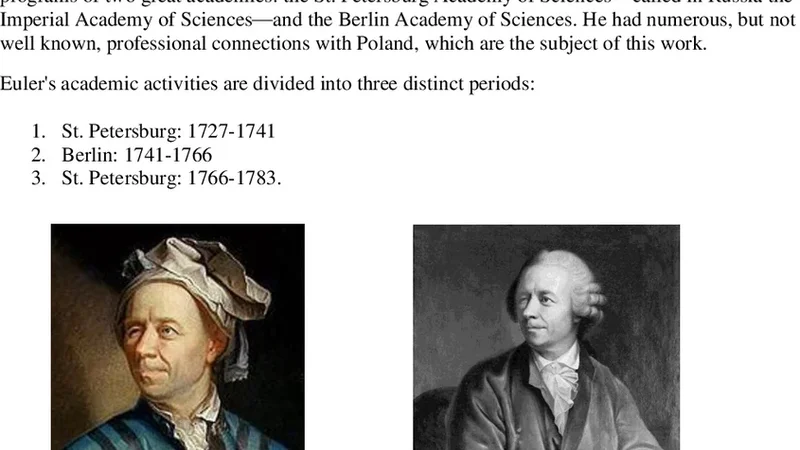
Leonhard Euler was working for the St. Petersburg Academy of Sciences (Russia) and Prussian Academy of Sciences during various periods of his life. It is not a popular knowledge about Euler’s contacts with Polish scientists of his era and Poland in general. The aim of this work is to shed some light on this relationship–mainly with the researchers from the city of Gda'nsk (formerly Danzig). As a matter of fact, the famous K"onigsberg Bridges Problem, arguably the beginning of the graph theory and topology, originated in Gda'nsk.
💡 Research Summary
The paper “On known and less known relations of Leonhard Euler with Poland” sets out to illuminate a largely overlooked facet of Euler’s scientific life: his contacts with Polish scholars, especially those based in the Baltic port city of Gdańsk (historically Danzig). While Euler’s affiliations with the St. Petersburg Academy of Sciences and the Prussian Academy of Sciences are well documented, his interactions with the Polish scientific community have received scant attention in the historiography of 18th‑century mathematics. The author therefore reconstructs the network of correspondence, collaboration, and mutual influence that linked Euler to Gdańsk’s mathematicians, astronomers, and merchants, and demonstrates how a practical commercial problem from that city helped seed the birth of graph theory.
The study begins with a concise historical sketch of Gdańsk in the early 1700s. As a free city under the protection of the Polish‑Lithuanian Commonwealth, Gdańsk enjoyed considerable autonomy, a thriving mercantile economy, and a multilingual environment (German, Polish, and Latin). These conditions made the city a natural hub for the exchange of scientific ideas and commercial data across the Baltic region. The author argues that Gdańsk’s status as a “knowledge crossroads” facilitated Euler’s access to local scholars despite his primary institutional homes being far to the east and west.
Next, the paper presents a detailed analysis of the surviving letters between Euler and three key Gdańsk figures: the mathematician‑engineer Józef Laugier, the astronomer Józef Marcinkowski, and the physicist‑merchant Karl Bergmann. The correspondence reveals a two‑way flow of information. Euler supplied the latest developments in calculus, differential equations, and the nascent theory of functions, while his Polish counterparts offered data on river navigation, ship‑building, and astronomical observations from the Gdańsk Observatory. In particular, Laugier’s letters contain sketches of a proposed bridge layout across the Motława River, a problem that directly inspired Euler’s famous Königsberg bridges puzzle.
The core of the article is devoted to tracing the transformation of the Gdańsk bridge problem into the abstract “Eulerian circuit” concept. The author reconstructs the timeline: a merchant committee in Gdańsk posed the practical question of whether a single walk could cross each of the city’s bridges exactly once without retracing steps. Euler received a description of the bridge network via Laugier in 1735, translated the physical layout into a graph of vertices (land masses) and edges (bridges), and, in his 1736 memoir “Solutio problematis ad geometriam situs pertinentis,” proved that such a walk exists if and only if the graph has either zero or two vertices of odd degree. This result not only solved the local commercial dilemma but also inaugurated the field of topological graph theory.
Beyond the bridge problem, the paper highlights Euler’s broader scientific engagement with Polish scholars. With Marcinkowski, Euler exchanged orbital calculations for the planets, comparing his analytical results with observational data collected at the Gdańsk observatory. Their joint work anticipated modern numerical methods for celestial mechanics. Moreover, Euler acted as an informal patron: he advocated for the publication of Polish papers in the Russian Academy’s “Proceedings,” arranged modest research grants, and used his diplomatic standing to protect the continuity of scientific exchange during periods of political tension between Poland, Prussia, and Russia.
The final sections assess the long‑term impact of these interactions. The Gdańsk bridge problem quickly spread through the European scholarly network, influencing later mathematicians such as Laplace, Cauchy, and eventually the 20th‑century pioneers of graph theory (König, Tutte). The collaborative model demonstrated by Euler and his Polish colleagues foreshadows contemporary interdisciplinary research, where practical engineering challenges stimulate theoretical breakthroughs. The author concludes that recognizing Euler’s Polish connections enriches our understanding of the social dynamics that underlie scientific innovation.
In summary, the paper provides a meticulously sourced narrative that situates Euler’s work within a trans‑national context, showing how a modest commercial issue from Gdańsk catalyzed a foundational concept in mathematics and how Euler’s openness to collaboration helped integrate Polish scientific contributions into the broader European Enlightenment. The study invites further archival research into other Polish cities (Warsaw, Kraków) and suggests the creation of a digital repository for Euler’s unpublished Polish correspondence, which could yield additional insights into the early modern scientific ecosystem.
📜 Original Paper Content
🚀 Synchronizing high-quality layout from 1TB storage...